
Bone Density Scan UK: DEXA, NHS Costs & Results
20 May 2026Updated 7 June 2026
You might be training hard, eating well, and keeping an eye on your weight, yet still have no clear idea what your skeleton is doing underneath it all. That's common. A bathroom scale can tell you total mass. A mirror can tell you roughly how you look. Neither can tell you whether your bones are strong, whether your frame is coping well with age or training load, or whether a preventable problem is developing.
That matters to more than people worried about osteoporosis. In the UK, we see the value of a bone density scan for several kinds of patients. A runner wants reassurance that frequent mileage isn't outpacing recovery. A woman in perimenopause wants objective information instead of vague advice. Someone in their forties or fifties wants a baseline for healthy ageing before a fracture forces the issue. In each case, the ultimate goal is the same: Get reliable data early enough to act on it.
A DEXA scan gives that clarity. Used properly, it's not just a test for disease. It's a way to measure structural resilience, track changes over time, and make better decisions about exercise, nutrition, recovery, and long-term health.
Table of Contents
- Your Guide to Bone Density and Long-Term Health
- What a Bone Density Scan Actually Measures
- Who Should Consider a Bone Density Scan
- Understanding Your Bone Density Scan Results
- NHS vs Private Scans in the UK
- Preparing for Your Scan and What to Expect
- Using Your Results to Build Better Bone Health
- Frequently Asked Questions
Your Guide to Bone Density and Long-Term Health
A good scan changes the conversation. Instead of asking, “Am I healthy?” in a broad, fuzzy way, you can ask better questions. Is my bone density where it should be for me? Am I protecting my hips and spine as I age? Is my training building a stronger body, or only a leaner one?

For many people, bone health feels abstract until something goes wrong. A stress injury. A low-trauma fracture. A report after menopause that suddenly introduces terms like osteopenia or osteoporosis. The better approach is to treat bone density as a proactive health metric, much like blood pressure or cholesterol. You don't wait for a crisis to care about it.
Why proactive data matters
Bone density sits at the intersection of several goals:
- Healthy ageing: Stronger bones support mobility, confidence, and independence later in life.
- Athletic durability: Your skeleton has to tolerate training load, not just your heart and muscles.
- Body composition planning: If you're losing weight or changing training style, bone health should stay on the dashboard.
- Clinical risk management: If you already have risk factors, a scan helps anchor decisions in evidence rather than guesswork.
Practical rule: If you're making long-term decisions about training, menopause, weight loss, or fracture prevention, objective bone data is more useful than reassurance.
People often assume a bone density scan is only for the frail or elderly. That's too narrow. In practice, it's often most useful when someone still feels well and has time to respond.
What a Bone Density Scan Actually Measures
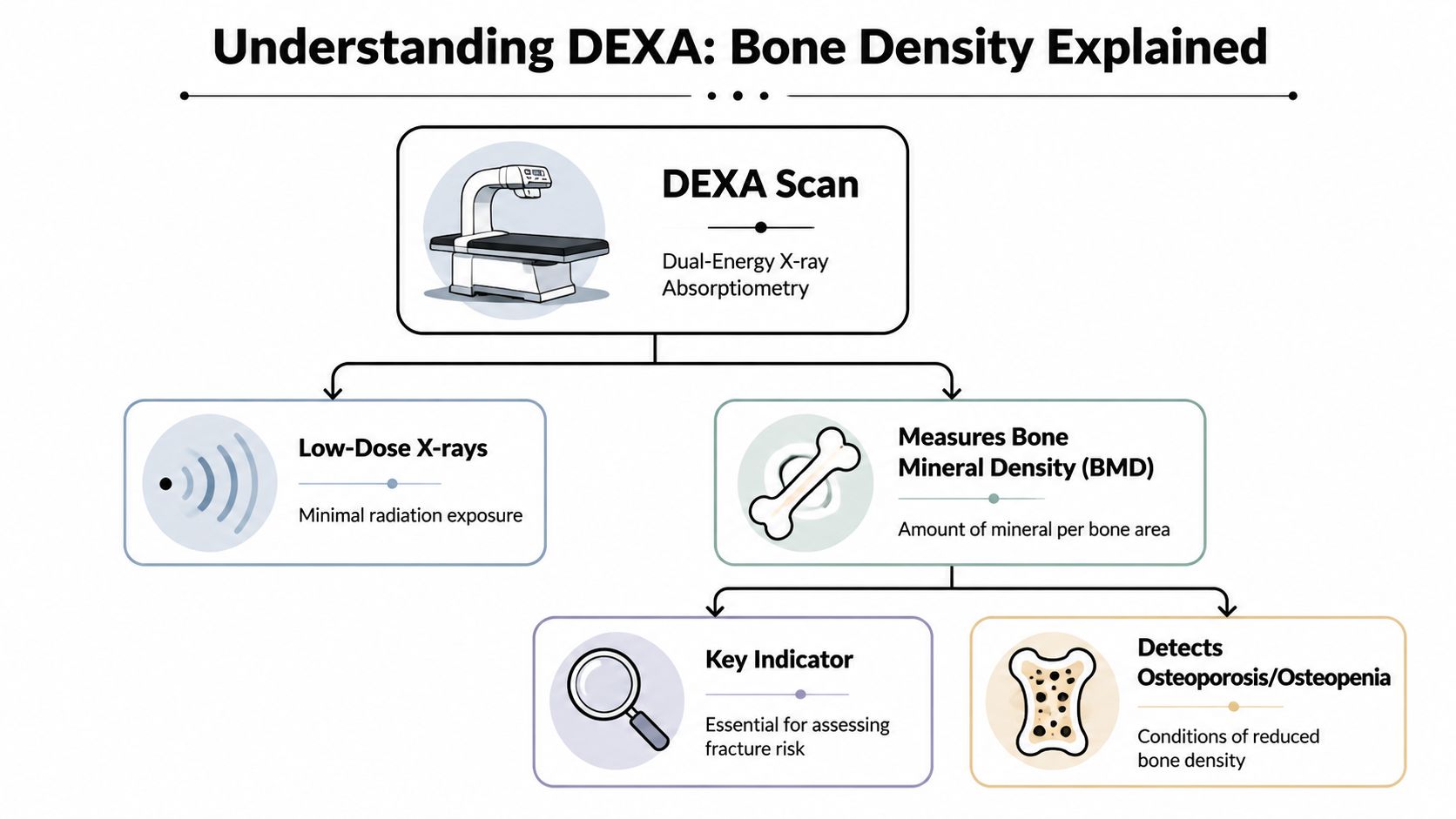
DEXA stands for Dual-Energy X-ray Absorptiometry. In the UK, bone density scans are typically performed this way, using very low-dose X-rays to measure how much radiation is absorbed by bone compared with soft tissue. Detectors convert that pattern into a bone mineral density estimate, usually at the hips and spine, because those are common fragility fracture sites. The NHS also notes that a lower result isn't interpreted on its own. It becomes clinically meaningful when combined with other risk factors such as age, sex, and fracture history in NHS guidance on DEXA scans.
How DEXA works
Assessing a building's foundations provides a good analogy. A standard X-ray can show obvious damage once it's fairly visible. A DEXA scan is more like a structural survey. It quantifies density with much more precision, which is why it's better for detecting low bone density before a plain film would make the issue clear.
The machine sends two low-energy X-ray beams through the body. Bone and soft tissue absorb them differently. The software separates those signals and calculates bone mineral density.
You'll often see results focused on:
- Hip measurements, because hip fractures can have major consequences for mobility and independence
- Lumbar spine measurements, because spinal bone loss can develop earlier and may affect posture and fracture risk
- Occasionally the forearm or wrist, when a service needs extra information
Why it matters beyond osteoporosis
A DEXA scan is widely associated with osteoporosis, and that's correct. But it's also useful for people who want a sharper view of body composition and long-term resilience. Some private services use the same scan platform to assess fat mass, lean mass, and bone-related metrics together, which gives a broader picture of how your body is changing.
That's why many people now use DEXA for more than diagnosis. They use it to guide weight cuts, monitor recovery from heavy endurance training, or check whether years of “being fit” are producing a strong body. If you want a concise overview of how the technology works, we explain what a DEXA scan is here. If you're in Greater Manchester, you can book a DEXA scan in Manchester with our mobile service.
Bone density isn't the whole story. But if you ignore the frame that carries everything else, you miss a major part of long-term health.
Who Should Consider a Bone Density Scan
Not everyone needs a scan immediately. But many more people should at least consider one than most realise.
Clinical reasons to book one
A bone density scan is particularly relevant if you've already moved beyond general curiosity into genuine risk assessment. In practice, that often includes:
- People with a fragility fracture history: If a relatively minor fall or impact caused a fracture, bone strength needs proper assessment.
- Women around or after menopause: Hormonal change can shift bone health significantly, and symptoms don't reliably tell you what your density is doing.
- People with a strong family history: If osteoporosis runs in the family, it's sensible to take skeletal health seriously before problems appear.
- Anyone on long-term medication known to affect bone: This is a discussion for your GP or specialist, especially if treatment is ongoing.
- People with a clinical picture that suggests reduced bone strength: Height loss, repeat fractures, or a combination of risk factors can justify more formal assessment.
One mistake we see is waiting for pain. Low bone density usually doesn't announce itself clearly. That's why scans matter.
Performance and longevity reasons
There's another group who may not meet strict NHS referral thresholds but still benefit from testing. These are proactive patients who want better data.
That can include:
- Endurance athletes and high-volume trainers who want confidence that their skeleton is coping with repetitive loading
- People in sustained calorie deficit who are focused on body recomposition and don't want bone health to become collateral damage
- Adults over 40 who want a baseline rather than relying on assumptions
- Men and women rebuilding after inactivity who want to know where they're starting from
- Health-conscious professionals who prefer measurable markers over vague wellness advice
If your plan spans the next decade, not just the next event or holiday, a baseline scan can be more useful than another short-term bodyweight target.
The key trade-off is simple. If you only test after a fracture, you've learned late. If you test earlier, you may catch an issue when exercise, nutrition, risk-factor review, or medical treatment can still be timed well.
Understanding Your Bone Density Scan Results
The result sheet can look technical at first, but the main ideas are straightforward once you strip away the jargon.
The traffic light way to read a report
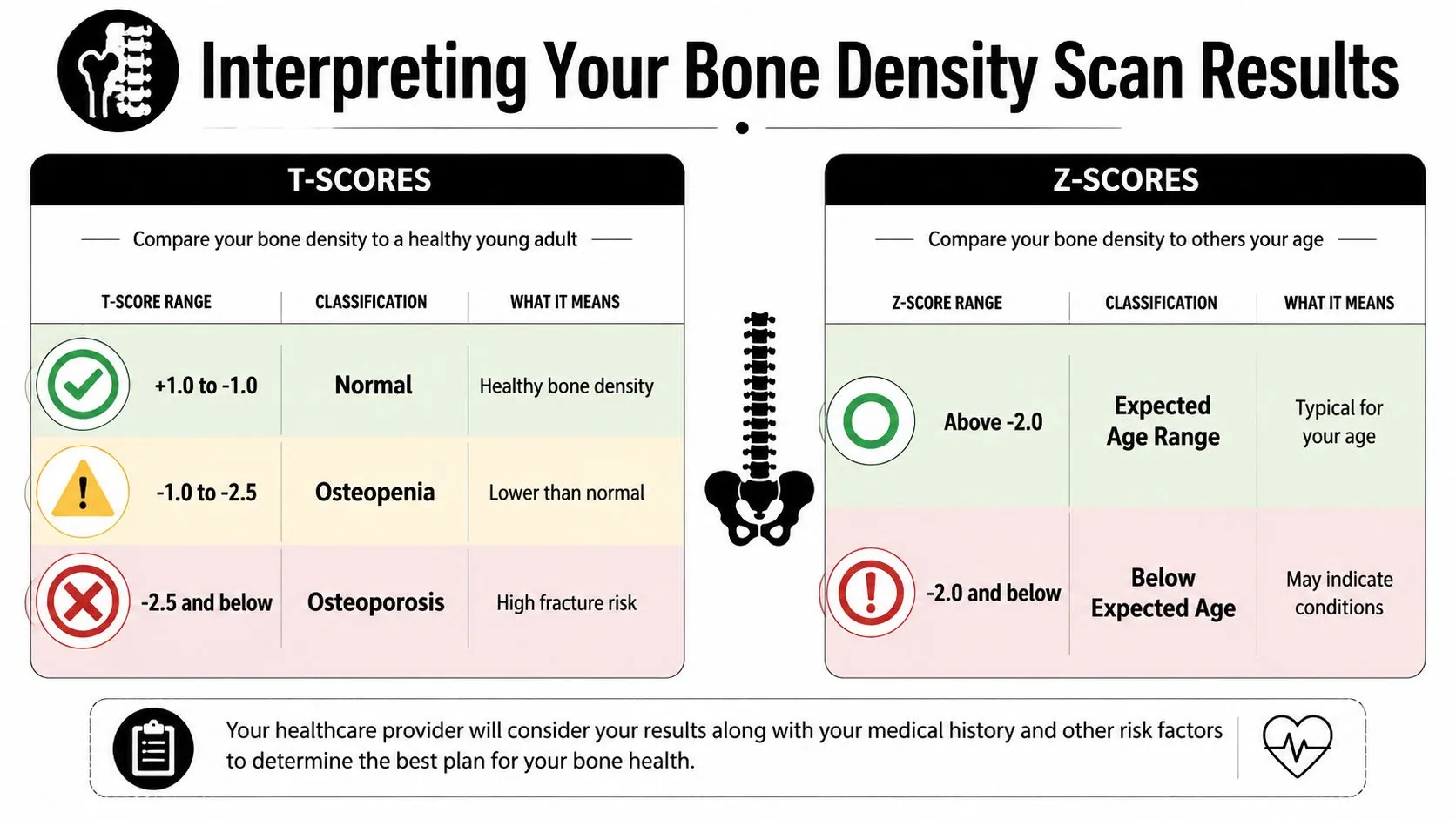
For T-scores, a simple traffic light model works well:
| Range | Meaning | Traffic light |
|---|---|---|
| +1.0 to -1.0 | Normal bone density | Green |
| -1.0 to -2.5 | Osteopenia | Amber |
| -2.5 and below | Osteoporosis | Red |
Green means bone density is in the normal range for comparison with a healthy young adult. Amber means bone density is lower than normal, but not in the osteoporosis range. Red means osteoporosis is present on that definition.
The important clinical nuance is this. Osteopenia is not a diagnosis of failure. It's a warning zone. It tells you bone density is lower than ideal and that context now matters more.
What T-scores and Z-scores mean
A T-score compares your bone density to that of a healthy young adult. This is the score often discussed when discussing osteopenia or osteoporosis.
A Z-score compares your bone density to people of a similar age. That's useful when a clinician wants to know whether your result is broadly in line with your peer group or lower than expected.
A practical way to think about them:
- T-score: “How far am I from peak reference bone density?”
- Z-score: “How do I compare with people like me in age terms?”
For Z-scores, many reports treat above -2.0 as within the expected range for age, while -2.0 and below may prompt a clinician to think about whether something else is contributing.
A report never exists in isolation. The same T-score can mean different things in a postmenopausal woman with a prior fracture than in a younger athlete being screened for baseline data.
What doesn't work is reacting to one number without context. What does work is reading the report alongside your age, sex, training pattern, menstrual or hormonal history, medication use, previous fractures, and broader risk profile.
NHS vs Private Scans in the UK
For many people searching bone density scan uk, the primary question isn't only “Should I get one?” It's “How do I get one?”
Why NHS access can be difficult
The NHS route usually starts with a GP or specialist deciding whether a referral is clinically justified. That works well when risk is clear, but access has been under strain for years.
The Royal Osteoporosis Society's parliamentary inquiry reported that the UK ranked 23rd out of 29 European countries for scanner coverage, and 89% of NHS Trusts had fewer than one scanner per 100,000 people. The same report highlighted service issues in reporting and safety processes. Related NHS England data also showed the average DXA waiting list rose from 31,851 in 2019 to 65,757 in 2023, with the share waiting over 6 weeks spiking from 0.9% before the pandemic to around 40% in 2020 as services were disrupted by COVID-19. The government has announced 13 new DEXA scanners in England in 2025, projected to provide 29,000 extra bone scans per year, which points to recovery efforts but not an overnight fix in UK government reporting on new scanners.
That means NHS access can be appropriate, but it may depend on local capacity, referral thresholds, and how urgent your case appears clinically.
How private and mobile options differ
Private scanning usually offers more direct access. In many settings, you can self-refer, choose a convenient date, and receive a report without waiting for NHS triage. Mobile clinics add another layer of convenience by bringing the scanner to partner sites rather than requiring a hospital visit.
Here's the practical comparison:
| Factor | NHS Pathway | Private Pathway |
|---|---|---|
| Referral route | Usually via GP or specialist | Often in-house referral |
| Eligibility | Based on clinical need and local criteria | Usually broader, including proactive health screening |
| Timing | Can vary with local capacity | Typically faster and more flexible |
| Setting | Usually hospital-based | Clinic-based or mobile clinic options |
| Use case | Strong clinical suspicion or established risk | Clinical concerns, baseline testing, body composition and longevity tracking |
One option in the private category is a whole-body composition DEXA scan from Telomyx, which combines body composition assessment with bone-related measurement. That sort of service suits people who want practical data for both health risk and performance planning.
What doesn't work is treating NHS and private as moral opposites. They solve different problems. The NHS is designed around medical necessity. Private access is often chosen for speed, convenience, and broader preventive use.
Preparing for Your Scan and What to Expect
Patients often feel relieved once they know how straightforward the scan is.
UK patient guidance describes a DXA scan as lying on a flat couch while a scanning arm passes over the body. It usually takes about 10 to 20 minutes, is painless, and is more effective than standard radiography for detecting low bone density because it measures mineral density directly in Bupa's patient guide to DEXA.
Before the appointment
Preparation is usually simple:
- Wear comfortable clothes: Clothing without metal zips, large buttons, or underwires is often easiest.
- Check supplement advice: Some providers ask you to avoid calcium supplements on the day of the scan.
- Bring relevant history: Prior scans, fracture history, medication details, and referral information can help interpretation.
- Arrive with realistic expectations: This isn't a claustrophobic or invasive test. It is often found to be easier than expected.
If you want a practical checklist before attending, Telomyx outlines how to prepare for a DEXA scan.
During the scan
You'll usually lie flat on the scanning bed while the arm moves above you. You don't feel the scan happening. You need to stay still while the machine records the images and measurements.
For a visual sense of the process, this short video is useful:
What works well is turning up calm, prepared, and ready to ask how the results will be explained. What doesn't work is assuming the scan alone is the whole answer. The value comes from the interpretation afterwards.
Using Your Results to Build Better Bone Health
A scan becomes useful when it changes behaviour or treatment. Otherwise it's just a report.
Turn data into action
If bone density is lower than ideal, the response usually sits in a few clear areas:
- Resistance training and weight-bearing exercise: Bones respond to load. The right programme matters more than random activity.
- Protein and overall nutrition: Bone doesn't exist separately from the rest of your metabolism and musculoskeletal system.
- Calcium and vitamin D review: Intake, absorption, and medical context all matter.
- Medication review: If a treatment may be affecting bone health, bring that discussion to your clinician.
- Medical therapy when appropriate: Some people with osteoporosis need prescription treatment, not just lifestyle advice.
The best plans are specific. “Exercise more” is weak advice. A structured strength programme with progressive loading is useful. “Eat healthier” is vague. Reviewing whether your diet supports bone, muscle, and recovery is useful.
Better bone health usually comes from a package of changes, not a single supplement or a single gym session.
When follow-up matters
Repeat scanning can help track whether bone density is stable, improving, or declining. The right interval depends on your age, baseline result, treatment status, and why you were scanned in the first place. A person with osteoporosis on treatment needs a different follow-up rhythm from an athlete using a baseline screen for monitoring.
The key idea is long-term thinking. Bone adapts slowly. That's frustrating if you want instant feedback, but it's also why regular, sensible action matters so much.
Frequently Asked Questions
Is a DEXA scan painful?
No. It's a painless, non-invasive scan. You lie still while the scanning arm passes over you.
Is it the same as a normal X-ray?
No. A DEXA scan uses very low-dose X-rays, but it's designed to measure bone mineral density rather than showing a visual image of bone structure.
Can I get one on the NHS?
Yes, if a clinician thinks it's medically appropriate. Access usually depends on referral criteria and local service capacity.
Do I need a scan if I'm fit and exercise regularly?
Not always, but fitness doesn't automatically mean bone density is optimal. That's especially true if you have risk factors, a history of dieting, hormonal changes, or high training load.
What part of the body is scanned?
Bone density assessment commonly focuses on the hip and lumbar spine. Some services may also assess another site if needed.
If my result shows osteopenia, should I panic?
No. Osteopenia means bone density is lower than normal, not that a fracture is inevitable. It's a prompt to look seriously at risk factors and intervene early.
Can DEXA help with body composition too?
Some DEXA services are used for body composition analysis as well as bone-related measurement. That can be useful if you're monitoring fat mass, lean mass, and skeletal health together.
How often should I repeat a scan?
That depends on the reason for scanning, your baseline result, and whether you're on treatment or monitoring change over time. Your clinician or provider should advise based on context, not habit.
The content in this article is for educational purposes only and does not constitute medical or dietary advice. If you have an underlying health condition, are taking medication, or are considering significant changes to your diet or exercise regimen, consult a qualified healthcare professional before making any adjustments.
If you want objective data on bone health, body composition, and long-term resilience, Telomyx offers mobile DEXA testing in the UK through partner locations and onsite services. It's a practical option for people who want measurable information they can use to guide training, nutrition, and healthy ageing.