
DEXA body composition scans, North West England
Mobile DEXA scans in Liverpool, Manchester, Warrington and Chester. Achieve your health, performance and fitness goals with the gold standard in body composition testing.
A DEXA scan is the gold-standard way to understand your body, and how to change it
It provides precise, regional measurements of body fat, lean muscle, and bone density, allowing you to see exactly where you're gaining muscle, losing fat, or plateauing. Whether your goal is sustainable weight loss, building muscle, improving sports performance, or optimising long-term health, a DEXA scan gives you the objective data needed to train, eat, and recover with purpose rather than guesswork.
Combining DEXA with RMR testing. Discover how combining a DEXA scan with an RMR test gives you the complete metabolic picture needed to reach your goals faster.
Inside a Telomyx DEXA scan
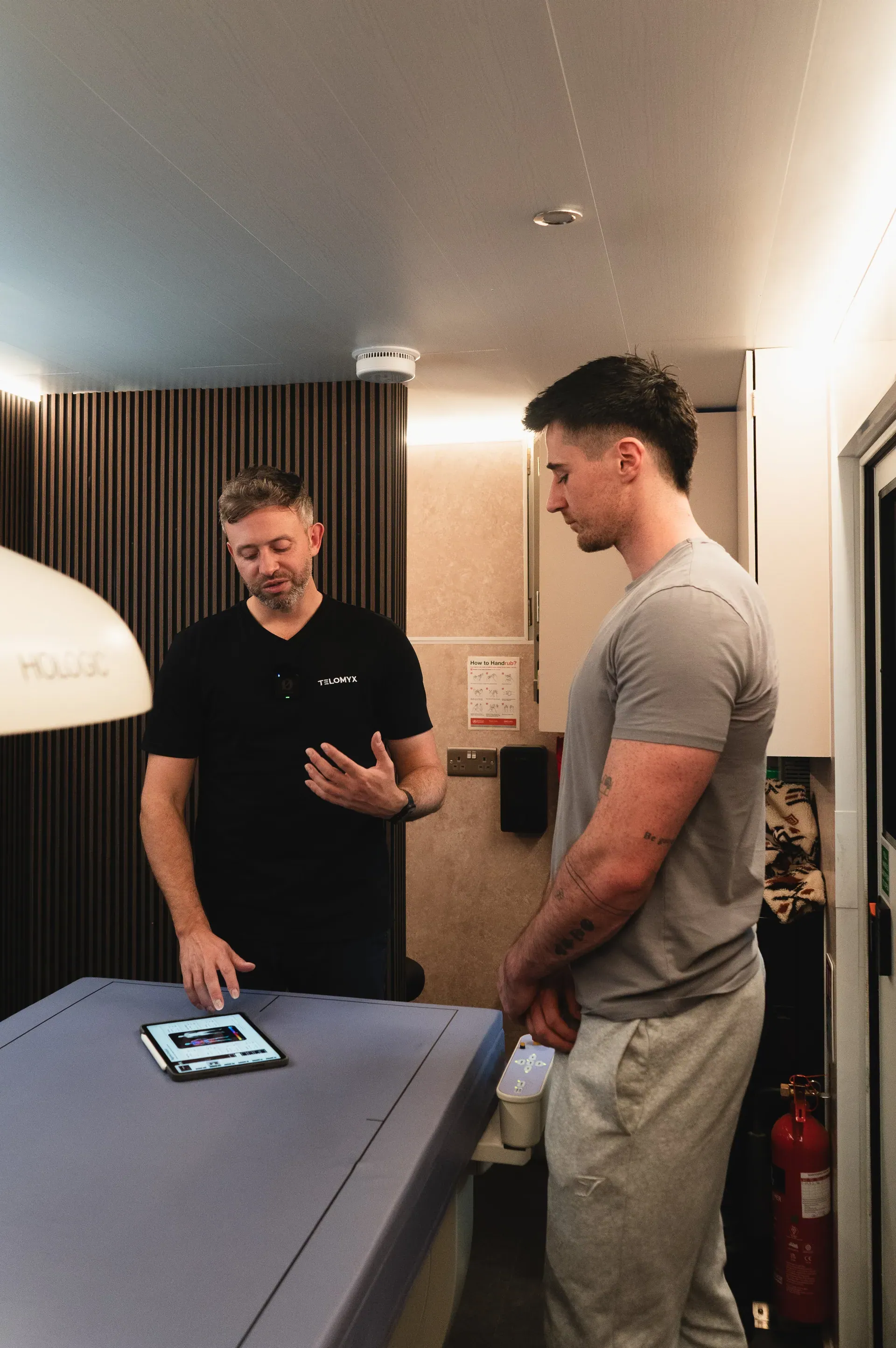
Dr Alex Trevatt, our Clinical Lead, walks you through what happens on a DEXA scan day at the mobile clinic.
Book a DEXA scan
See how combining a DEXA scan with an RMR test gives you the complete metabolic picture /
Not sure which test is right for you?
Tell us what you want to measure or improve and we will point you towards the most appropriate option.
Who would benefit from a DEXA scan?
A DEXA scan isn't just for elite athletes or bodybuilders, it's for anyone who wants to understand their body better and take control of their health. Here's who can benefit the most:
- 01Fitness enthusiasts and athletes
- 02Health-conscious individuals
- 03People on a fat loss or body recomposition journey
- 04Longevity focussed people, live better for longer
- 05People recovering from injury or illness
Why track body composition (not just weight)?
We've been taught to focus on weight as the main sign of health, but the number on the scales doesn't tell the full story. Two people can weigh the same but have completely different body compositions. One might have more muscle, the other more fat. One might carry dangerous visceral fat around their organs, while the other doesn't. That's why tracking your body composition is so much more insightful than tracking weight alone. A DEXA scan shows you what your weight is made of, how much is fat, how much is lean muscle, and where it's all stored in your body. This matters because:
- You could be losing fat and gaining muscle (a great result) while your weight stays the same
- You might be losing weight too quickly, breaking down muscle instead of fat
- You could have high visceral fat, even with a "normal" BMI or clothing size
- Your training or nutrition might be working better than you think, but the scale isn't showing it
What is a DEXA scan?
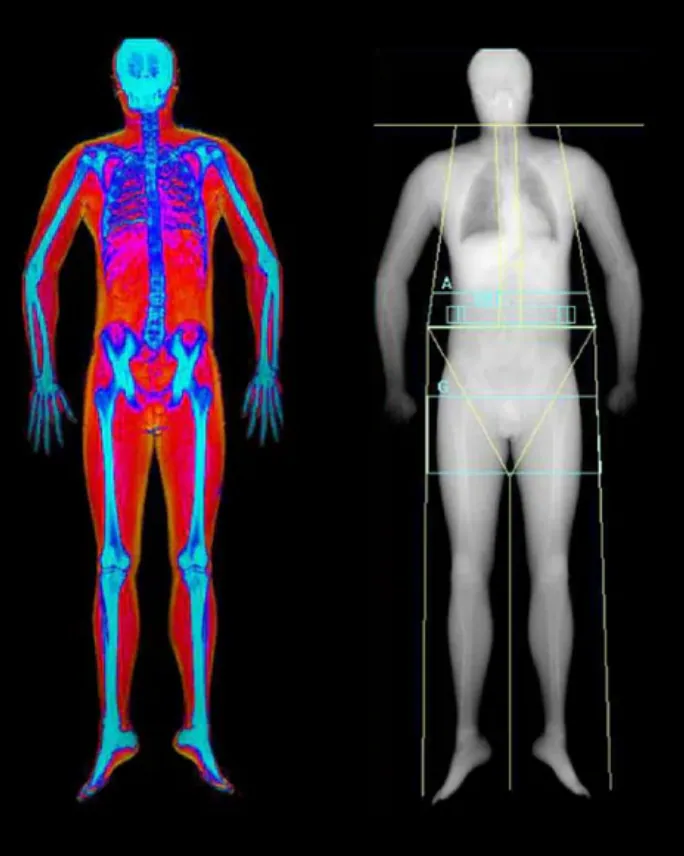
A DEXA scan (Dual-Energy X-ray Absorptiometry) is a medical-grade imaging test used to measure body composition with exceptional precision. Originally developed for clinical use and adopted by elite athletes, sports scientists, and professional teams, it has long been the reference standard for understanding fat, muscle, and bone in detail.
Unlike consumer devices, a DEXA scan produces a high-resolution, regional analysis of your body, showing exactly how fat and muscle are distributed, including hard-to-measure areas such as visceral fat. What was once reserved for hospitals and high-performance sport is now accessible to anyone who needs objective, reliable data to support goals like fat loss, muscle gain, improved performance, or long-term health.
Health benefits of monitoring body composition
Spot hidden health risks early
Not all fat is visible. A DEXA scan measures visceral fat, the deep fat around your organs that's linked to heart disease, type 2 diabetes, and other metabolic conditions. Even people who appear lean can have high visceral fat. Catching it early gives you the chance to make changes before problems develop.
Build (and keep) lean muscle
As we age, we naturally lose muscle mass, unless we actively work to preserve it. By tracking your lean mass, you can make sure you're maintaining strength, mobility, and a healthy metabolism over time.
Improve energy, focus and metabolic health
Body composition affects how your body burns fuel, stores energy, and performs throughout the day. By reducing excess fat and improving your muscle-to-fat ratio, many people experience better energy levels, sharper mental focus, and improved insulin sensitivity.
Make smarter health and fitness decisions
Whether you're trying to lose weight, gain muscle, or simply stay on track, body composition data helps you train and eat with purpose, no more guessing. You'll know if your plan is working and where to adjust.
See exactly what your body is made of.
What does a DEXA scan measure?
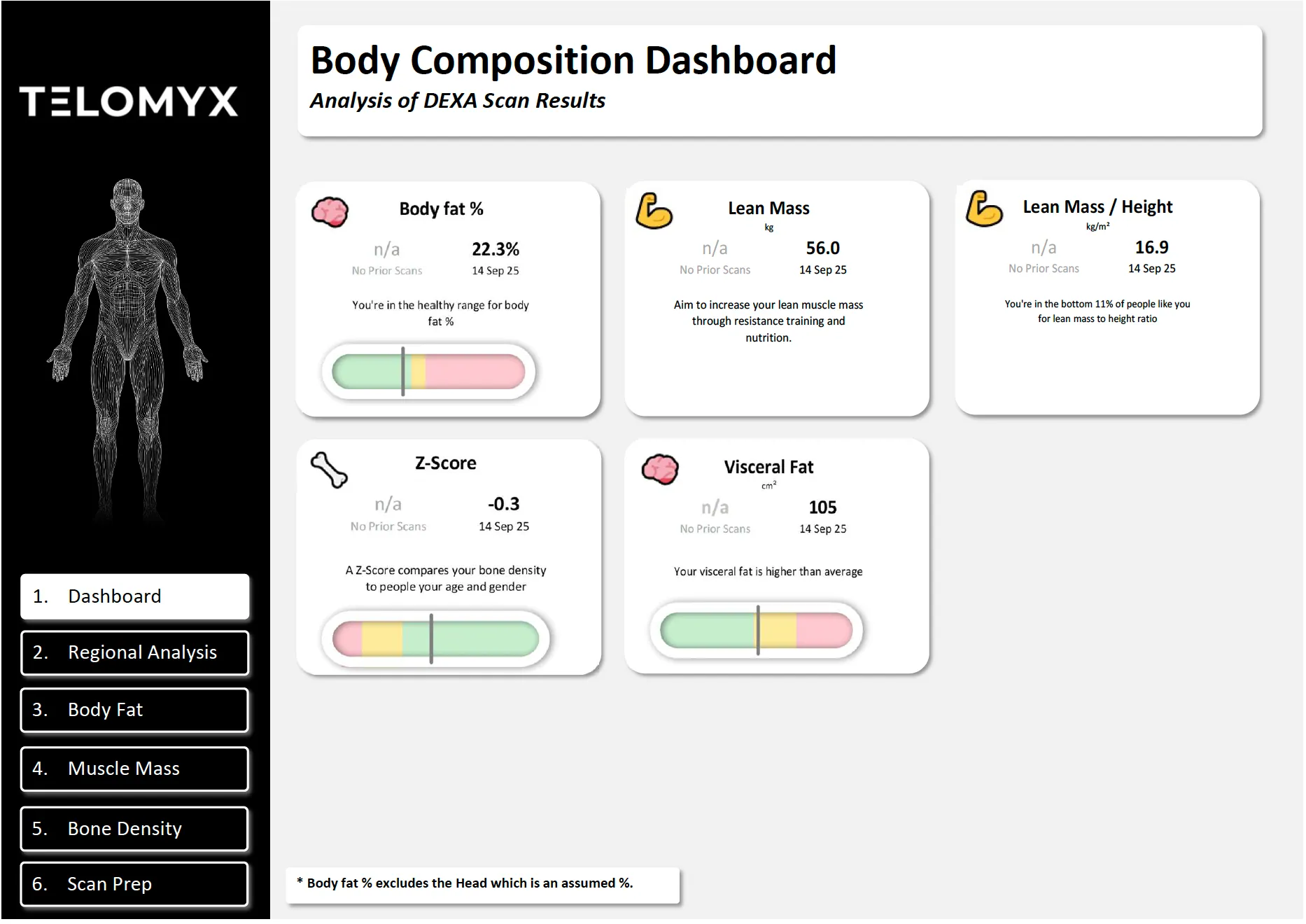
Find out exactly how much of your body is made up of fat, not just a vague estimate, and where it is stored. This includes both subcutaneous fat (the fat under your skin) and more importantly, visceral fat (the deeper fat around your organs, which is linked to long-term health risks).
See how much lean tissue you have, including your muscles. This is especially helpful if you're working on building strength or improving fitness because progress doesn't always show up on the bathroom scales.
DEXA was originally designed to assess bone health, so it also gives you insights into your bone density. That's useful not just for older adults, but also for athletes and anyone interested in long-term skeletal health.
Rather than just giving you one big number, the scan breaks your body down into regions including arms, legs, and trunk. That way, you can track where you're gaining or losing fat or muscle. It's especially valuable for spotting imbalances, recovering from injury, or tailoring your training.
Where it sits, not just how much
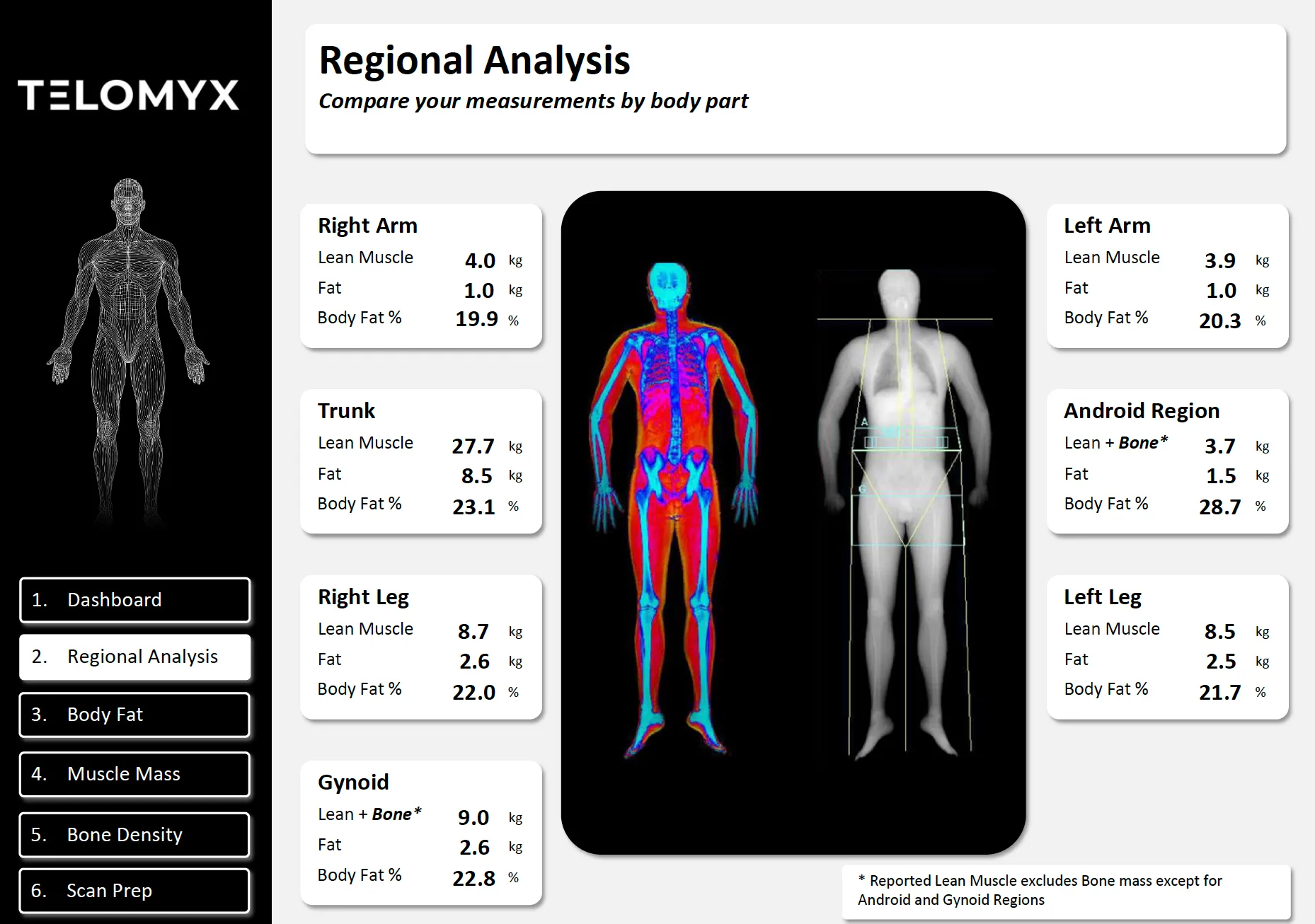
It's not just about how much fat you have, but where it's stored. DEXA breaks your body down into regions, arms, legs, trunk, and abdomen, so you can see if fat is spread evenly or concentrated in higher-risk areas. This matters because abdominal and visceral fat are more strongly linked to long-term health risks, while fat in the hips and legs is generally less harmful. Tracking these patterns over time shows whether your training and lifestyle changes are reducing the fat that matters most.
Knowing your total muscle is useful, but knowing where it's distributed is even more powerful. DEXA shows muscle in your arms, legs, and core, making it easy to spot imbalances that affect strength, posture, and performance. By tracking these regions over time, you'll see whether your training is building balanced strength, reducing weak spots, and improving overall fitness.
Every fat metric, in detail
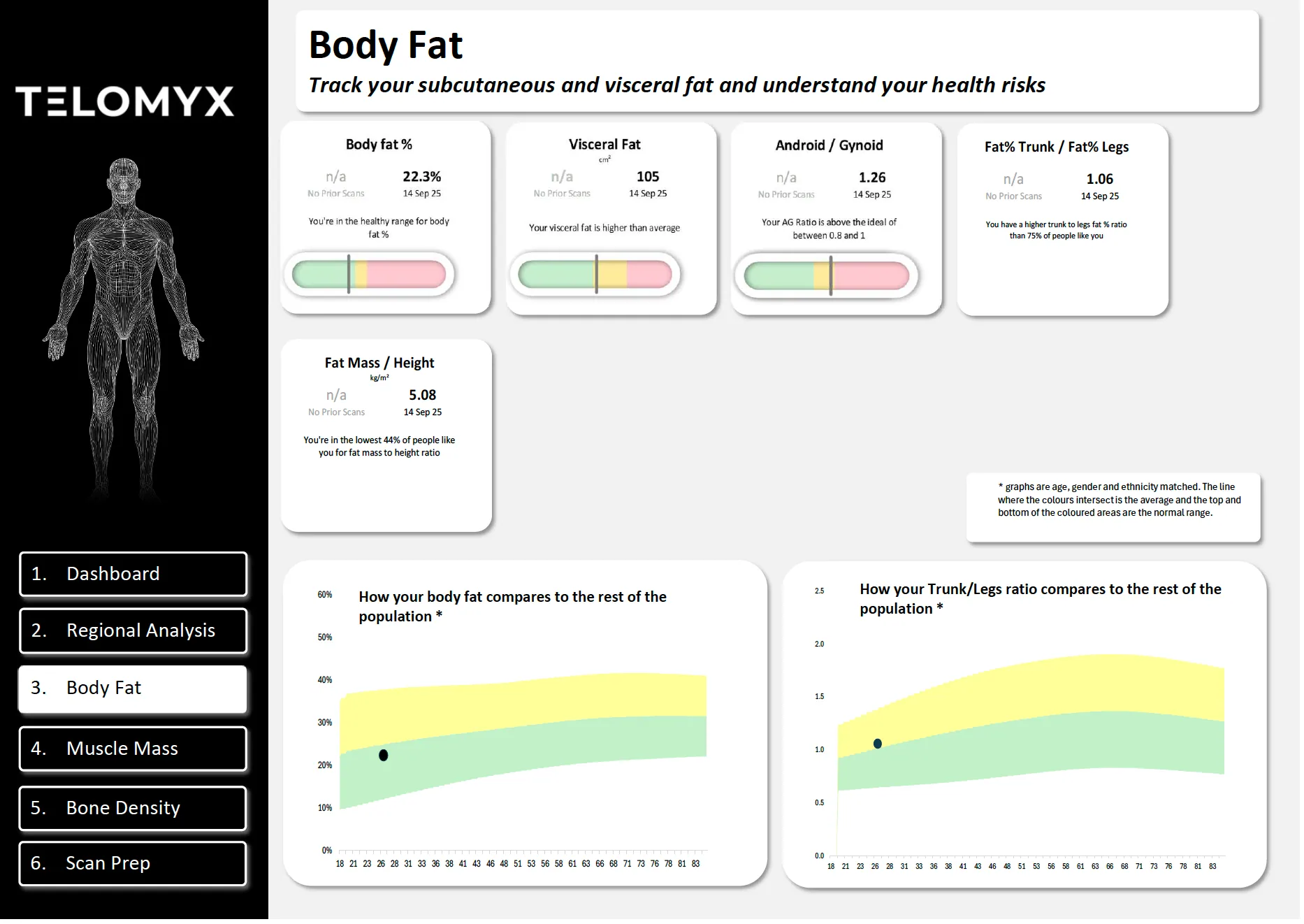
Go beyond the scales. DEXA gives you an accurate percentage of body fat, rather than relying on rough estimates from BMI or handheld devices. This lets you track real changes in fat loss or muscle gain over time, and see how close you are to your personal health or performance goals.
Visceral fat is the deeper fat stored around your organs, the type most strongly linked to long-term health risks like diabetes, heart disease, and metabolic syndrome. Measuring it directly gives you insight into health risks that body weight or total fat % can't show. Reducing visceral fat is one of the most powerful changes you can make for long-term health.
Your fat distribution matters. "Android" fat (around the abdomen) carries higher health risks, while "Gynoid" fat (hips and thighs) is generally less harmful. DEXA measures both, so you can see your balance. Tracking this ratio helps identify whether your fat loss is coming from the right areas, particularly the abdomen, where risk is higher.
Comparing fat stored in your trunk (midsection) versus your legs highlights whether fat is being stored in riskier areas. A higher proportion in the trunk is associated with greater health risks, while more in the legs is typically protective. DEXA makes this distinction clear, helping you understand not just how much fat you have, but where it matters most.
This index adjusts your total fat mass for your height, giving a fairer picture than body fat % alone. It helps standardise results between individuals of different sizes and is increasingly used in research and clinical settings to assess health risks linked to body composition.
Lean tissue, mapped
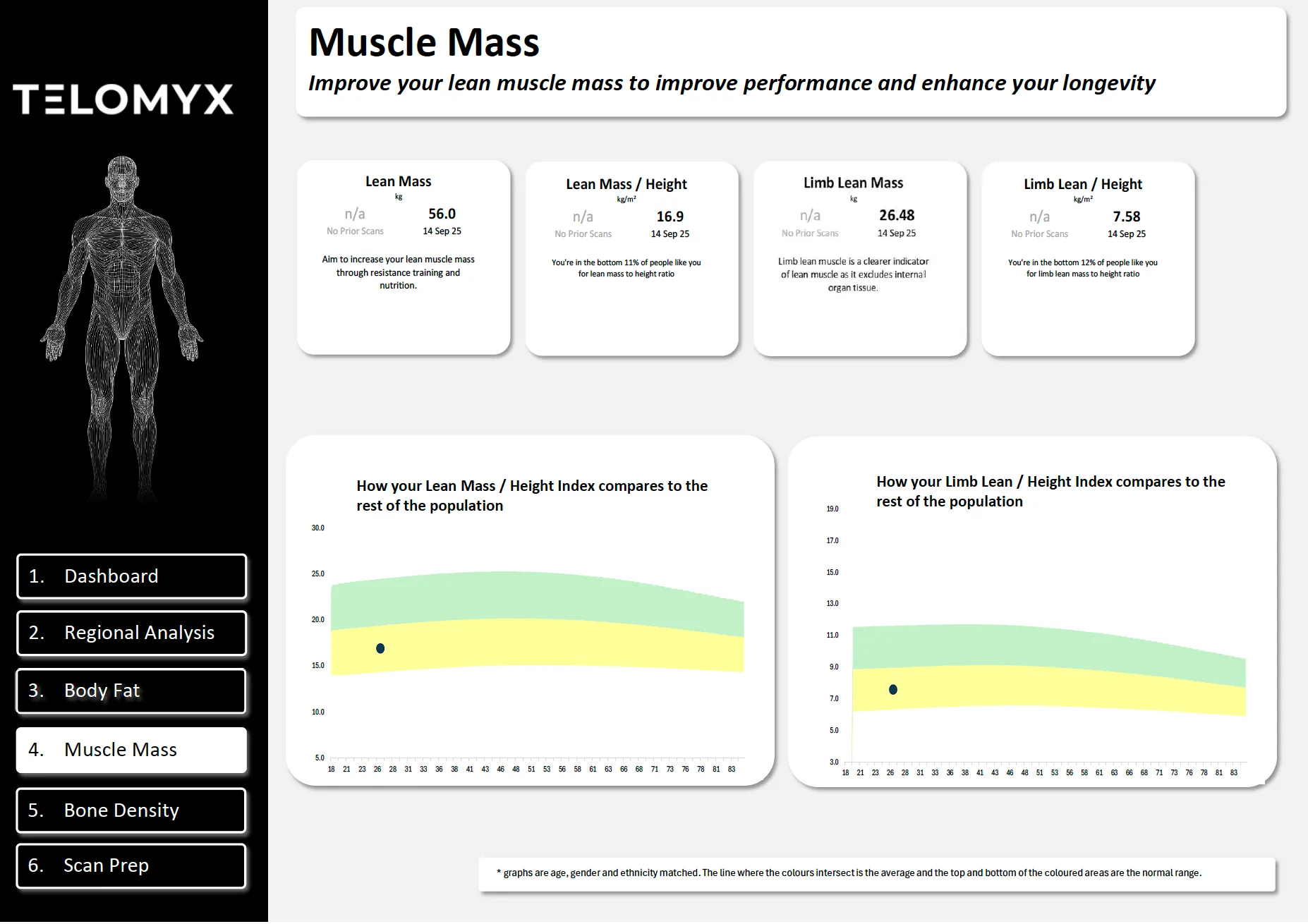
Lean mass includes your muscles, bones, and organs, everything in your body that isn't fat. Tracking lean mass shows whether you're building or maintaining muscle alongside any fat loss, giving a clearer picture of overall health and performance than weight alone.
This index adjusts your lean mass for your height, creating a fair comparison between people of different sizes. It's a reliable way to assess whether you have enough muscle relative to your body frame, and it's increasingly used in research and health assessments.
DEXA measures lean mass separately in your arms and legs. This is especially useful for athletes and anyone recovering from injury, as it highlights strength imbalances between left and right, or between upper and lower body. Spotting these differences helps guide more effective, balanced training.
By adjusting your arm and leg muscle mass for your height, this measure gives a standardised view of muscle distribution. It's particularly helpful for tracking whether you're building and maintaining enough limb strength for performance, function, and healthy ageing.
The original DEXA measurement
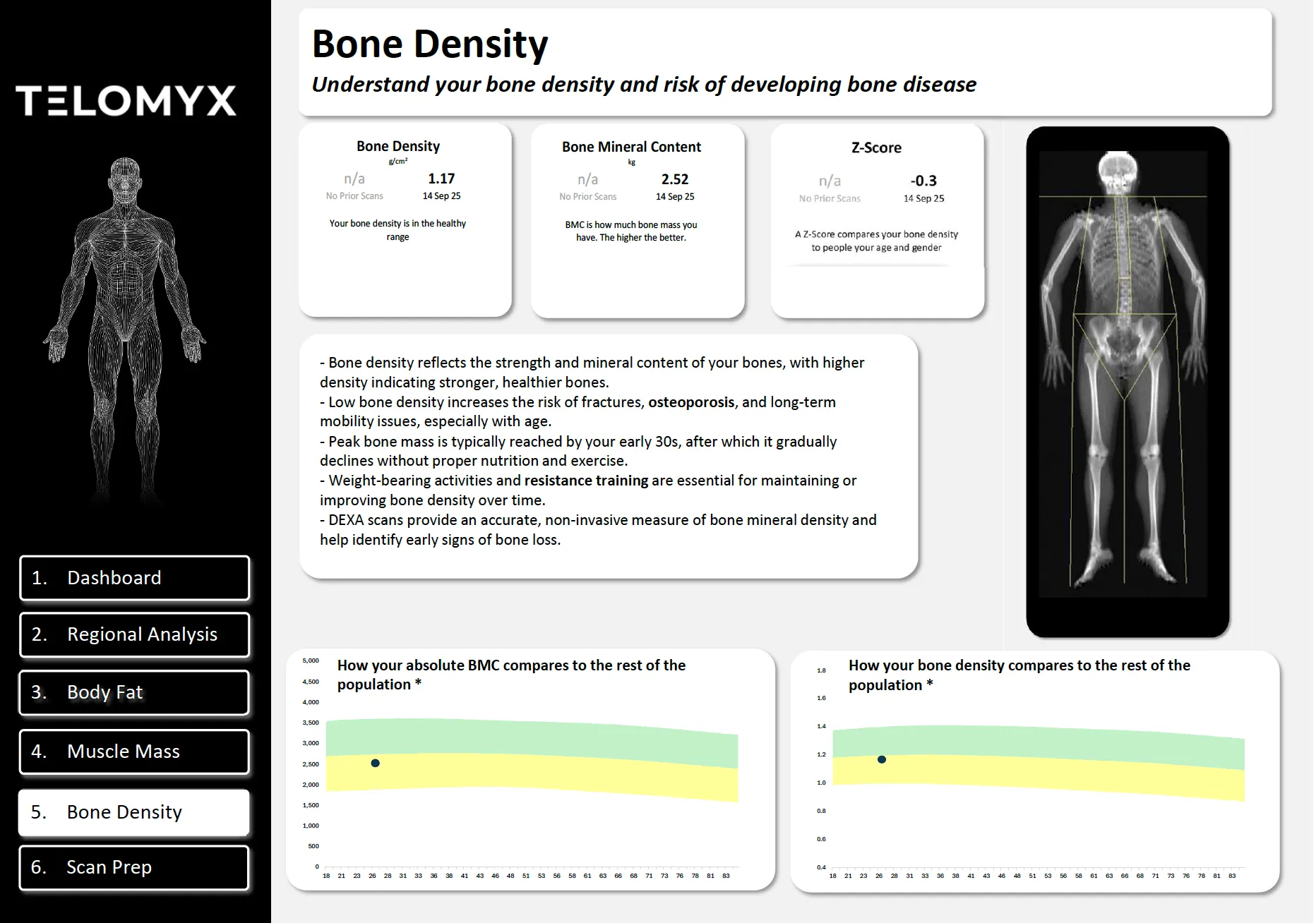
Bone density measures how strong and mineral-rich your bones are. Higher density means stronger bones that are less likely to fracture, while lower density can signal early signs of conditions like osteoporosis. Tracking it over time helps monitor bone health and the effects of diet, training, or ageing.
This is the total amount of mineral in your bones, measured in grams. It reflects the actual "weight" of mineral making up your skeleton. Together with bone density, BMC helps you understand the overall strength and structure of your bones.
The Z-score compares your bone density to what's typical for someone of your age, sex, and body size. It's useful for spotting whether your bone health is above or below what's expected for you personally, especially important for athletes, younger people, or those with specific health concerns.
Measured data,
not guesswork.
Join the Telomyx newsletter to get the latest dates and locations
Clinic days and new venues, straight to your inbox. No spam.