
Fat vs Muscle: The Truth About Body Composition
7 June 2026
The most common advice about fat vs muscle is also the most misleading: “just watch the scale.” That works only if all body weight behaves the same way. It doesn't. A falling scale can hide muscle loss. A stable scale can hide major fat loss. An increasing scale can reflect useful gains in lean tissue rather than failure.
In practice, health decisions improve when you stop asking, “What do I weigh?” and start asking, “What is my weight made of?” That shift matters for anyone trying to improve metabolic health, athletic performance, healthy ageing, or long-term resilience.
Body composition is the clinically useful lens. It separates fat mass, lean mass, and bone density, which is why advanced assessment tools such as DEXA are so valuable in real-world decision-making. Two people can share the same body weight and present very differently in strength, shape, energy, and health risk because their proportions of fat and muscle are different.
| Feature | Fat | Muscle |
|---|---|---|
| Primary role | Energy storage, insulation, organ protection | Movement, force production, physical function |
| Physical characteristic | Less dense, takes up more space for the same mass | More dense, takes up less space for the same mass |
| What the scale shows | Included in total weight, but not separated | Included in total weight, but not separated |
| Why it matters clinically | Excess body fat can raise health concerns depending on amount and distribution | Preserving or building muscle supports function, training capacity, and metabolic health |
| Best way to measure accurately | Body composition testing rather than scale weight alone | Body composition testing rather than scale weight alone |
Table of Contents
- Why a Pound of Fat Is Not the Same as a Pound of Muscle
- Understanding Adipose Tissue vs Skeletal Muscle
- The Metabolic and Health Impact of Body Composition
- Why Your Bathroom Scale Can Mislead You
- How to Accurately Measure Fat and Muscle
- A Practical Plan to Build Muscle and Reduce Fat
- Tracking Your Progress Accurately with Telomyx
Why a Pound of Fat Is Not the Same as a Pound of Muscle
A pound is a pound. That part is obvious. The mistake is assuming equal weight means equal effect inside the body.
The practical difference is volume. Muscle is denser than fat, so the same weight of muscle occupies less space. That's why two people can stand side by side, weigh the same, and still look very different. One may carry more lean tissue and appear more compact. The other may carry more fat mass and appear less defined.
That difference changes how clothes fit, how someone moves, and often how progress should be interpreted. A person can lose fat, gain muscle, and see very little change on the scale. If they judge success only by total weight, they may conclude that nothing is working when their body composition is improving.
The real comparison is composition, not weight
Clinically, body weight on its own is a blunt tool. It doesn't separate fat mass, lean mass, or bone density. That's the central problem with simplistic “weight loss” advice. It treats all kilograms as interchangeable when they aren't.
Clinical takeaway: If your goal is better health, performance, or physique, the target isn't simply less weight. It's a better ratio of fat to lean tissue.
This is also why BMI has limits. It can place people with very different body compositions into similar categories. Someone with more muscle and someone with less muscle can look identical on paper if all you record is height and weight.
Why this matters in practice
Useful coaching and clinical interpretation focus on body recomposition. That means reducing excess fat while preserving or increasing muscle where possible. It's a more demanding goal than merely driving scale weight down, but it produces better decision-making.
What doesn't work well is chasing the lightest version of yourself at any cost. Rapid weight loss without attention to muscle retention often produces a worse outcome than people expect. They may become lighter, but also weaker, less capable, and harder to fuel correctly.
Better questions are these:
- Are you losing fat or just losing weight
- Are you preserving lean mass while dieting
- Are your training and nutrition choices moving you towards a healthier composition
Those answers never come from the bathroom scale alone.
Understanding Adipose Tissue vs Skeletal Muscle
Fat and muscle aren't rival substances battling for space. They're different tissues with different jobs. Once you understand that, the fat vs muscle conversation becomes much more useful.
What fat tissue actually does
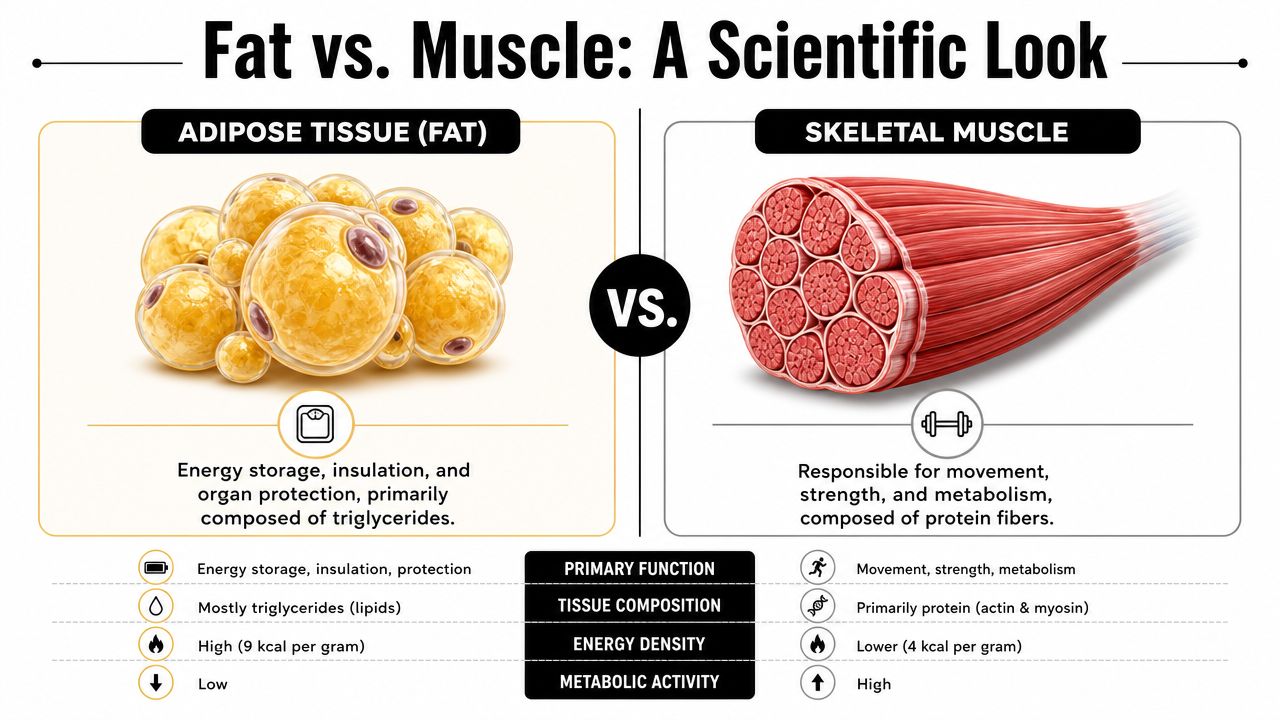
Adipose tissue stores energy. It also helps with insulation and physical protection. That doesn't make fat “bad”. Some fat is necessary for normal physiology. The problem is excess fat, especially when it accumulates in less favourable patterns.
In practice, location matters. Subcutaneous fat sits under the skin. Visceral fat accumulates around internal organs and has far greater relevance to metabolic risk. That's one reason visual appearance alone doesn't tell the whole story. Two people can look broadly similar but carry very different internal risk profiles.
Fat tissue is also physically less dense than muscle. A useful estimate is around 0.9 g/ml for fat and 1.06 g/ml for muscle, which means 1 litre of muscle weighs about 1.06 kg while 1 litre of fat weighs about 0.9 kg, as outlined in this body composition explanation.
Why skeletal muscle matters beyond appearance
Skeletal muscle is the tissue you use to move, stabilise joints, produce force, and perform physical tasks. It supports everything from lifting and sprinting to climbing stairs and getting out of a chair confidently later in life.
It also changes how the body handles training, recovery, and food. In clinical work, we treat muscle as functional infrastructure. The more useful question isn't whether someone looks “toned”. It's whether they're maintaining enough muscle to support strength, metabolic resilience, and long-term independence.
A key physical distinction is density. Skeletal muscle is about 18% denser than adipose tissue, with approximate densities of 1.06 g/cm³ for muscle and 0.9 g/cm³ for fat, which is why equal masses occupy different volumes and someone can look leaner at the same body weight, according to this explanation of muscle and fat density.
Fat isn't just visible tissue, and muscle isn't just cosmetic tissue. One is energy storage. The other is a major part of how you move, perform, and age.
A useful way to consider this is:
- Fat tissue answers a storage need
- Muscle tissue answers a function need
- Body composition tells you how those needs are balanced
If you rely only on mirror checks, scale readings, or generic online calculators, you miss that balance.
The Metabolic and Health Impact of Body Composition
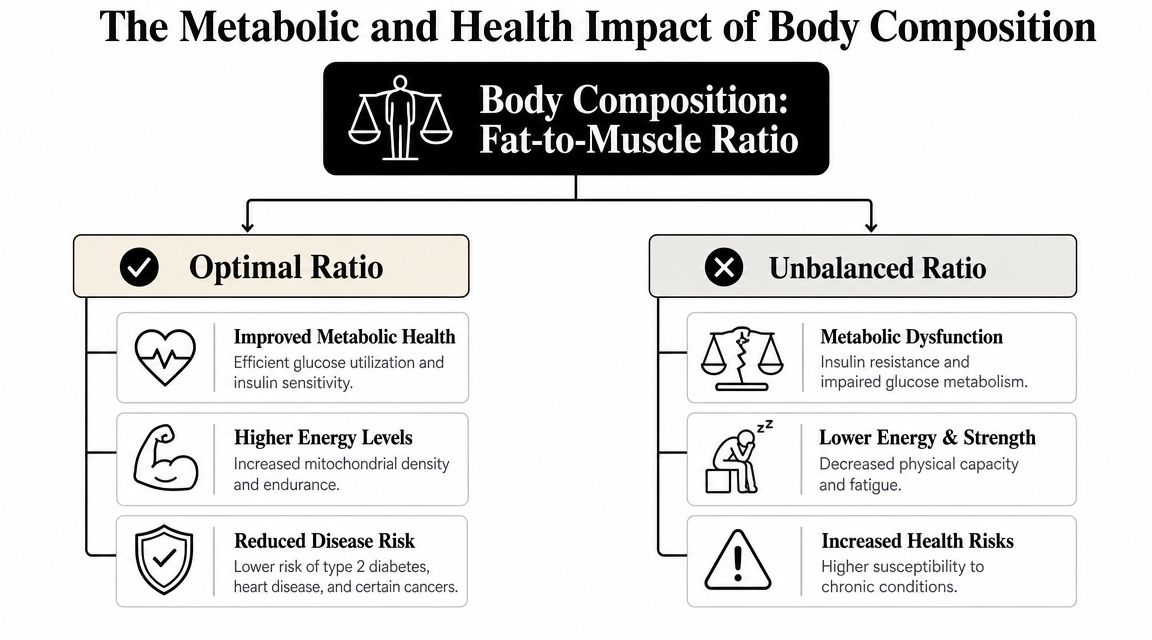
Body composition matters because it changes what your body can do, how it copes with stress, and how intelligently you can manage nutrition and training.
The public conversation often reduces fat vs muscle to appearance. That misses the bigger issue. A better body composition usually supports better function. Poorer body composition often makes health management harder because it affects energy regulation, physical capacity, and the quality of decisions you can make around diet and exercise.
Why this is a public health issue
This isn't a niche concern for physique athletes. In England, 64.0% of adults were overweight or obese in 2022 to 2023, including 26.2% who were obese, according to the government's Obesity Profile. NHS physical activity guidance recommends adults complete at least 150 minutes of moderate-intensity activity per week plus muscle-strengthening activity on 2 or more days. That guidance reflects a simple point: reducing excess fat and preserving lean mass both matter for health.
That recommendation is easy to overlook. Many people focus on cardio alone. Cardio has value, but it doesn't replace strength work when the goal is to hold on to muscle while improving health markers.
Body composition also explains why two people with a similar BMI can have different health profiles. BMI can't distinguish between fat and muscle. It doesn't tell you where fat is carried. It doesn't tell you whether weight loss has come from fat, lean tissue, or both.
RMR changes the quality of decision-making
Muscle is often called metabolically active tissue, and that's useful shorthand. In practice, the point isn't to obsess over a single tissue in isolation. The point is that your resting metabolic rate, or RMR, influences how much energy your body uses at rest, and body composition is part of that picture.
That's where testing becomes valuable. Generic calorie calculators assume too much. They estimate. They don't measure. For someone trying to reduce fat without sacrificing muscle, or build muscle without overshooting energy intake, guesswork usually creates unnecessary friction.
Practical rule: If your plan depends on precision, estimate less and measure more.
A higher proportion of healthy lean tissue generally supports better training tolerance and more useful nutritional planning. Excess fat, especially centrally stored fat, often comes with more metabolic complications to manage. The goal isn't to moralise either tissue. It's to understand what your current composition is doing to your health and what changes would be most protective.
Why Your Bathroom Scale Can Mislead You
A bathroom scale reports one thing: total mass. It can't tell you whether a change came from fat, muscle, water, gut content, or a mix of all four.
That's why people often abandon effective plans too early. They start resistance training, improve nutrition, feel stronger, and notice clothes fitting better. Then the scale stalls. They assume they've hit a wall, when in reality they may be improving in exactly the way that matters.
The scale reports total mass, not tissue type
The problem is built into the tool. Fat has an average density of about 0.9 g/ml and muscle about 1.06 g/ml, meaning 1 litre of muscle weighs about 1.06 kg while 1 litre of fat weighs about 0.9 kg, which is why equal body weight can look very different depending on the proportion of lean tissue and fat, as explained in this fat and muscle density overview.
So if someone loses a meaningful amount of fat and gains some muscle at the same time, the visual result may be excellent while the scale barely moves. The wrong interpretation would be “nothing changed”. The correct interpretation is “the scale cannot identify recomposition”.
This is one reason we often steer people towards the distinction between fat loss vs weight loss. Weight loss is broad. Fat loss is specific. Only one tells you whether the change was desirable.
What useful progress tracking looks like
A better tracking system combines several inputs:
- Body composition data that separates fat and lean tissue
- Performance markers such as strength, output, and recovery
- Fit and function including how clothes sit, how joints feel, and how easily daily tasks are handled
If the scale is your only metric, you'll misread good progress and overreact to normal fluctuations.
Scales aren't useless. They're just incomplete. Use them as one signal, not the scoreboard.
How to Accurately Measure Fat and Muscle
If you want to understand fat vs muscle with clinical precision, you need a tool that separates tissues rather than lumping them together.

What a DEXA scan tells you
DEXA is one of the most useful methods for body composition analysis because it quantifies fat and lean tissue separately. In DXA-based body composition analysis, a typical whole-body scan takes about 10 to 20 minutes and radiation exposure is below 5 mrem, making it a practical benchmark for tracking whether changes are coming from fat loss or lean-mass gain rather than scale weight alone, according to this review of DXA body composition analysis.
That matters because action should follow measurement. If a client loses weight but the scan shows lean-mass loss, the plan needs adjusting. If body weight is stable but body fat is down and lean mass is maintained or up, the plan is likely working.
A clinically useful body composition assessment can help identify:
- Total fat mass
- Lean mass
- Regional distribution, which is often where the more important interpretation sits
- Bone-related context, which matters for ageing, training load, and long-term resilience
Consumer devices often promise similar insight, but many rely on indirect estimation. Their outputs can shift with hydration status, timing, and testing conditions. They can still be useful for rough trends, but they shouldn't be treated as equivalent to clinical imaging.
If you want a broader primer on methods and trade-offs, Blue Haven RX on body composition gives a helpful overview of common body-fat measurement approaches.
Where RMR testing fits
DEXA tells you what your body is made of. RMR testing helps show how much energy your body uses at rest. Together, they improve decision-making far more than generic online formulas.
For people trying to cut fat while preserving muscle, many plans often fail. They under-eat, overestimate calorie burn, or assume their metabolism matches a calculator. RMR testing removes some of that guesswork and gives a more stable base for calorie targets.
A useful example is the combination of body composition assessment with an advanced body fat scanner and metabolic testing. Telomyx offers DEXA body composition scans and RMR testing in a mobile clinical format across the UK, which gives people a measured baseline for both tissue composition and resting energy use.
Here's a short overview of the process in action:
A Practical Plan to Build Muscle and Reduce Fat
Once measurement is in place, the next step is execution. The best body composition plans are rarely complicated. They're consistent, repeatable, and built around training, nutrition, and recovery that can hold up for months rather than days.
Training that actually changes body composition
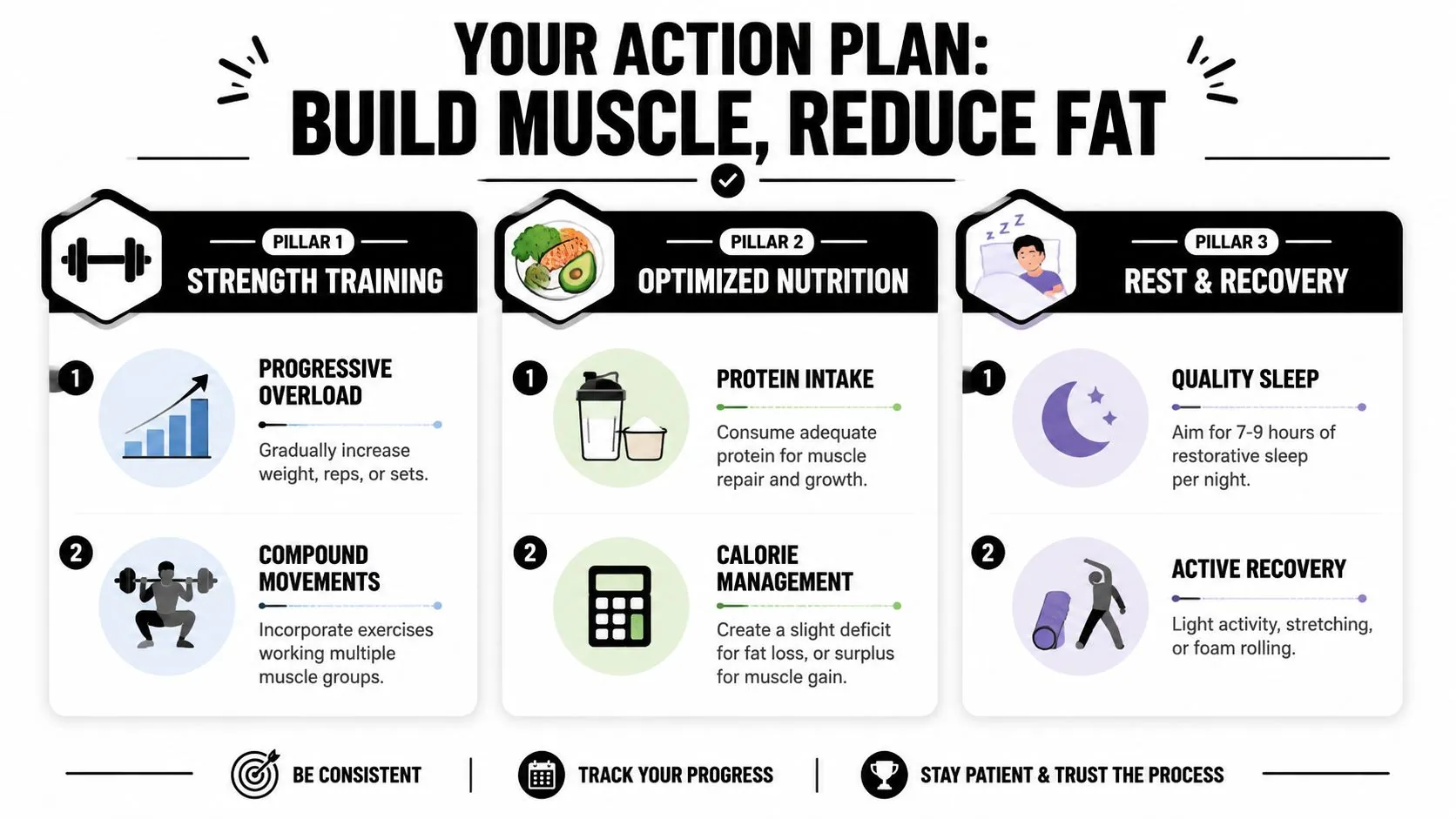
If your goal is to build muscle and reduce fat, resistance training needs to be central. Walking more and doing cardio can support fat loss, but neither replaces the stimulus required to maintain or increase muscle.
Three principles matter most:
- Progressive overload. Your body needs a reason to adapt. That can come from more load, more reps, better control, or more total work over time.
- Compound lifts and stable patterns. Squats, hinges, presses, rows, carries, and similar patterns train more tissue and give clearer progression.
- Patience. People often switch plans too quickly. Body recomposition rewards consistency more than novelty.
If muscle gain is the main target, a structured approach to muscle gain strategies is far more useful than random high-volume training.
Nutrition and recovery that support recomposition
Nutrition should support the goal, not fight it. For fat loss, that usually means an energy deficit that's controlled rather than aggressive. For muscle gain, it means enough energy and protein to support adaptation without drifting into unnecessary fat gain.
Protein deserves special attention because it supports repair, recovery, and lean-mass retention during periods of fat loss. If someone is unsure where to start, this guide to understand your protein requirements is a practical resource.
Recovery is the part many driven people skip. They train hard, tighten calories, and then neglect sleep and fatigue management. That tends to reduce performance quality and makes body composition harder to improve.
A sensible framework looks like this:
- Lift regularly with a plan you can progress.
- Match calories to the goal using measured data where possible.
- Prioritise protein and meal quality so the deficit or surplus is productive.
- Protect sleep and recovery because adaptation happens outside the session.
Good body recomposition plans feel disciplined, not punishing. If the plan is so extreme that you can't hold it, it won't work for long.
Tracking Your Progress Accurately with Telomyx
Individuals don't need more motivation. They need better feedback.
This underscores the value of repeated body composition testing. A baseline tells you where you are starting. Follow-up testing tells you whether your current strategy is producing the change you intended. Those are not the same thing. Many people follow a plan consistently but still don't know whether they're losing fat, preserving muscle, or just bouncing around in body weight.
Why repeat testing changes behaviour
Objective re-testing removes a lot of false narratives. It stops the “I feel like nothing's happening” spiral when progress is real but hidden. It also catches unhelpful trends early, such as lean-mass loss during a dieting phase or poor tissue gain during a muscle-building phase.
That kind of feedback is especially useful for:
- Adults focused on healthy ageing who want to preserve function, muscle, and bone-related health
- Athletes and active professionals who need their training decisions to align with measurable outcomes
- Women dealing with changing body composition who feel that effort and results no longer match
- Executives and high-performers who want health data that supports long-term resilience rather than guesswork
What better tracking actually gives you
Better tracking doesn't just produce a report. It improves choices. You can decide whether calories need adjusting, whether training volume is appropriate, whether strength work is sufficient, and whether your current plan is preserving the tissue you want to keep.
The most useful mindset is to treat body composition testing as part of an ongoing strategy rather than a one-off event. Health, performance, and longevity all benefit from that kind of measured review.
A scale can tell you that your weight changed. Good testing tells you whether the change was worth having.
The content in this article is for educational purposes only and does not constitute medical or dietary advice. If you have an underlying health condition, are taking medication, or are considering significant changes to your diet or exercise regimen, consult a qualified healthcare professional before making any adjustments.
If you want clearer answers than the bathroom scale can give, Telomyx provides mobile advanced body analytics across the UK, including DEXA and RMR testing, so you can assess fat, lean mass, and metabolism with objective data and make more informed decisions about your health.