
Postural Assessment: Your 2026 Guide to Better Health
25 May 2026Updated 7 June 2026
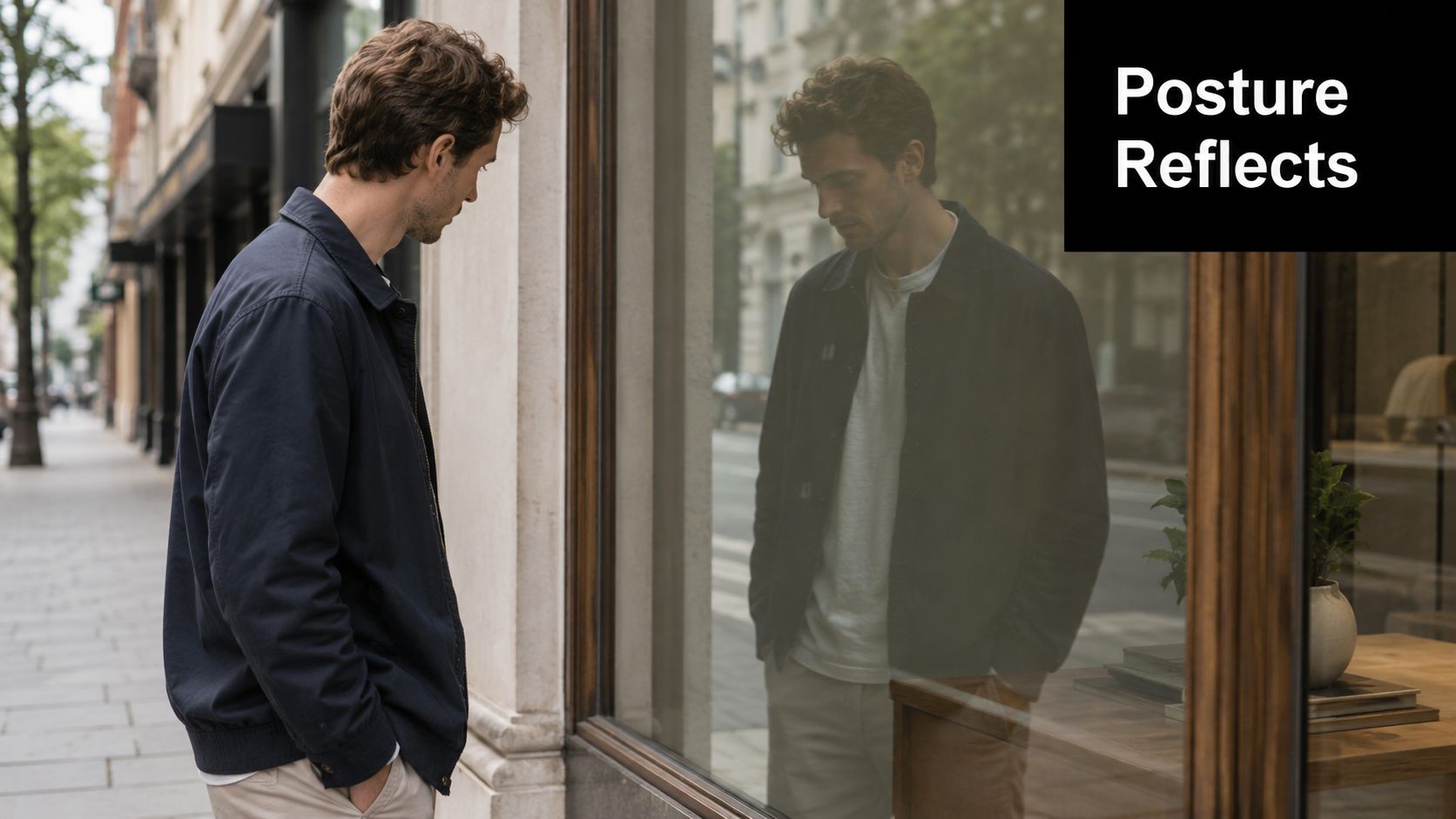
You notice it in an odd moment. A reflection in a shop window. Your head sitting a little too far forward. One shoulder higher than the other. Or maybe it's not visual at all. It's the neck stiffness after laptop hours, the low back tightness after driving, the sense that your body is working harder than it should for ordinary tasks.
That's usually when people start thinking about posture.
A good postural assessment isn't about telling you to “stand up straight”. It's a clinical way to observe how your habits, work setup, training history, injuries, strength balance, and movement strategies show up in your resting alignment. In UK practice, it remains a routine part of musculoskeletal care. A 2025 UK survey of chiropractors found that 79% used postural assessment “almost always” with new patients with back or neck pain, while 89.2% used it to help inform diagnosis and 81.8% used it to guide treatment planning.
That tells you two things. First, posture still matters in real clinics. Second, clinicians use it because it helps generate useful leads, not because a quick visual check gives a complete answer.
Many want three practical answers. What exactly is being assessed? What do the findings mean? And how much can you trust a visual screen on its own?
Those are the right questions. Postural assessment can reveal patterns worth acting on, but it also has limits. If you want better comfort, stronger performance, or clearer health decisions, it helps to know where observation ends and objective measurement begins.
Table of Contents
- Your Posture a Mirror to Your Habits and Health
- What Is a Postural Assessment?
- Comparing Postural Assessment Methods
- Who Needs an Assessment and What Can You Learn?
- Posture and Performance The Limits of Observation
- From Assessment to Optimisation Your Next Steps
Your Posture a Mirror to Your Habits and Health
Posture is often treated as a cosmetic issue. In practice, it's more useful to see it as a record of repeated exposure. Long desk hours, one-sided sport, old ankle sprains, poor sleep positions, strength deficits, and even stress can all leave a visible signature on the body.
A runner might present with a rotated shoulder girdle and persistent calf tightness. An executive who spends most of the day seated may show a forward head position, reduced thoracic extension, and a pelvis that sits differently when standing than when moving. Neither finding means the body is “wrong”. It means the body has adapted.
Why clinicians still use it
Postural assessment remains common because it gives a fast, low-cost starting point. You can often spot asymmetry, guarding, habitual loading patterns, and areas that deserve closer testing before you ask someone to squat, run, lift, or train hard.
Practical rule: Treat posture as an opening clue, not a verdict.
That's where good practitioners differ from simplistic posture advice online. A skilled clinician doesn't stare at your shoulders and declare that they've found the cause of your pain. They use your alignment to decide what needs checking next. That might mean range of motion, balance, gait, strength, breathing mechanics, previous injury history, or workload.
What your habits reveal
Common patterns often reflect ordinary life:
- Laptop and phone use: Head and shoulder position often adapts to what your eyes and hands do all day.
- Strength training bias: Lifters sometimes build around restrictions instead of resolving them, so posture reflects compensation as much as effort.
- Old injuries: A past foot, knee, or hip issue can alter load distribution up the chain.
- Sedentary work: Static positions reduce variation. The body gets efficient at the position you repeat most.
Posture isn't a moral score. It's information. Used well, that information can help explain why one area keeps overworking, why technique breaks down under fatigue, or why one side never seems to feel quite right.
What Is a Postural Assessment?
A postural assessment is a structured observation of how your body lines up at rest. It isn't a casual glance. Done properly, it looks at you from the front, side, and back, then checks how different body regions relate to each other.
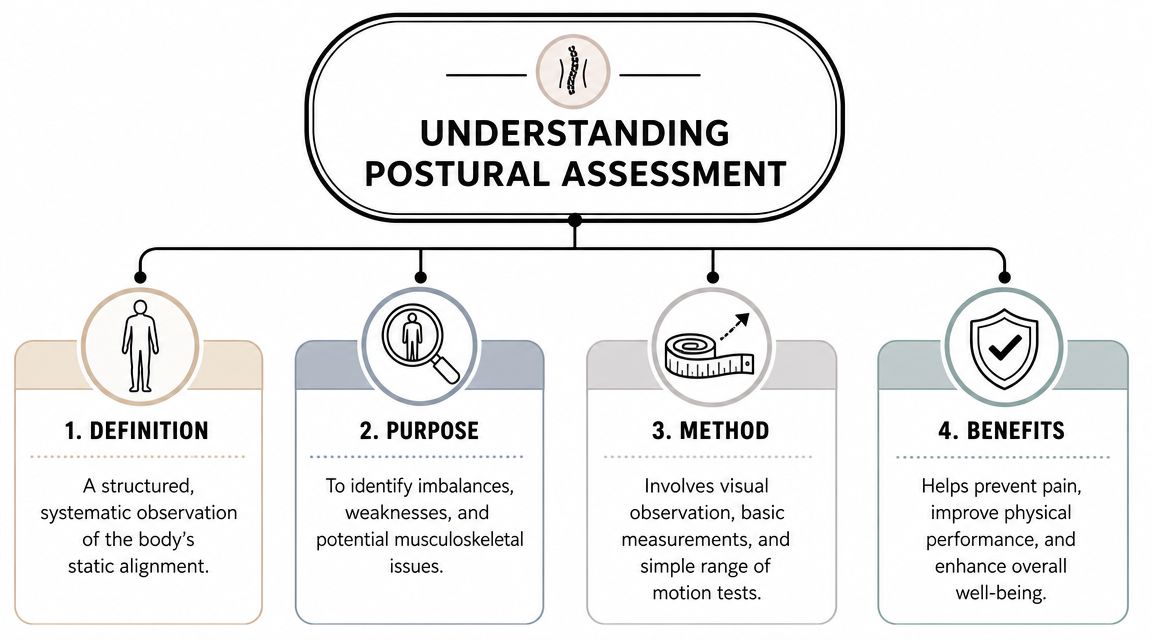
A useful clinical screen views the body in anterior, lateral, and posterior planes and checks the full kinetic chain, from feet and ankles through knees, the lumbopelvic-hip complex, shoulders, and head and neck, looking for asymmetries, pelvic tilt, and spinal curvatures that can suggest muscle imbalance or movement constraints, as described in these posture and movement assessment teaching materials.
The body is checked as a chain
It's comparable to wheel alignment on a car. If one tyre tracks differently, the wear doesn't stay isolated to that tyre. The whole system compensates. The body does the same thing.
A practitioner usually checks for issues such as:
- At the feet and ankles: Collapse, outward turn, uneven weight shift, or positional asymmetry.
- At the knees: Valgus, varus, or one knee sitting differently from the other.
- At the pelvis and hips: Tilt, rotation, lateral shift, or an unloaded side.
- At the trunk and shoulders: Rib flare, shoulder height differences, thoracic rounding, or rotation.
- At the head and neck: Forward head posture, side tilt, or compensatory extension.
Those observations don't diagnose a weak muscle on sight. They point towards a working theory. If the pelvis appears anteriorly tilted, for example, the next step isn't to label it “bad posture”. The next step is to test what's contributing. That may include hip mobility, trunk control, breathing strategy, glute contribution, and how the person moves under load.
What a screen can and cannot tell you
Many assessments go wrong because people assume a posture screen should produce a binary judgement. Good posture or bad posture. Balanced or dysfunctional. That's too crude for real clinical use.
Posture screening works best when it narrows the field of possibilities.
A competent assessment should leave you with better questions, not false certainty. If you want a simple at-home starting point before seeing a professional, this guide on how to check your posture is a sensible way to build awareness of your own alignment.
In clinic, the strongest use of a postural assessment is to connect what you see with what you test next. Observation first. Confirmation second. Intervention third.
Comparing Postural Assessment Methods
Not all posture assessments are equal. Some are quick and accessible. Others are slower, more standardised, and more useful for comparing change over time. If you're paying for an assessment, it's worth knowing what method is being used.
Visual checks are easy and limited
The simplest method is plain visual observation. A clinician watches you stand and notes asymmetries, curves, and positional shifts. This is the most common approach because it's fast, requires little equipment, and fits easily into a first appointment.
Its weakness is obvious. Visual observation is subjective. A 2014 review of postural assessment methods reported that visual observation is the most common clinical approach, but it cannot generate quantitative data, can miss minor changes, and has poor interrater agreement. The same review noted much stronger reliability for photogrammetry-based methods, with reported intraclass correlation coefficients ranging from 0.84 to 0.99 across many postural variables in one cited study.
That doesn't make visual screening useless. It makes it incomplete.
When measurement starts to matter
As soon as you want repeatability, you need more structure. That may involve a plumb line and grid, standardised photographs, software-assisted angle measurement, or dynamic movement screens that test what happens once the body is loaded.
Different tools answer different questions:
- Plumb line and grid: Better than an unstructured glance, but still limited by examiner judgement.
- Photogrammetry: Uses standardised images and angle measurements. Much stronger if you want comparison over time.
- Dynamic movement screening: Adds information about control, balance, and compensation during motion.
- Digital posture systems: Can improve consistency, but software quality and setup matter. Fancy visuals don't automatically mean valid interpretation.
A key trade-off is convenience versus precision. A quick visual screen is accessible. A measured system is harder to set up but gives you something much more useful for review, comparison, and accountability.
A posture screen becomes more clinically valuable the moment it can be repeated under the same conditions.
That principle shows up across health testing. The same reason clinicians value standardised blood markers or repeatable body metrics applies here. If you're interested in how objective testing changes decision-making more broadly, Telomyx has a useful overview of point-of-care testing in health and performance settings. See where Telomyx offers mobile health testing across the North West.
Postural Assessment Methods Compared
| Method | Description | Pros | Cons |
|---|---|---|---|
| Visual observation | Clinician assesses alignment by eye from front, side, and back | Fast, low cost, useful first impression | Subjective, no quantitative output, poor reliability |
| Plumb line and grid | Standing alignment checked against vertical reference | More structured than a glance, easy to use in clinic | Still examiner-dependent, limited precision |
| Photogrammetry | Standardised photos analysed for joint and segment angles | Repeatable, quantitative, better for tracking | Setup matters, protocol differences affect interpretation |
| Dynamic movement screen | Assesses posture and control during movement tasks | Shows compensation under load, relevant for sport and exercise | Less about static alignment, interpretation can vary |
| Digital or AI posture analysis | Uses software to map posture from images or video | Efficient reports, easier follow-up comparisons | Quality depends on protocol and software, can overpromise meaning |
If you only want a broad impression, a visual check can be enough. If you want to know whether an intervention changed anything, measurement beats memory every time.
Who Needs an Assessment and What Can You Learn?
Postural assessment isn't just for people in pain. It can be helpful for anyone whose daily life or training repeatedly loads the body in the same way.

The most important point is interpretation. UK practice still lacks strong normative reference values for many posture measures, which makes it difficult to say what is “normal” for a specific age or sex. This is one reason the literature suggests posture assessment is often most useful for tracking within-person change over time, rather than making a one-off judgement of good or bad posture, as discussed in this review of posture measures and normative limitations.
Athletes and active adults
Athletes often use posture as a window into efficiency. A swimmer, cyclist, runner, or Hyrox competitor may not care whether one shoulder sits slightly lower in a static photo. They do care whether that asymmetry reflects a restriction or compensation that wastes energy, alters technique, or keeps loading the same tissue.
Static posture won't predict every injury, but it can highlight where further screening is sensible. For readers interested in a broader clinical view of Sports injury prevention, screening has the most value when it leads to better programme decisions, not when it becomes a label.
Desk-based professionals
Executives and office-based professionals often present with a similar pattern. Long seated hours, frequent screen use, reduced movement variety, and stress-driven breathing mechanics can all shape resting alignment.
In this group, a posture screen often reveals where the body has become efficient at one position and underprepared for others. That matters if you train hard before or after work. Many people don't lack effort. They lack variation, recovery, and an accurate baseline. A broader health risk assessment for performance-focused adults often makes more sense than chasing posture alone.
Women in midlife and adults focused on healthy ageing
This group often gets generic advice that misses the bigger picture. Changes in strength, balance confidence, training tolerance, recovery, and body composition can all influence posture and movement strategy.
A posture screen can be useful here because it may reveal shifts in head carriage, thoracic position, pelvic control, or side-to-side unloading. But the finding only becomes meaningful when matched to real goals. Better walking tolerance. More confidence under load. Fewer aches after work or travel. Better resilience for the next decade, not just the next month.
A short demonstration of screening principles can make this easier to visualise:
What your findings usually mean
Most common posture findings are descriptions, not diagnoses.
- Forward head posture: Often prompts a closer look at thoracic mobility, scapular control, workstation setup, and breathing pattern.
- Anterior pelvic tilt: May suggest the need to assess hip extension, abdominal control, rib position, and loading strategy.
- Uneven shoulders or pelvic height: Can reflect habit, sport, old injury, guarding, or simple asymmetry that may or may not matter.
- Thoracic rounding: May relate to mobility, strength balance, visual habits, or repeated seated work.
Clinical reality: There isn't one perfect posture that every body should be forced to match.
That's why the most useful question isn't “Is my posture normal?” It's “Has my posture changed, does it match my symptoms or goals, and what does it suggest we should test next?”
Posture and Performance The Limits of Observation
The biggest mistake in posture work is assuming that what you see tells you enough.
Posture does not equal diagnosis
A slouched resting position doesn't automatically explain neck pain. An anterior pelvic tilt doesn't automatically explain back pain. Rounded shoulders don't prove weakness. Bodies are adaptable, and visible alignment is only one piece of a much larger picture.
The evidence-based position is more restrained. As outlined in this sports screening summary on postural assessment, posture should not be treated as a standalone diagnosis or a reliable predictor of pain. Its most defensible role is monitoring change in measured angles over time, not inferring health status from a single snapshot.
That's a useful correction, especially for high-performing people who want certainty. Observation can be suggestive. It is rarely definitive.
Observation tells you what, not always why
A visual screen might suggest that one side of the body is contributing less. It cannot confirm whether that pattern reflects true muscle mass asymmetry, reduced aerobic fitness, fatigue, compensation from an old injury, poor sleep, low training tolerance, or habit.
That's the central limitation.
A coach or clinician may suspect that your gait inefficiency links to trunk control and side-to-side loading. A photo may support that suspicion. But if you want to optimise performance or body composition, suspicion isn't enough. You need objective data that can validate or reject the theory.
Consider a few common mismatches between observation and reality:
- Visible asymmetry without meaningful limitation: Some people look uneven and function very well.
- Neat-looking posture with poor capacity: Others stand well but fatigue quickly, decondition easily, or lack force production.
- Static alignment that changes under load: What you see standing still may disappear or worsen once movement starts.
- Assumed weakness that turns out to be strategy: A body may compensate not because a muscle is “off”, but because the person has learned a different movement solution.
If you treat posture as the final answer, you often end up correcting the wrong thing.
For comfort, health, and performance, the better model is simple. Use posture to form hypotheses. Then test capacity, composition, and physiology with methods that can confirm what's going on.
From Assessment to Optimisation Your Next Steps
Postural assessment is worth doing. It can reveal patterns you'd miss, sharpen clinical reasoning, and help direct exercise or rehab more intelligently. It's a strong first step.
Use posture to ask better questions
If a screen suggests that one side is doing less work, ask whether there's a measurable lean mass difference. If standing posture hints at poor trunk organisation or reduced movement economy, ask whether aerobic capacity and fatigue resistance support the way you train. If your alignment seems to be changing with age, ask what's happening to bone and muscle, not just what's visible in the mirror.
Those are better questions than “Do I have bad posture?”
Validate the picture with objective testing
The path to optimisation starts with thorough assessment. A posture screen can suggest imbalance. A DEXA scan can show lean mass distribution, fat mass, and bone metrics with far more precision than observation. A VO2 Max test can show whether your engine matches your ambitions. Resting Metabolic Rate testing can remove guesswork from fuelling and recovery.
For anyone serious about progress, repeatable metrics beat visual impressions alone. The same principle applies whether your goal is longevity, weight management, athletic output, or feeling more capable in your body. If you care about measurable change, it helps to understand fitness progress tracking through objective data.
Posture can point you in the right direction. It shouldn't be the only map you use.
The content in this article is for educational purposes only and does not constitute medical or dietary advice. If you have an underlying health condition, are taking medication, or are considering significant changes to your diet or exercise regimen, consult a qualified healthcare professional before making any adjustments.
If your postural assessment has raised questions about asymmetry, performance, body composition, or healthy ageing, Telomyx is the practical next step. Telomyx brings hospital-grade DEXA, VO2 Max, and metabolic testing across the UK, so you can move from visual guesswork to measurable evidence and make decisions based on what your body is doing.