
The Best Rep Range for Hypertrophy Is Not What You Think
7 June 2026

The most repeated advice in hypertrophy training is also the most misleading. People still talk about 8 to 12 reps as if muscle growth begins at 8 and ends at 12. That's tidy, memorable, and incomplete.
The better question isn't “what's the magic rep range for hypertrophy?” It's “what kind of effort, loading, exercise selection, and weekly volume are producing measurable muscle gain for me?” Modern evidence has moved the conversation away from a narrow rep prescription and towards a broader principle: hard sets with sufficient load, done consistently, can build muscle across a wide spectrum of repetitions.
That shift matters because rigid rules often fail the people who care most about results. Busy professionals need efficient training. Athletes need to manage fatigue. Adults over 40 need muscle without unnecessary joint irritation. Women in perimenopause or menopause often need programmes that respect recovery and changing body composition, not generic gym folklore. If you only inherit the old “3 sets of 10” mindset, you miss the essential lever.
Table of Contents
- The Myth of the One True Hypertrophy Rep Range
- How Your Muscles Actually Grow: The Science of Hypertrophy
- The Rep Range Spectrum: Strength, Power, and Pump
- Building Your Hypertrophy Programme: Beyond Reps
- How to Adapt Rep Ranges for Your Body and Goals
- Stop Guessing: Measure Your Progress with Objective Data
- Your Blueprint for Smarter Muscle Growth
The Myth of the One True Hypertrophy Rep Range
The old hypertrophy rule survives because it's simple. Simplicity sells. Biology doesn't.
A 2021 paper in Sports reported that hypertrophy is similar across a broad range of loads, with the practical minimum likely around 30% of 1RM when sets are taken close to failure. That doesn't mean every rep range is equally convenient. It means the body doesn't care about tradition nearly as much as the fitness industry does.
The implication is bigger than it first appears. If you can grow with lighter loads taken close to failure, then rep range for hypertrophy is not a fixed destination. It's a tool for managing fatigue, technique, time, discomfort, exercise choice, and recovery capacity.
Practical rule: Stop treating reps as the main variable. Start treating reps as the way you deliver enough stimulus with the least unnecessary cost.
That changes how you think about programming. A lifter chasing muscle gain shouldn't ask only, “Should I do 8 or 12?” They should ask:
- How close to failure am I training?
- Can I repeat this work week after week?
- Does this rep choice suit the exercise?
- Can I recover well enough to maintain quality volume?
The old rep-zone model also hides an important trade-off. Lower reps can produce high force with less burn but greater technical demand. Higher reps can create enormous local fatigue with lighter loads, but they can become unpleasant and time-consuming. Moderate reps often sit in the middle, which is why they remain useful. Useful is not the same as exclusive.
Individuals don't need a single answer. They need a decision system. That's what the rest of this article is really about.
How Your Muscles Actually Grow: The Science of Hypertrophy
Muscle doesn't grow because you hit a sacred number on the end of a set. It grows because training creates a stimulus that the body interprets as a reason to adapt.
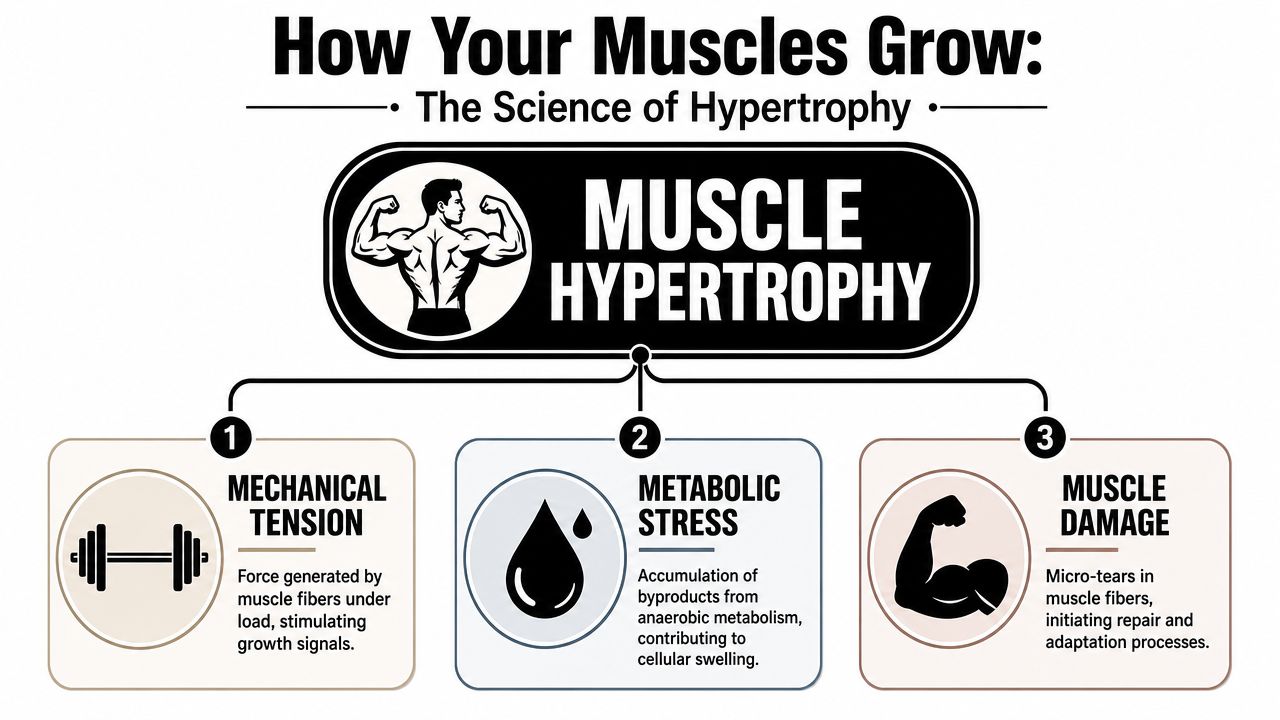
A useful way to think about hypertrophy is through three overlapping mechanisms. None acts in total isolation, and all can appear in the same session. The difference is emphasis.
Mechanical tension is the core signal
Mechanical tension is the force your muscle fibres produce while resisting load. Think of a rope pulled tight. The harder the fibres have to work, especially as a set becomes demanding, the stronger the growth signal tends to be.
This is why a wide range of repetition schemes can work. Science for Sport's coaching summary notes that while the traditional target is 8 to 12 repetitions, emerging research supports hypertrophy across roughly 5 to 30 repetitions if sets are taken close to failure. The mechanism that ties those options together is effort under load.
That also explains why light weights lifted casually don't do much for muscle gain. Light weights lifted hard are different. Once a set gets close enough to failure, the body is forced to recruit more motor units to keep the movement going. That recruitment is one reason challenging sets can produce growth whether they happen at the lower or higher end of the rep continuum.
A short visual explanation helps here:
Metabolic stress and muscle damage still matter
If mechanical tension is the main anchor, metabolic stress is the dense, burning sensation that builds as a set drags on. You feel it most clearly in moderate and high-rep work. Metabolites accumulate, the muscle swells, and the set becomes locally miserable. That environment appears to contribute to hypertrophy, even if it isn't the only pathway.
Muscle damage is the third mechanism people often exaggerate. Hard training can create micro-damage that the body repairs. But soreness is not the goal, and it's a poor proxy for progress. Lifters who chase damage often sabotage performance in the sessions that matter most.
Hard training should create a growth signal, not a recovery crisis.
That's why a smart programme uses these mechanisms without letting any one of them dominate. Heavy sets can emphasise tension. Longer sets can increase metabolic stress. Novel exercises may create more damage than you need. The best setup is usually the one that gives you enough stimulus to grow while preserving the quality of your next session.
The Rep Range Spectrum: Strength, Power, and Pump
Rep ranges work better as a spectrum than as separate camps. Low, moderate, and high reps all have a place. The mistake is assuming one must replace the others.
Why moderate reps became the default
A widely cited synthesis from Stronger by Science describes the classic hypertrophy range as 6 to 15 reps per set with loads around 60 to 85% of 1RM. It also notes that muscle growth can still occur from about 30% to around 85% of 1RM, and that the practical advantage of the 6 to 15 zone is probably only around 10 to 15% at most when time and effort are considered.
That last point is the nuance many lifters miss. Moderate reps are not magical. They're efficient.
You get enough load to create meaningful tension, enough time under tension to make the target muscle work, and usually less technical breakdown than very heavy lifting. For many exercises, that's a strong balance. But balance is different from superiority in every context.
If you're an athlete, you may still need lower-rep work to maintain strength qualities. If you're trying to spare your joints on lateral raises or leg extensions, higher reps may feel better and target the muscle more cleanly. If you're short on time, some ranges are easier to execute with focus.
For readers who also care about performance transfer, this athlete strength training guide is a useful companion because it frames loading choices around sport demands rather than bodybuilding habits alone.
A broad training structure can also include compound patterns done across the week. This full body compound exercise routine is a practical example of how movement selection can support that.
Rep Range Comparison for Hypertrophy
| Rep Range | Primary Stimulus | Pros | Cons |
|---|---|---|---|
| Low reps | High force production and mechanical tension | Efficient for building strength alongside size, often useful on compound lifts | Greater technical demand, heavier joint loading for some lifters, less margin for sloppy form |
| Moderate reps | Strong blend of tension and metabolic stress | Time-efficient, familiar, usually easy to standardise and progress | Can become the default even when another range fits the exercise better |
| High reps | Metabolic stress with lighter loads and hard local fatigue | Useful when joints dislike heavier loading, often suits isolation work well | Sets can become uncomfortable, cardiovascular fatigue can limit the target muscle |
The best rep range for hypertrophy is often the one that lets you train the target muscle hard, recover, and repeat the work next week with quality intact.
A mature programme doesn't pick a side. It assigns the right rep range to the right task.
Building Your Hypertrophy Programme: Beyond Reps
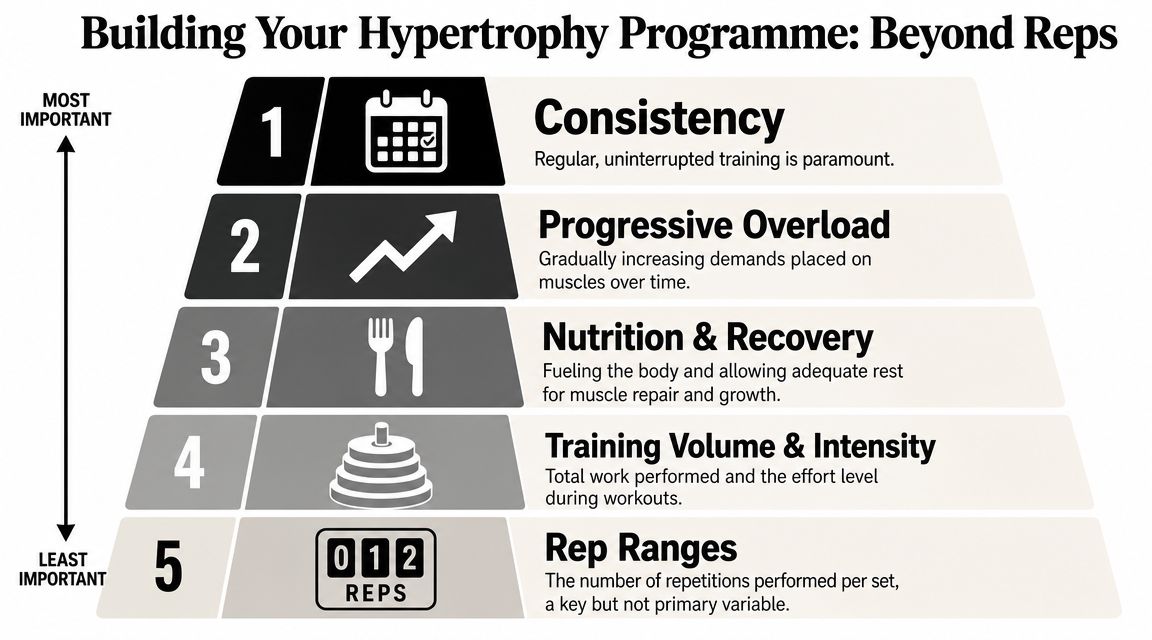
Rep ranges matter less than many lifters want them to. A hypertrophy plan succeeds or fails on whether it produces enough high-quality tension, enough hard work across the week, and a progression pattern you can sustain long enough to measure a result.
What to prioritise first
Brad Schoenfeld's review in the Journal of Strength and Conditioning Research argues that muscle growth is shaped by several interacting variables, especially mechanical tension, metabolic stress, and muscle damage. That matters for programming because reps are only one way to influence those mechanisms. If load, effort, exercise selection, and weekly workload are poorly matched, the rep target on its own does very little.
Here is the practical order to use.
-
Consistency
Muscle is built by repeated exposure to training, not by isolated perfect sessions. A plan you can complete for months beats an aggressive setup you abandon after two weeks. -
Progression
The muscle needs a reason to adapt. That can come from more load, more reps at the same load, more total hard sets, or better execution. For a practical framework, this guide to understanding progressive overload explains how to progress without turning every session into a max-effort test. -
Weekly hard volume
Hypertrophy responds to enough challenging work accumulated over time. Looking at the week also solves a common mistake. Lifters often judge a programme by how one session feels instead of whether the target muscle received enough productive sets across several exposures. -
Proximity to failure
Sets need to be hard enough to recruit high-threshold motor units, especially when loads are lighter. In practice, that usually means finishing most working sets with little room left, while still keeping technique consistent. -
Rep range and rest intervals
These are tuning variables. They influence fatigue, exercise suitability, and how much quality work you can repeat. They do not compensate for low effort, poor exercise fit, or random progression.
A strong programme treats rep targets as part of a system. That is why well-designed personalised training plans for muscle growth and recovery usually start with adherence, recovery capacity, and exercise tolerance before they fine-tune rep prescriptions.
A practical weekly structure
Good programming assigns different jobs to different exercises. Heavy compound lifts often carry a high tension role. Machine and cable work often let you accumulate more stable, lower-skill volume. Isolation work is often the cleanest place to push close to failure without large systemic fatigue.
That means your week should be organised by stimulus quality, not by forcing every movement into the same rep box.
- Compound lifts usually work well when the load is heavy enough to create high tension without letting technique break down early.
- Machine-based exercises are useful for accumulating repeatable hard sets because balance and coordination are less limiting.
- Isolation exercises often fit moderate to higher reps because the target muscle can be trained hard with less joint stress and less whole-body fatigue.
The useful question is not, “What rep range is best?” It is, “Which setup lets this muscle do the most productive work, recover, and improve next week?”
Programming checkpoint: If performance trends down, joints become irritated, and fatigue stays high, change the programme variables that drive recoverability first. Rep range is rarely the main problem.
This is also where theory has to meet measurement. If two rep strategies both look sensible on paper, the one that deserves to stay is the one that produces better changes in your lean mass over time. Clinical tools such as DEXA scans make that evaluation far more objective than gym feel or pump alone.
How to Adapt Rep Ranges for Your Body and Goals
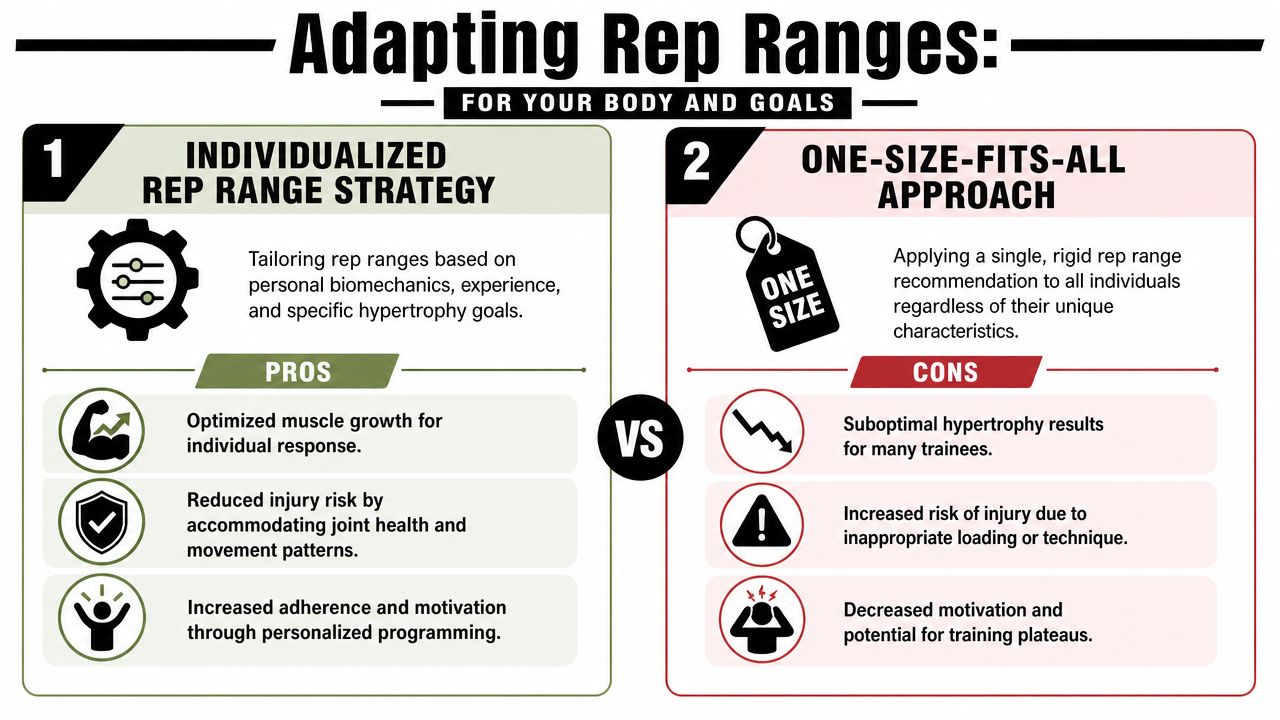
The right rep range for hypertrophy changes when the exercise changes, and it changes again when the person changes. That's why generic templates work brilliantly for some people and badly for others.
Choose reps by exercise type
A practical coaching rule from pro-hypertrophy sources is simple: heavier low-rep work often suits compound lifts, while moderate to higher reps often suit isolation work, because technical failure, joint loading, and target-muscle fatigue differ by movement pattern, as discussed in this rep range guide from Dabbs Fitness.
That logic holds up in the gym.
A squat, Romanian deadlift, or bench press asks for coordination, bracing, and control across several joints. If form degrades badly, the set stops being useful before the target muscles are fully challenged. Lower or moderate reps can help you keep output high without turning the set into a technical grind.
A lateral raise, leg curl, cable fly, or biceps curl behaves differently. These movements are easier to push near local muscular fatigue without large systemic cost. In those cases, moderate or higher reps often make more sense.
A personalised approach works best when your whole programme reflects your needs, not just your exercise list. That's the value of personalised training plans built around recovery, schedule, and movement tolerance.
Adjust for age recovery and training background
Age and life stage change the cost of training decisions. Not the possibility of growth, but the price you pay to get it.
For many adults over 40, the key question isn't “Can I build muscle with heavier sets?” It's “Can I do that consistently without provoking joint irritation or creating so much fatigue that the rest of my week suffers?” A younger athlete with deep recovery reserves may tolerate more aggressive loading. A time-poor executive, a runner balancing strength with endurance, and a woman in perimenopause may need a more selective approach.
Use these decision rules:
- If technique is the limiting factor, lower the reps only if you can preserve form. Otherwise, use a more stable exercise.
- If joints dislike heavy loading, move some work into higher reps where the target muscle still works hard but the external load is lower.
- If recovery is tight, reduce the number of brutally hard sets before changing every exercise in the plan.
- If you're a beginner, choose ranges that let you learn the movement while feeling the target muscle. Precision beats bravado.
One-size-fits-all programming fails because it ignores trade-offs. The best rep strategy often isn't the one that creates the hardest set. It's the one that lets you accumulate the most productive training over months.
Stop Guessing: Measure Your Progress with Objective Data
Training theory matters. Outcome data matters more.
You can run a thoughtful programme, choose sensible rep ranges, train close enough to failure, and still misread what's happening. A stronger lift doesn't always mean more muscle in the area you're trying to build. A good pump definitely doesn't. Even scale weight can move in the wrong direction for the wrong reason.

Why performance alone can mislead you
A lifter can add reps to a movement because skill improved. Another can gain body weight with little change in lean mass. Someone else can feel flatter and assume they've lost muscle when they've only reduced glycogen or changed hydration.
That's why the final step in an evidence-based hypertrophy process is objective measurement. If your real goal is more lean tissue, then the question becomes very concrete: is your lean mass increasing where you intend it to increase?
A DEXA scan is valuable here because it measures body composition directly and can show regional lean mass rather than forcing you to infer muscle gain from gym performance alone. That changes the conversation from “this rep range feels good” to “this programming approach is producing measurable change”.
What objective measurement changes
Objective data sharpens your decisions in three ways.
-
It validates the programme
If lean mass is rising in the expected regions, you know your combination of exercise selection, rep strategy, and weekly volume is working. -
It reveals mismatches early
If strength is improving but lean mass is not, you may be practising lifts well without providing enough hypertrophy-focused stimulus. -
It improves nutrition decisions
Resting Metabolic Rate testing helps align energy intake with the goal of gaining muscle without unnecessary fat gain.
For anyone serious about evidence-based progress, this broader guide to fitness progress tracking is useful because it frames body composition, performance, and recovery as parts of the same system.
The deeper lesson is simple. Rep ranges are inputs. Lean mass change is the outcome. Good coaching pays attention to both, but it judges success by the outcome.
Your Blueprint for Smarter Muscle Growth
The useful question is not which rep range is best in theory. The useful question is which rep range, or mix of ranges, adds lean mass on your body over time.
That changes the blueprint.
Start with effort. A set has to be hard enough to recruit and fatigue the fibres that can grow. Then choose rep ranges based on the job of the exercise and your ability to recover from it. Lower reps often fit compound lifts that are limited by technique and loading. Moderate reps are usually the most time-efficient middle ground. Higher reps can be productive for isolation work, for accumulating volume with less joint stress, and for training muscles that respond well to long tension and metabolic fatigue.
Then build the rest of the system around outcomes you can repeat. Weekly volume, exercise selection, load progression, sleep, food intake, and fatigue management will shape hypertrophy more than loyalty to one number on the rep chart.
Use this as a decision rule:
- Make each set challenging enough to stimulate growth. Reps only matter if the set is close enough to a meaningful effort threshold.
- Assign rep ranges to exercises strategically. Compounds, isolations, and joint-sensitive movements often perform best under different loading conditions.
- Judge the programme by repeatable progress. Better performance matters, but hypertrophy programmes should also produce visible and measurable increases in lean tissue.
- Adjust to your constraints. Age, injury history, sport demands, schedule, and recovery capacity all change the most productive rep distribution.
- Test your assumptions with objective measurement. A DEXA scan can show whether your current mix of low, moderate, and high-rep training is increasing lean mass in the places you want it to.
Recovery still sets the ceiling. If soreness, sleep debt, or accumulated fatigue keeps performance unstable, review practical methods for effective recovery for athletes, because even well-designed rep prescriptions fail when adaptation never catches up with training stress.
The deeper point is simple. Rep ranges are tools. Muscle gain is the target. The best programme is the one that turns sound training theory into a measurable increase in lean mass, then uses that feedback to refine the next block.
If you want to replace guesswork with clinical-grade feedback, Telomyx provides mobile advanced body analytics across the UK, including full-body DEXA scans and Resting Metabolic Rate testing. That lets you assess whether your training is increasing lean mass, where those changes are happening, and whether your nutrition supports muscle gain without drifting off target.
The content in this article is for educational purposes only and does not constitute medical or dietary advice. If you have an underlying health condition, are taking medication, or are considering significant changes to your diet or exercise regimen, consult a qualified healthcare professional before making any adjustments.