
How to Get Big Pecs: A Science-Based Plan
15 August 2026Updated 19 August 2026
Most advice on how to get big pecs starts with the bench press. Add weight, chase a personal best, swap the barbell for dumbbells when progress slows, then repeat. That approach can improve your pressing strength, but it doesn't guarantee a thicker, fuller chest.
Pectoral growth depends on training, nutrition and recovery. You need enough challenging weekly work, spread across sessions you can recover from, with technique that keeps the pecs contributing instead of allowing the shoulders and triceps to take over. Chest measurements, standardised photographs and training performance are more specific to pec progress than whole-body weight or regional body-composition data.
The practical question isn't “Which chest exercise is best?” It's “What dose can I perform consistently, progress safely, and recover from while my body has the energy to add muscle?”
Table of Contents
- Why Pressing Harder Won't Build the Pecs You Want
- Pec Anatomy and How It Actually Grows
- Best Exercises for Chest Size and How to Pick Them
- Weekly Dose, Frequency, and Progression Rules
- Eating for Chest Growth Without Wasting Fat Gain
- Recovery, Sleep, and the Hidden Reasons Pecs Stall
- Sample 8 to 12 Week Chest Programmes and Modifications
Why Pressing Harder Won't Build the Pecs You Want
A heavier bench press measures how effectively you can move a load through a particular movement. It also reflects your triceps, anterior deltoids, technique, arch, bar path, body mass, and familiarity with the lift. It doesn't function as a direct measurement of pec size.
A lifter can add weight while the chest changes very little, especially when the additional load comes from improved coordination or greater contribution from the shoulders and triceps. The reverse can happen too. Your bench can stall during a stressful period while your pectorals continue to grow from well-executed, sufficiently hard sets.
The real hypertrophy variables
The UK Chief Medical Officers' physical activity guidance recommends muscle-strengthening activity on at least two days per week. This is a public-health minimum, not a chest-specific hypertrophy prescription. A separate private UK practitioner summary describes the commonly used range of around 60–80% of 1RM and 8–12 repetitions per set, but muscle growth can occur across a broader loading range when effort and volume are appropriate.
For chest growth, prioritise four variables:
- Weekly hard sets: Enough challenging work to stimulate growth, without treating every session as a test of tolerance.
- Frequency: More than one exposure can make the required work easier to distribute.
- Effort: Sets need to finish close enough to fatigue that the pecs have a reason to adapt.
- Recovery context: Sleep, food, shoulder health, and total upper-body workload determine whether those sets produce progress.
Practical rule: Treat the bench press as one tool for building your chest, not as the scoreboard for your chest.
Pressing strength still matters. Stronger pressing can help you use more resistance over time, but a stronger lift only helps hypertrophy when the target muscle continues to receive meaningful tension. If your shoulders hurt, your elbows flare, or every set becomes a slow grind with poor control, adding load may move you further away from the result you want.
The contrarian answer to how to get big pecs is simple: solve the dose problem before the exercise-selection problem, and solve the exercise-selection problem before obsessing over load.
Pec Anatomy and How It Actually Grows
The pectoralis major is a broad, fan-shaped muscle, not one uniform slab. Its clavicular fibres contribute to the upper chest, while the sternal and abdominal portions add more to the central and lower sweep. You cannot isolate these regions completely, but changing the resistance direction and upper-arm path can shift which fibres contribute most.
A flat press can provide broad chest loading, while a moderate incline may shift emphasis towards the clavicular portion. In a small surface-EMG study of 30 trained adults, upper-pec activity was highest at 30°, middle and lower-pec activity was higher at 0°, and inclines above 45° increased anterior-deltoid activity while reducing pec performance. A Men's Health summary discusses the practical exercise choice. EMG measures acute electrical activity, however, and does not by itself prove which angle produces the most long-term hypertrophy.
Match anatomy to movement
The pecs bring the upper arm across the body, rather than pushing a bar away. Presses train that function with heavier resistance. Flyes train the same broad action with less triceps assistance, but demand more control in the lengthened position.
Scapular control affects both stimulus and comfort. On a bench, set the shoulder blades firmly, control the ribcage, and let the elbows follow a strong path instead of forcing an exaggerated flare. During cable flyes, move the upper arms through a comfortable arc and bring the hands together without turning the finish into a shoulder roll.
Fibre orientation, joint angle, and controllable tension shape the visual result. A lagging upper chest may respond to a low or moderate incline. If the whole chest lacks thickness, use flat pressing as a foundation and add a flye pattern for controlled shortening.
Loading does not need to stay in one narrow bracket. Similar hypertrophy can occur across a broad range of loads at roughly 30% 1RM and above, provided effort and weekly hard-set volume are appropriate. A practical guide to the rep range for hypertrophy explains how different repetition targets fit this approach.
A Telomyx DEXA body-composition scan can show total and regional trends in fat mass and lean soft tissue, which may help distinguish general body-composition change from altered definition. It cannot isolate pectoralis size, and lean soft tissue is not identical to skeletal-muscle mass, so use chest-specific measurements and performance alongside it.
Posture can also change chest appearance and pressing comfort. For alignment assessment rather than another exercise swap, this resource on computer vision for spinal alignment provides relevant context.
Best Exercises for Chest Size and How to Pick Them
The best chest exercise is not automatically the heaviest press. Choose movements that let you load the pecs, repeat the same technique, and progress without shoulder irritation. A practical menu usually combines a flat press, a moderate-incline press, and a shortened-position exercise such as a cable flye or pec-deck.
Build the menu around your goal
Flat barbell bench press builds pressing strength and provides efficient chest loading. Use a controlled descent, a stable upper back, and a touch point that keeps the bar moving smoothly. Treat it as one tool, not the entire programme, particularly if the deltoids and triceps take over.
Incline dumbbell pressing suits lifters who need more upper-chest work or want to address left-to-right differences. Keep the bench at a moderate angle. A steep setup shifts more demand towards the shoulders. Dumbbells also allow a wrist and elbow position that may feel better than a fixed bar path.
Flat or low-incline dumbbell pressing gives you another way to train the pecs when barbell pressing irritates a joint. The independent loads can accommodate individual range of motion and arm position. Use the deepest comfortable stretch, rather than forcing depth through a pinching sensation at the front of the shoulder.
Cable flyes and machine flyes make chest-specific work easier to control after pressing. They reduce the balance demands of free weights and can keep tension on the pecs when fatigue makes heavy pressing technique less consistent.
Dips can train the lower chest and triceps, but results depend on shoulder comfort, torso angle, and usable range. Stop before pain, especially at the bottom. Push-ups work well as a finisher when the set approaches fatigue. Raise the feet or add resistance when standard repetitions no longer challenge the pecs.
Choose substitutes without losing the pattern
At home, use weighted push-ups, resistance-band presses, dumbbell presses, or band flyes. In a commercial gym, pair a barbell or machine press with cables. In a machines-only facility, combine a converging chest press with a pec-deck, adjusting the seat so the handles line up with mid-chest.
The exercise matters less than repeatable pec tension and a progression you can track. A chest-biased full-body compound exercise routine is a practical option when your schedule does not support a dedicated bodybuilding split.
A Telomyx RMR test estimates resting energy expenditure through indirect calorimetry. It can replace a formula estimate for the resting component of nutrition planning, but it does not measure total daily expenditure or determine the surplus required for muscle gain.
A technical demonstration can help refine pressing setup and execution:
Weekly Dose, Frequency, and Progression Rules
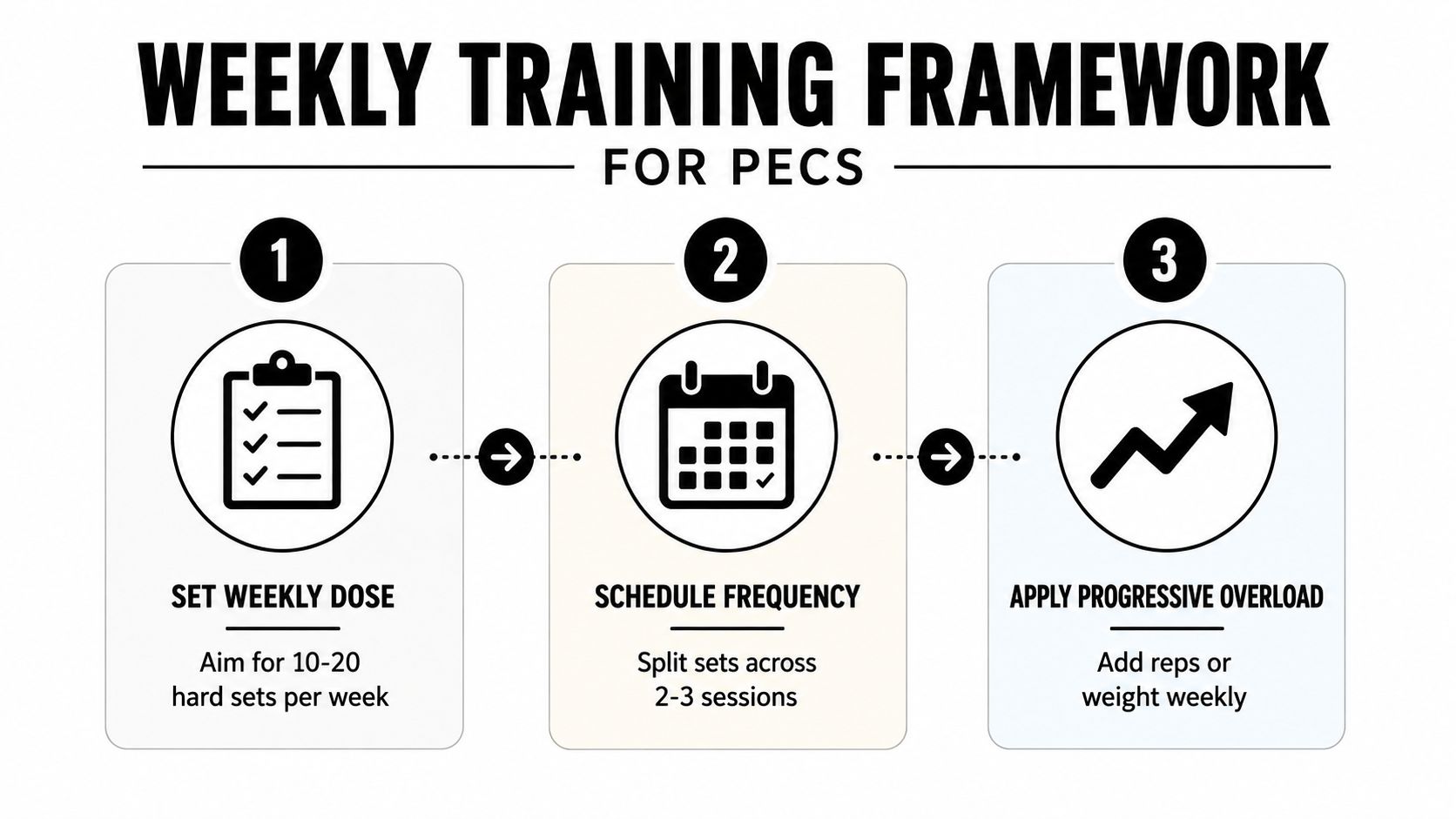
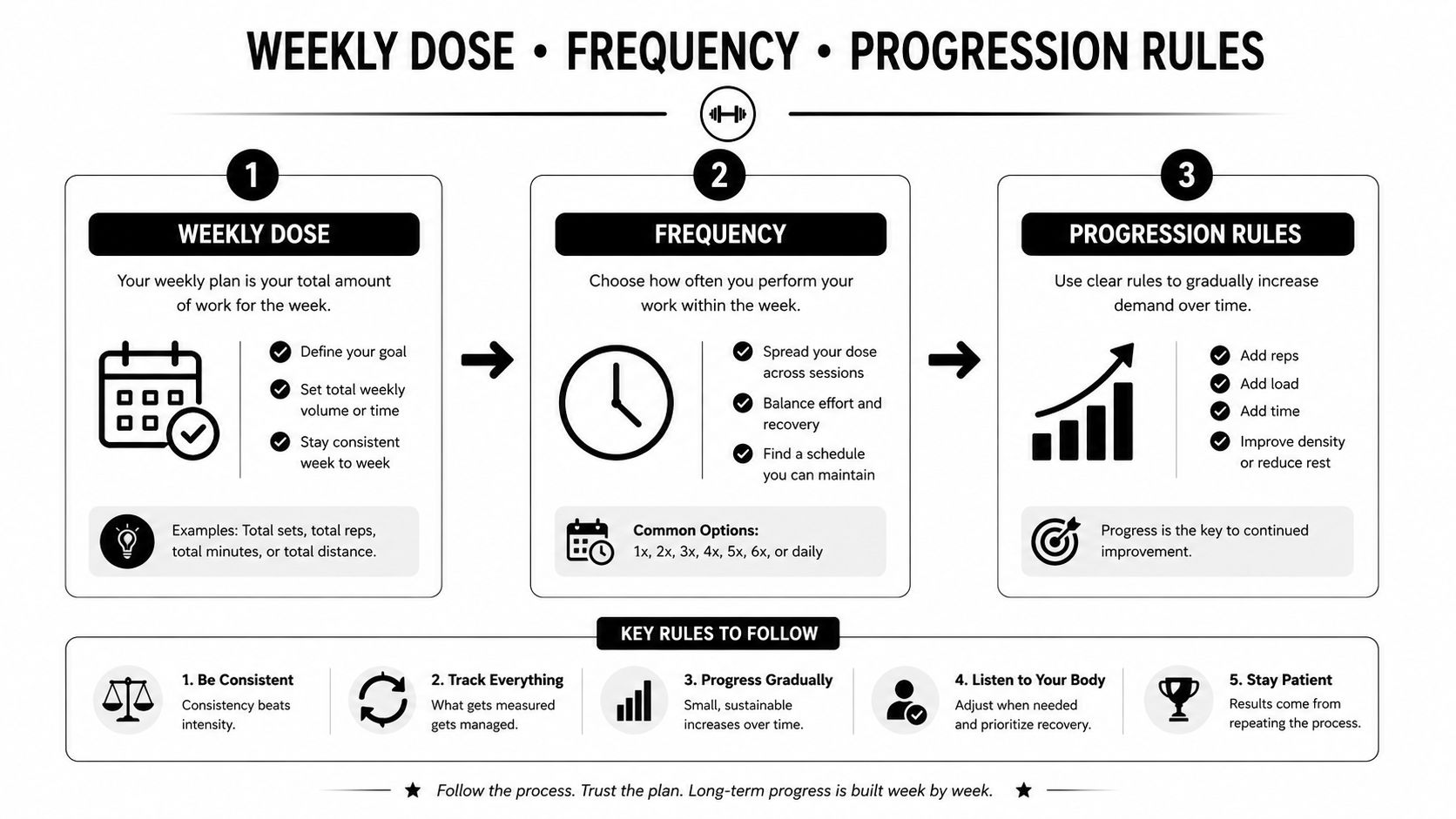
Chest growth is often limited by poorly managed weekly work, not a shortage of pressing variations. The 2026 American College of Sports Medicine guidance suggests around 10 weekly sets per muscle group as a useful hypertrophy target for healthy adults, with evidence of a dose-response. Individual response and recovery vary, and some newer or detrained lifters can progress with less. Frequency is mainly a way to distribute tolerable weekly work when volume is matched.
Begin near the lower-middle of that range if you are new, returning after time away, or already performing substantial shoulder and triceps pressing. Experienced lifters may benefit from additional sets, but only while repetitions, loads, joint comfort, and recovery remain stable. More work is not automatically better work.
Set the weekly structure
Use at least two chest exposures when splitting the work improves performance and consistency. Two, three, or four sessions can work. Avoid placing every set in one long workout, where fatigue turns later exercises into low-quality repetitions.
A practical starting structure is:
- Flat press: 3 sets in a moderate repetition range.
- Incline press: 3 sets with dumbbells or a machine.
- Flye pattern: 2 sets with deliberate control.
- Optional second exposure: Repeat a press and flye combination later in the week.
This arrangement moves you toward the evidence-supported weekly dose without assuming that your recovery matches that of a high-volume specialist. Count pressing from other training days as part of the chest workload rather than adding it unnoticed.
Progress without turning every set into a test
Choose repetitions that let you control the lowering phase, keep the shoulder position consistent and finish with useful effort. The private practitioner summary retained above uses 8–12 repetitions and loads around 60–80% of 1RM as a practical range. This is not the only effective range: longer sets can also stimulate growth when performed with sufficient effort, although they may become uncomfortable and technically inconsistent on compound presses.
Use double progression:
- Choose a repetition range.
- Keep the load until every prescribed set reaches the top of that range with sound technique.
- Increase the load modestly.
- Return to the lower end and build again.
Keep most sets around one to three repetitions in reserve. An occasional final isolation set can approach failure if your joints tolerate it. Grinding every bench set to failure usually reduces the quality of the work that follows.
Rest long enough to reproduce strong repetitions. In one 10-week bench-press study, participants used 3–4 sets of 12 repetitions at 50–55% 1RM, three times weekly, with three-minute rests; the pectoralis major increased more than the triceps brachii and pectoralis minor (bench-press hypertrophy study). Because the study did not compare rest intervals, it cannot show that three minutes caused the result. Choose enough rest to preserve technique and intended effort.
Progression principle: Add repetitions first when possible, load second, and sets only when the current dose no longer produces useful progress.
Eating for Chest Growth Without Wasting Fat Gain
Your chest can't grow from training alone. Resistance exercise provides the stimulus, but building new tissue requires sufficient energy, protein, and recovery. A large calorie surplus may raise body weight quickly, yet it can also add fat faster than you can turn the extra energy into muscle, making the chest look less defined.
Start by estimating maintenance intake as accurately as practical. A measured resting baseline can replace one formula input, while daily activity and training still need to be estimated. The TDEE guide explains why total daily energy expenditure differs between people and why a generic calculator should be treated as a starting estimate.
Use a controlled muscle-gain approach
Choose a modest surplus rather than an aggressive bulk. Because the brief provides no verified calorie surplus or protein figure, the responsible approach is to use your measured intake, training performance, body-composition trend, and appetite as feedback rather than pretending one universal number suits everyone.
Protein should appear consistently across the day. Build meals around foods such as eggs, Greek yoghurt, poultry, fish, lean meat, tofu, tempeh, beans, lentils, and dairy. Carbohydrate-rich foods support hard training, while fats help make the diet satisfying and provide essential nutrients.
A simple day might include eggs and porridge with yoghurt at breakfast, chicken or tofu with rice and vegetables at lunch, fruit and cottage cheese as a snack, and salmon, potatoes, and salad at dinner. Adjust portions according to your measured energy needs and body-composition direction, not according to a dramatic bulking template found online.
Let body composition guide adjustments
If performance is improving and lean mass is rising without an unwanted increase in fat mass, keep the plan steady. If body fat is climbing while chest measurements and performance remain unchanged, reduce the surplus and inspect training quality. If weight and performance are both stagnant, increase food cautiously after checking sleep, exercise volume, and adherence.
Nutrition checkpoint: A bigger chest is a lean-mass project, not a race to gain scale weight.
Recovery, Sleep, and the Hidden Reasons Pecs Stall
A lifter can follow a sensible chest programme and still stop progressing because the programme sits on top of poor recovery. The problem often isn't a lack of motivation. It's accumulated pressing volume, inconsistent sleep, under-eating, or shoulder irritation that lowers the quality of every set.

A common stalled-lifter pattern
Consider a lifter whose bench has stopped moving and whose chest looks unchanged. They train chest twice weekly, but also perform heavy overhead pressing, high-volume shoulder work, close-grip benching, and demanding upper-body conditioning. Their elbows ache, their sleep is fragmented, and they add intensity whenever a session feels poor.
The solution isn't another chest exercise. Reduce overlapping pressing, keep the most productive chest movements, and allow performance to stabilise. A short deload with less volume can restore readiness, after which the lifter can rebuild with the same or slightly lower weekly dose.
Use a recovery checklist
- Sleep quality: Keep a consistent bedtime, reduce late stimulation, and treat repeated poor sleep as a programming variable.
- Total pressing load: Count chest, shoulder, triceps, and upper-body conditioning together.
- Joint feedback: Muscle fatigue is expected. Sharp or escalating shoulder and elbow pain needs attention.
- Deload timing: Reduce training stress when performance, motivation, and joint comfort all deteriorate.
- Movement quality: Include comfortable shoulder and thoracic-spine mobility, without forcing painful ranges.
Soreness isn't a reliable measure of growth. Productive training can cause little soreness, while excessive soreness can interfere with the next session. For practical food and recovery ideas that fit demanding schedules, this guide to refueling for busy fitness enthusiasts is a useful supplement to, not a replacement for, a complete eating plan.
Sample 8 to 12 Week Chest Programmes and Modifications
Run either programme for 8–12 weeks, keeping the main exercises stable long enough to judge the response. Record load, repetitions, repetitions in reserve, and shoulder symptoms. Changing movements every week creates novelty, but it makes progression and recovery harder to interpret. The useful question is whether your planned weekly chest dose is producing better performance, measurements, and body-composition data.
Programme one for an intermediate lifter
Use a four-day upper-lower split, with chest trained on both upper days. Place lower-body sessions between the upper sessions where scheduling allows.
Upper A
- Barbell bench press, 3 sets of 6–10
- Low-incline dumbbell press, 3 sets of 8–12
- Cable flye, 2 sets of 10–15
- Row variation, 3 sets of 8–12
- Triceps exercise, 2 sets of 10–15
Lower A
- Squat pattern
- Hip hinge
- Single-leg exercise
- Calf and trunk work
Upper B
- Machine or dumbbell chest press, 3 sets of 8–12
- Moderate-incline machine press, 2 sets of 10–12
- Pec-deck or cable flye, 2 sets of 12–15
- Pulldown or pull-up variation
- Rear-delt and arm work
Lower B
- Deadlift or hinge pattern
- Leg press
- Hamstring curl
- Calf and trunk work
This arrangement provides pressing and shortened-position work without making every set a test of maximal strength. The barbell bench can improve pressing performance while the machine, dumbbell, and flye work may offer a more repeatable stimulus for hypertrophy. Progress with double progression: add repetitions within the target range, then increase load while preserving technique and the intended repetitions in reserve. Reduce volume for a deload when performance and recovery decline together, rather than forcing another hard week.
Programme two for a beginner or busy trainee
Train full body three days per week, alternating the following sessions.
Session A
- Goblet squat or leg press
- Dumbbell bench press, 2 sets of 8–12
- Seated row
- Romanian deadlift
- Cable flye, 2 sets of 12–15
Session B
- Split squat
- Machine chest press, 2 sets of 8–12
- Lat pulldown
- Hip thrust
- Optional push-up finisher, 1 controlled set
Alternate A and B across the week. Keep at least a day between sessions when possible. The chest dose is modest enough to recover from while a new trainee learns stable pressing mechanics. The push-up finisher should stop before technique deteriorates. If it reduces performance in the next session, remove it rather than treating extra fatigue as proof of a better programme.
| Programme | Sessions per Week | Chest Sets per Session | Total Weekly Chest Sets | Progression Style |
|---|---|---|---|---|
| Four-day upper-lower | 2 upper sessions | 8 and 7 | 15 | Double progression |
| Three-day full body | 3 sessions | 4 and 3 | 10–11 | Repetitions, then load |
Modify the plan for real people
Older adults may respond well to machines, a slower lowering phase, and the lower end of the weekly set range at first. Use a pain-free range, stable equipment, and gradual loading instead of frequent strength tests. Anyone with a medical condition or recent surgery should obtain appropriate clinical clearance before resuming resistance training.
For menopausal women, resistance training can support muscle retention and functional capacity, although recovery and joint comfort vary considerably. Stable presses, moderate effort, and flexible scheduling often make adherence easier. Machine substitutions are a practical option when free-weight balance or shoulder positioning limits repeatable loading.
Track whether the chest is genuinely changing
Take progress photographs and measure chest circumference under the same conditions. This pro's guide to chest measurement can help standardise tape placement and posture.
Use several signals rather than relying on the scale:
- Training log: Are repetitions or loads improving with stable technique?
- Chest measurement: Is circumference changing under repeatable conditions?
- Photographs: Does fullness change at the same distance, lighting, and posture?
- Body-composition data: Is broader lean and fat mass changing as intended, while recognising that the scan cannot isolate the pecs?
- Nutrition data: Does intake support performance without unwanted fat gain?
Body-composition testing can add context about broader lean and fat-mass trends, while resting-energy measurement can improve one input to nutrition planning. Neither can confirm pec hypertrophy or replace a training log, repeatable chest measurement and standardised photographs.
Use the first phase to practise technique and establish a sustainable dose. In the middle phase, progress repetitions and load while protecting shoulder recovery. In the final phase, keep the best-performing movements, avoid last-minute exercise changes, and review the complete data set before altering food or volume.
If chest size remains unchanged, check adherence and measurement consistency first. Stop a movement that causes sharp, escalating or persistent shoulder pain and seek assessment from an appropriately qualified clinician or physiotherapist, particularly after trauma, weakness or loss of movement. If fat gain is unexpected, compare intake with the broader trend instead of cutting calories reflexively.
The content in this article is for educational purposes only and does not constitute medical or dietary advice. If you have an underlying health condition, are taking medication, are recovering from injury or surgery, or are considering significant changes to your diet or exercise regimen, consult a qualified healthcare professional before making any adjustments.
Visit Telomyx to explore objective measurements that can complement, but not replace, a well-designed training plan and qualified professional advice.