
Is VO2 Max Testing Worth It? A Data-Driven Guide
28 August 2026

The popular advice is simple: if your watch already displays a VO2 max estimate, a laboratory test is unnecessary. That advice is convenient, but it confuses continuous estimation with direct measurement. A wearable can help you follow a broad trend. It can't tell you, with laboratory gas analysis, where your ventilatory thresholds sit or whether your current training zones are appropriately set.
So, is VO2 max testing worth it? For some people, absolutely. For others, it's an expensive number that changes nothing. The answer depends less on athletic ambition than on whether you have a specific health, performance, or occupational decision to make.
Table of Contents
- Why VO2 Max Testing Is Not Just for Elite Athletes
- What VO2 Max Actually Measures and Why It Matters
- Who Genuinely Benefits From VO2 Max Testing
- Turning VO2 Max Data Into Actionable Training and Health Insights
- Costs, Limitations, and Accuracy Trade-Offs to Consider
- How and When to Get a Professional VO2 Max Assessment
- Deciding If VO2 Max Testing Is Worth It for You
Why VO2 Max Testing Is Not Just for Elite Athletes
VO2 max testing is often marketed through images of professional cyclists, endurance runners, and athletes chasing marginal gains. That framing misses the more useful question for most UK adults: how much cardiorespiratory reserve do I have, and is my training preserving it?
VO2 max reflects cardiorespiratory fitness, the integrated ability of the lungs, heart, blood vessels, and muscles to deliver and use oxygen. It's therefore relevant to someone preparing for a race, but also to a professional trying to maintain function through midlife, a firefighter meeting an operational standard, or an older adult who wants objective evidence that exercise is protecting independence.
A peer-reviewed UK Biobank analysis involving 79,981 participants found that each one-metabolic equivalent difference in estimated cardiorespiratory fitness was associated with an 8% lower risk of all-cause mortality and a 9% lower risk of cardiovascular mortality. The British Heart Foundation explains the wider relevance of VO2 max. This observational association does not prove that raising one person's score will reduce risk by the same amount, and a single test is not a diagnosis.
Practical rule: Test when the result will change what you do, not simply because the number is interesting.
The UK context matters. The same BHF source notes that over 8 million people in the UK are living with cardiovascular disease, making measurable aerobic capacity a potentially useful part of a broader health conversation. It should complement medical assessment, blood pressure, cholesterol, symptoms, and clinical history, not replace them.
Functional capacity matters more than athletic status
UK occupational standards reinforce this point. London Fire Brigade guidance uses operational standards equivalent to 42.3 ml/kg/min for firefighters and 36.8 ml/kg/min for incident commanders. These thresholds are role-specific, not general health targets. They reflect the aerobic demands of safety-sensitive work, where physical capacity can affect whether someone can perform reliably under pressure.
For a recreational exerciser, the return may be even clearer than it is for an elite athlete. An elite competitor may already understand their programme in detail and be trying to improve a narrow margin. A health-conscious adult may still be guessing whether weekly exercise is building reserve, merely maintaining it, or being undermined by fatigue and inconsistent intensity.
The case for testing is strongest when the score is interpreted against age, sex, symptoms, training history, and real-world demands. “Higher is better” is too crude. The useful question is whether your capacity supports the life and work you want to sustain.
What VO2 Max Actually Measures and Why It Matters
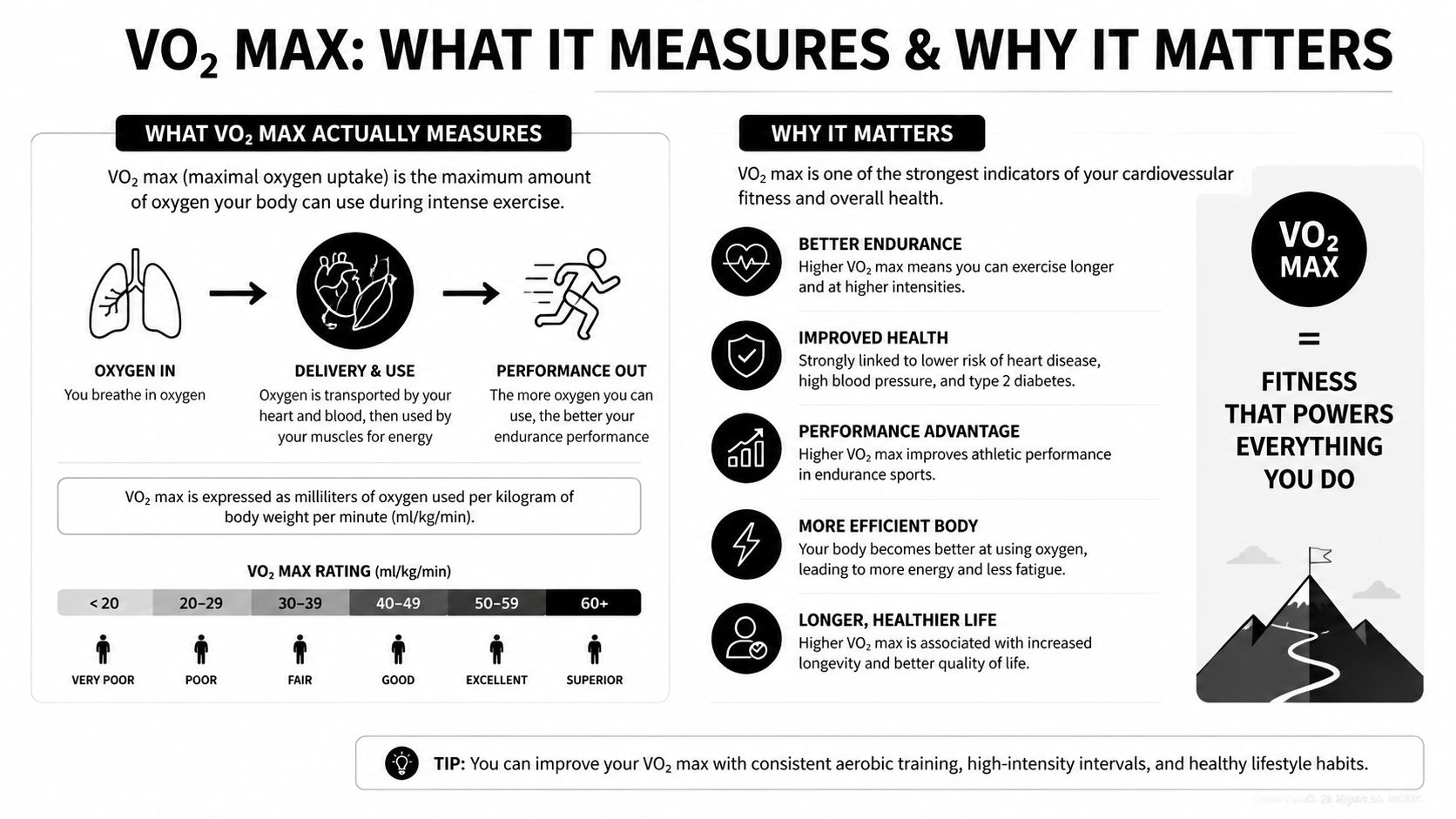
VO2 max is the maximum rate at which your body can consume oxygen during progressively harder exercise. Think of it as the maximum fuel-burning capacity of an engine. The engine analogy isn't perfect, but it helps: the test examines how much oxygen you can bring in, transport, and use when the workload keeps rising.
During a direct test, you exercise on a treadmill or cycle ergometer while breathing through a mask connected to a metabolic cart. The system analyses inhaled and exhaled gases, including oxygen and carbon dioxide, while heart rate and workload are monitored. A wearable takes a different route. Devices such as Garmin and Apple Watch infer VO2 max from heart rate and exercise data using algorithms, rather than measuring gas exchange directly.
The physiology behind the number
Your result reflects several linked systems:
- Ventilation: How effectively your lungs move air in and out.
- Cardiac output: How much blood your heart can pump to working muscles.
- Peripheral delivery: How capillaries and blood vessels deliver oxygen to tissue.
- Muscle utilisation: How efficiently mitochondria use oxygen to produce energy.
The result is commonly expressed as millilitres of oxygen per kilogram of body mass per minute, written as ml/kg/min. Relative VO2 max is useful when comparing people of different body sizes and when considering weight-bearing exercise. Absolute VO2 max, expressed as litres per minute, can be more relevant when assessing the total oxygen-processing capacity of a person independent of body mass.
A direct test can also identify ventilatory thresholds, points where breathing changes as exercise intensity rises. Those thresholds often have greater day-to-day value than the peak number. They can help translate physiology into sensible heart-rate, running-speed, or cycling-power zones.
The distinction matters for people who are training through hormonal and lifestyle changes. If you're trying to understand how moderate-to-hard aerobic work fits into a perimenopause programme, this guide to training in zone 3 for perimenopause offers useful context. The correct intensity still depends on the person and the test method, not on a generic label alone.
Measurement is not the same as interpretation
Direct graded gas analysis is the criterion laboratory method, but it is not error-free. A review of VO2 max testing notes that ±5% is commonly accepted for metabolic-system measurement error when equipment is properly calibrated. Day-to-day biological variation, preparation, protocol and effort add further uncertainty. A change of roughly 2 ml/kg/min around a result of 40 ml/kg/min should therefore be interpreted alongside thresholds, test conditions and the provider's repeatability data rather than treated automatically as a true physiological change.
VO2 max also has genetic constraints, and improvement tends to plateau. That doesn't make testing pointless. It means the test should be used to guide training and monitor meaningful change, while thresholds, recovery, sport specificity, and functional ability receive equal attention. A broader overview of cardiovascular fitness testing can help place VO2 max alongside other measures rather than treating it as a standalone verdict.
Who Genuinely Benefits From VO2 Max Testing
The people who benefit most aren't necessarily the fittest. They're the people with a clear decision attached to the result.
A competitive athlete may use testing to refine training zones, investigate a plateau, or compare the demands of running and cycling. A recreational exerciser may use it to find out whether a routine is developing aerobic capacity or just providing familiar exercise at a familiar intensity. In both cases, the test has value because it changes programming.
A properly administered 20-metre shuttle run can also be useful. In a peer-reviewed study of 48 physical-education students, shuttle performance correlated with directly measured VO2 max at r = 0.87 and with velocity at VO2 max at r = 0.93, as reported by Leeds Trinity University's study record. This was not a representative UK population study, and correlation does not make a field estimate equivalent to gas analysis. It supports field testing for consistent monitoring when laboratory precision is not required.
A practical comparison
| User profile | Primary benefit | Testing value | Key considerations |
|---|---|---|---|
| Competitive athlete | Sport-specific zones and performance diagnosis | High when training has plateaued or margins matter | Test in the mode that matches the main sport |
| Recreational exerciser | Objective baseline and feedback on programme quality | Moderate to high if results will alter training | A watch may be sufficient for broad trend tracking |
| Midlife or ageing adult | Cardiorespiratory reserve and functional benchmarking | High when preserving capability is a priority | Interpret against appropriate age and sex references |
| Safety-sensitive worker | Evidence relevant to role demands | High when occupational standards apply | Occupational requirements may use defined thresholds |
| Clinical or rehabilitation population | Structured progress monitoring | Potentially high, but only with suitable clinical oversight | Symptoms and medical history determine the right setting |
| Beginner with no specific goal | General awareness | Lower | Establish consistent exercise habits before buying precision |
| Weight-loss-focused exerciser | Context for fitness and energy management | Variable | VO2 max alone won't explain body-composition change |
| Curious data collector | A precise number | Low if behaviour stays the same | Information has little value without an action plan |
For adults concerned about ageing, testing can quantify reserve without demanding an athletic identity. The British Heart Foundation provides wider cardiovascular-health context, but a homepage is not a source for age-specific VO2 max reference values. Results should be interpreted using a validated reference set matched to age, sex, test mode and population; generic athlete benchmarks can mislead.
Body composition may also affect how you interpret a fitness result. A Dexa Body Composition Scan measures total and regional fat mass, lean muscle mass, and bone density, giving context that a VO2 max number alone cannot provide.
Turning VO2 Max Data Into Actionable Training and Health Insights
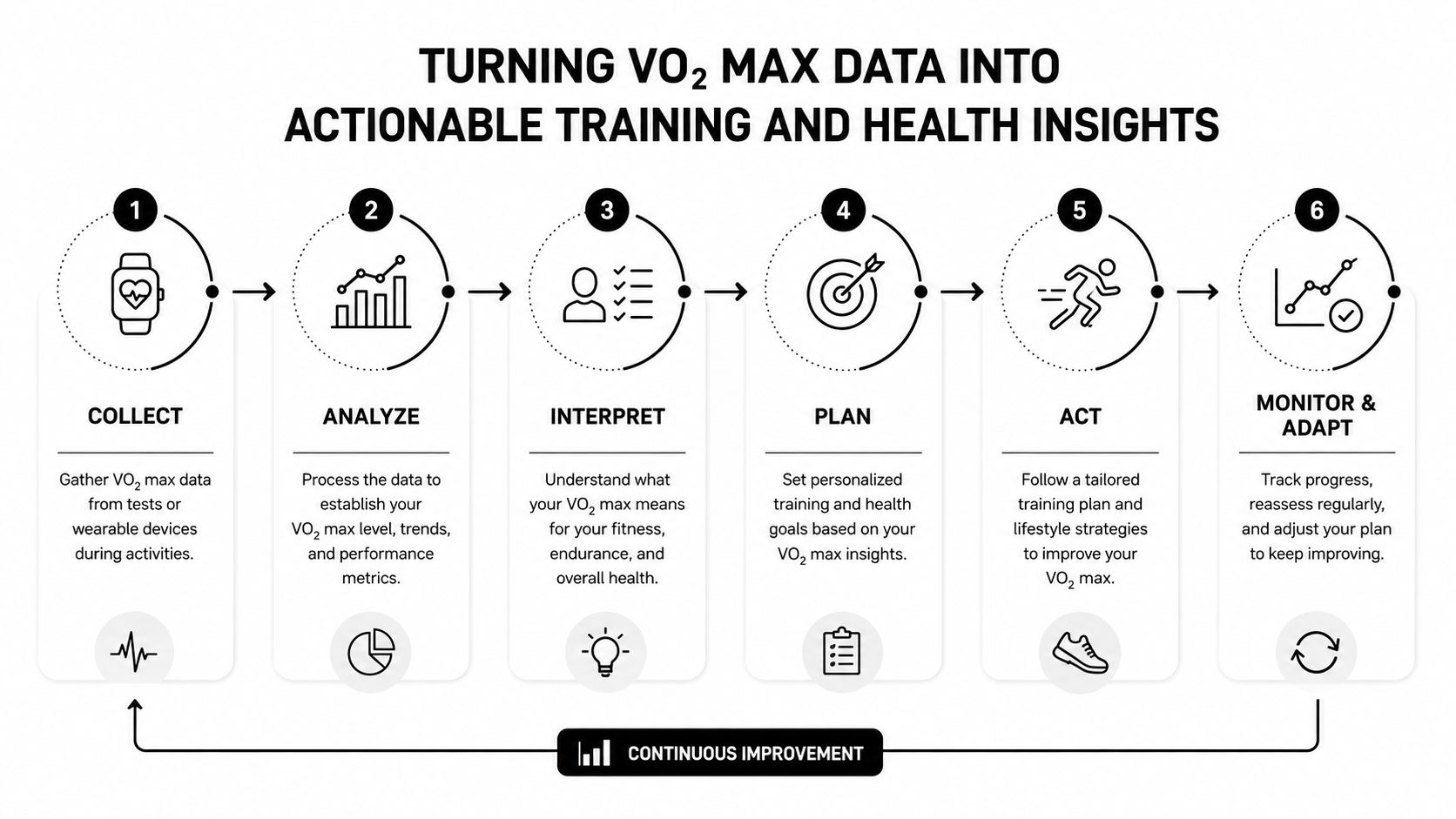
A raw VO2 max result is not a training plan. The practical value begins when the assessment identifies how your body responds as intensity increases.
The first ventilatory threshold, often called VT1, can help identify the upper boundary of easier aerobic work. VT2 marks a harder domain where breathing and fatigue rise more rapidly. A useful report should translate these findings into heart-rate and, where appropriate, running-speed or cycling-power zones. That's more individualised than assigning zones from a generic age-based maximum-heart-rate formula.
Use the result to change the week
Consider a recreational cyclist who feels fit but has stopped progressing. A useful assessment might show that most rides sit above the intended easy aerobic range, while genuinely hard work is not hard enough to create a clear stimulus. The answer wouldn't be “ride harder every day”. It might be to separate easier volume from targeted high-intensity work and allow recovery between demanding sessions.
For a longevity-focused professional, the result can establish a baseline for future comparison. A later assessment can show whether structured exercise is maintaining or improving aerobic capacity. That trend is more informative than reacting to a single watch estimate taken after a stressful week, poor sleep, or an unfamiliar route.
UK evidence also supports using estimated fitness pragmatically. In the UK Biobank validation work, estimates from an individualised submaximal cycle protocol correlated with directly measured VO2 max at r = 0.68 to 0.74, with little mean bias at group level. Individual error still existed, so the method supports population research and broad trend information rather than proving that every estimate is close enough for precise personal training zones.
Thresholds often beat the headline score
Gas-exchange testing may also provide information about how fuel use changes across exercise intensity, including the shift towards greater carbohydrate use as effort rises. That can inform how you place carbohydrate around demanding sessions and how you fuel longer training. It shouldn't be used to prescribe a rigid diet from one appointment, but it can add physiological context to nutrition decisions.
The test becomes worthwhile when you can connect each finding to an action:
- Training zones: Replace generic zones with intensities tied to your measured response.
- Programme review: Check whether the training block is producing adaptation or accumulating fatigue.
- Health planning: Put aerobic capacity alongside clinical markers and functional goals.
- Retesting: Repeat under comparable conditions so the trend means something.
- Communication: Give a coach, clinician, or exercise professional data they can interpret.
Practical guidance on how to increase VO2 max is most useful after you know which training changes are realistic for your current capacity. The measurement doesn't remove judgement. It improves the starting information.
Costs, Limitations, and Accuracy Trade-Offs to Consider
The financial question is where much of the marketing becomes vague. Prices vary by provider and by what the appointment includes. The Solent University VO2 max assessment information describes the service, while its current online store lists one visit at £90. Check the live price before booking. A higher fee may still be reasonable when it includes careful screening, calibrated gas analysis, interpretation and usable zones; it is harder to justify when you receive only a headline score.
A wearable estimate costs nothing beyond the device you already own and can provide repeated observations during ordinary training. Its weakness is that it estimates rather than directly measures oxygen consumption, and the result can be affected by the activity, terrain, heart-rate response, and quality of the underlying data. A field test can sit between the two. The 20-metre shuttle run is one example with strong UK validation, although it still isn't a substitute for a full laboratory assessment when precision is the priority.
Compare the methods honestly
| Method | Typical cost UK | Accuracy vs lab | Frequency | Best for |
|---|---|---|---|---|
| Direct graded gas-analysis test | Provider-dependent; Solent currently lists £90 for one visit | Gold-standard method, with commonly accepted error of about ±5% | Occasional baseline and progress checks | Precise zones, clinical or occupational decisions, performance diagnosis |
| Wearable estimate | No separate test fee when a compatible device is already owned | Algorithmic estimate, useful for broad trends | Frequent or continuous | Convenience and day-to-day monitoring |
| 20-metre shuttle run | Usually accessible without laboratory equipment | Strong correlation with direct VO2 max in UK validation | Repeatable field monitoring | Schools, teams, workplaces, cost-sensitive settings |
| Other self-administered field tests | No specialist laboratory fee | Prediction rather than direct measurement | Periodic monitoring | Basic progress checks when standardised carefully |
The table shows why there isn't one universally correct choice. Direct testing has better measurement precision, but a single appointment can't describe every training day. Wearables have lower friction, but they can't provide the same gas-exchange detail. Field tests can be actionable when administered consistently, yet pacing, motivation, surface, and protocol all influence the outcome.
The limitations are physiological as well as financial
A VO2 max score is influenced by body mass, exercise mode, fatigue, illness, sleep, and willingness to continue through discomfort. It also has a ceiling. Some people will make meaningful health and performance gains without seeing dramatic movement in the peak value, particularly when their thresholds, economy, strength, or consistency improve instead.
The mask can feel awkward, and maximal testing is demanding. Do not undertake a maximal test if you have a recent myocardial infarction or acute coronary syndrome, unstable angina, an uncontrolled significant arrhythmia, severe symptomatic aortic stenosis, decompensated heart failure, an acute pulmonary embolism or another acute serious illness. Anyone with chest pain, unexplained fainting or breathlessness, a cardiac history, known cardiovascular disease or uncertainty about their suitability should obtain GP or cardiologist clearance and use an appropriately supervised clinical setting. For people who need a less maximal assessment or want a practical baseline, a respiratory fitness test may be a more suitable starting point, depending on the provider's protocol.
How and When to Get a Professional VO2 Max Assessment
Book a professional assessment when you can act on the findings. That usually means you're beginning a structured programme, trying to resolve a performance plateau, reviewing your aerobic fitness during midlife, or needing a benchmark for a physically demanding role.
A sensible approach is to establish a baseline, train consistently, then retest after a meaningful training block. An interval of roughly three to six months is often practical for someone making structured changes, but it is not a universal clinical rule; the goal, expected adaptation, training load, health status, measurement error and provider advice should determine timing. Monthly testing is rarely necessary for a non-elite adult.
Prepare for a valid result
Follow the testing centre's instructions first. In general, arrive rested, hydrated, and ready to exercise. Avoid an intense session beforehand, and don't turn the appointment into a test of how well you can tolerate poor preparation.
Expect the following process:
- Screening and setup: You'll complete health questions, discuss the protocol, and be fitted with monitoring equipment.
- Warm-up: You'll walk or pedal at a manageable intensity while the technician checks the equipment and your response.
- Graded exercise: Speed, incline, or resistance increases progressively until you reach your limit or the protocol ends.
- Gas collection: The mask measures breath-by-breath oxygen and carbon dioxide exchange.
- Recovery: The team monitors you as the workload falls.
- Interpretation: The provider should explain the result rather than leaving you with a number to decode alone.
A useful report should include absolute and relative VO2 max, ventilatory thresholds, heart-rate response, the test modality, and zones mapped to your training. Ask how the provider confirms that the test reached a valid maximal effort and whether the protocol suits your main sport.
Credentials matter, particularly if you're testing because of symptoms, a clinical concern, or an occupational requirement. Look for an appropriately qualified practitioner, transparent protocols, calibrated equipment, sensible screening, and a results consultation. The cheapest appointment isn't good value if the data can't guide a decision.
For UK-based clients comparing providers, a VO2 Max Test uses graded exercise with metabolic gas analysis to assess maximum oxygen use, aerobic capacity, fitness age, and training zones. Telomyx states that its testing follows NHS and elite sports science protocols and is available through mobile clinics across the North West.
Deciding If VO2 Max Testing Is Worth It for You
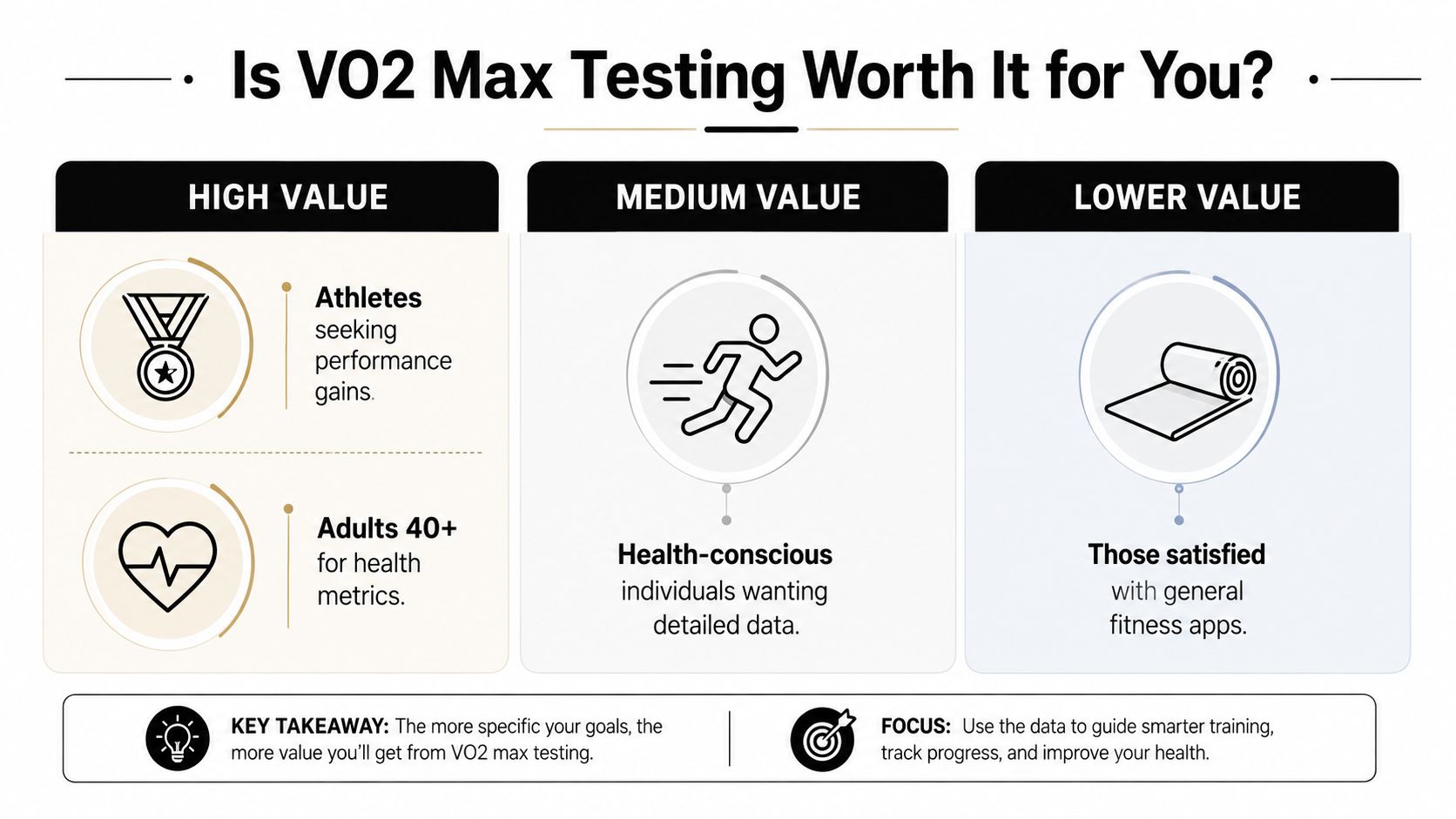
VO2 max testing is a high-value purchase when it answers a question you can't answer reliably from ordinary training data.
You're more likely to benefit if you're:
- Pursuing a defined performance goal: You need sport-specific zones or an explanation for stalled progress.
- Prioritising healthy ageing: You want an objective measure of aerobic reserve and a benchmark for preserving function.
- Managing a relevant health concern: Testing is part of an appropriate clinical or rehabilitation plan.
- Meeting occupational demands: Your role has a meaningful physical standard.
- Prepared to change your programme: You'll use the findings to alter intensity, recovery, or training structure.
It's lower priority if you're new to exercise, satisfied with broad wearable trends, focused solely on body weight, or unlikely to change your behaviour after receiving the result. In those situations, consistent training and basic monitoring may offer more value than precision testing.
Ask yourself three questions:
- Do I have a specific performance, health, or functional goal?
- Will I adjust my training or seek appropriate follow-up based on the findings?
- Can I access a reputable provider with direct gas analysis and proper interpretation?
If you answer yes to two or more, testing may be a sound investment in physiological intelligence. If not, start with consistent exercise and a repeatable field or wearable measure, then reconsider when a clearer decision emerges.
The number isn't the product. The useful outcome is a better plan, a more honest baseline, and evidence that your actions are moving you towards the capacity you want to keep.
The content in this article is for educational purposes only and does not constitute medical or dietary advice. If you have an underlying health condition, are taking medication, or are considering significant changes to your diet or exercise regimen, consult a qualified healthcare professional before making any adjustments.
Telomyx provides mobile VO2 max testing across the North West, using graded exercise and metabolic gas analysis to produce an objective aerobic-capacity benchmark and personalised training zones. Visit Telomyx to explore whether a professionally interpreted assessment fits your health, longevity, or performance goals.