
Obstacle Course Training Guide for Real Strength Gains
24 August 2026Updated 25 August 2026
Obstacle course racing combines running with climbing, carrying, crawling, jumping and negotiating uneven terrain. Good preparation develops aerobic fitness, whole-body strength, grip endurance and obstacle skill gradually. It should also account for falls, impact, heat, cold and water exposure rather than treating every session as a test of toughness.
Table of Contents
- Understanding the Demands
- What the Injury Evidence Shows
- Build the Five Key Capacities
- An 8–12 Week Framework
- Fuelling and Recovery
- Race-Day Safety and Tactics
Understanding the Demands
OCR is not simply road running with obstacles inserted. The athlete must repeatedly change pace, produce force and make technical decisions while fatigued. Course length, terrain, obstacle design, penalties and environmental exposure vary greatly between events.
A 2017 BBC report on UK obstacle course racing cited industry estimates of up to 250,000 participants across more than 150 annual events and discussed the sport’s commercial history. Those figures describe the market at that time and should not be read as current participation data.
British Obstacle Sports is the UK national governing body for obstacle course racing and ninja sport. Event rules and required skills differ, so read the organiser’s guidance before choosing a training plan.
This inflatable obstacle-course page from PSW Events describes a corporate entertainment product. An inflatable activity may be enjoyable, but it does not reproduce the terrain, height, load or technical demands of a competitive OCR.
What the Injury Evidence Shows
A 2022 review of seven event studies found that a weighted 1.4% of participants sought on-site medical care. Approximately 6% of those patients required higher-level hospital care. These figures do not mean 6% of all racers were transported to hospital. Definitions and event conditions varied, and minor problems not presented to medical staff were not captured.
Other studies use self-report rather than medical records. A 2026 survey of 176 OCR participants found that 79, or 44.9%, recalled an OCR-related injury in the previous 12 months. Among those reported injuries, the foot and ankle were most common, followed by the shoulder or upper arm and the knee. The small, retrospective sample cannot establish the injury rate for all UK racers.
A 2024 systematic review reported ACL injury rates of 1.51 per 1,000 athlete-exposures in female participants and 0.29 in male participants across the included OCR evidence. Only two studies supplied specific ACL data, so the estimate is uncertain. High-impact landings, deceleration and rubber-matting terrain were identified as relevant features.
Safety lesson: build running volume, landing control, grip exposure and obstacle height progressively. No warm-up or single exercise can remove injury risk.
Build the Five Key Capacities
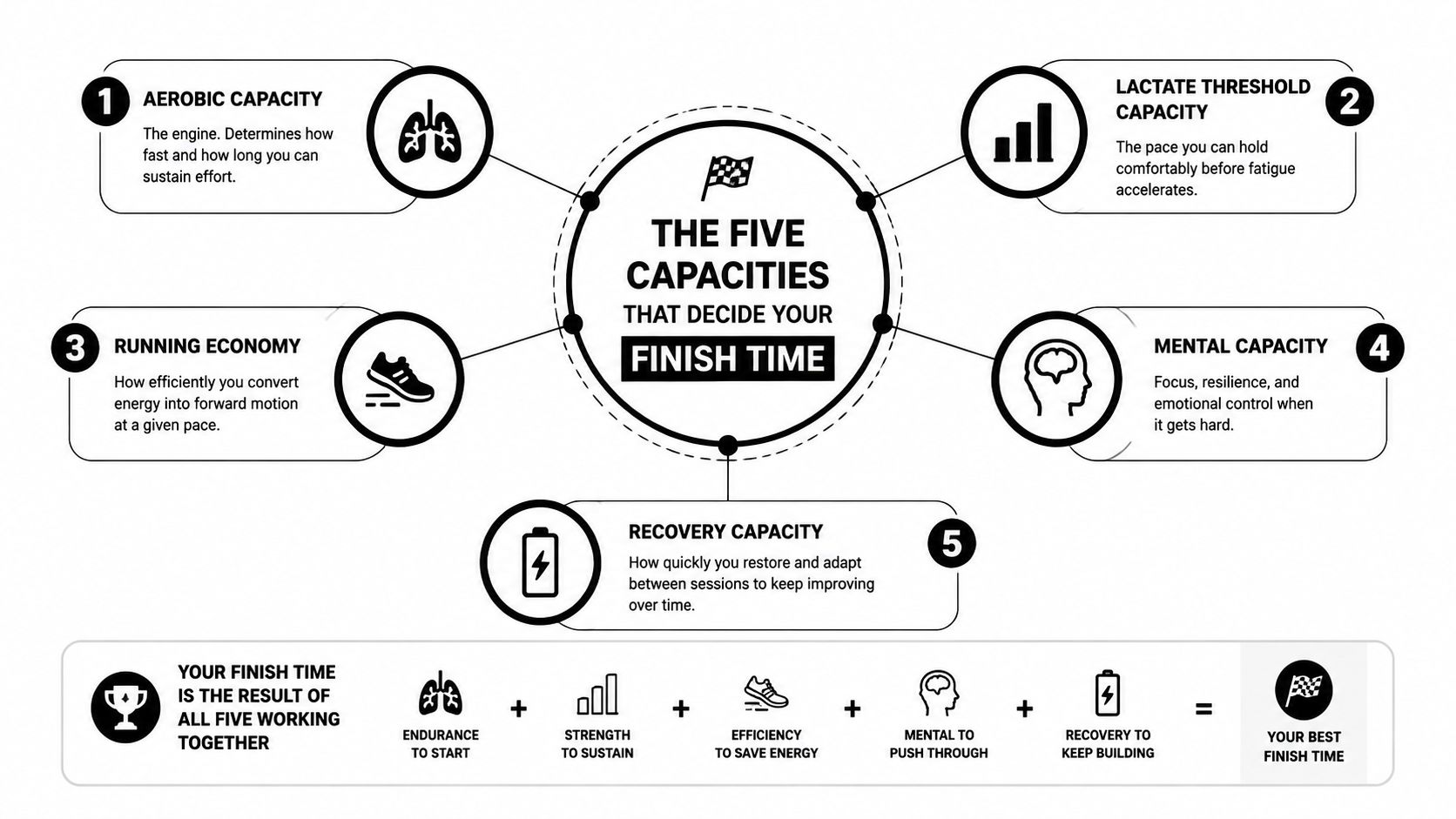
1. Aerobic endurance
Easy running, hiking or cycling develops repeatable aerobic work. Add hills and trails gradually because uneven surfaces increase lower-limb demands. One faster session may be useful once a basic running tolerance is established.
A graded VO2 max test with gas analysis can measure aerobic capacity and ventilatory thresholds for more individual training zones. It is optional, not a prerequisite for OCR training.

2. Strength
Squats or split squats, hip hinges, rows, presses, assisted pull-ups and loaded carries build useful general strength. Choose versions appropriate to current ability. Leave repetitions in reserve and prioritise stable technique.
3. Power and landing
Low-volume jumps, medicine-ball throws and short accelerations can develop power when performed fresh. Begin with low heights and controlled two-foot landings before adding single-leg, lateral or fatigued work. Stop a set when landing position or speed deteriorates.
4. Grip endurance
Use supported hangs, farmer carries, rows and progressively more obstacle-specific holds. Avoid maximal hangs every day. Tendons and skin need recovery, and grip fatigue can compromise climbing safety.
5. Skill and agility
Practise crawling, climbing, vaulting, deceleration and direction changes in a controlled environment with qualified supervision. Progress from dry, stable and low obstacles before adding height, water, mud, speed or fatigue.
Vanta Sports’ commercial youth strength-endurance guide gives general examples of combining resistance work and conditioning. Young athletes require age-appropriate coaching, safeguarding and supervision.
An 8–12 Week Framework
The correct starting point depends on current running tolerance, strength experience, injury history and event distance. The following is a framework, not a medical prescription.
| Phase | Emphasis | Example weekly content |
|---|---|---|
| Weeks 1–3 | Movement quality and aerobic base | Two easy aerobic sessions, two strength sessions, short grip practice |
| Week 4 | Consolidation | Maintain frequency but reduce volume if fatigue has accumulated |
| Weeks 5–7 | Hills, carries and controlled obstacles | One easy run, one quality run, two strength sessions, one skills session |
| Week 8 | Reassessment | Review symptoms, running response, grip and technique |
| Weeks 9–11 | Race-specific combinations | Short run-obstacle blocks without turning every session maximal |
| Week 12 | Taper | Reduce volume, retain brief technique and familiar intensity |
Beginners may need longer than 12 weeks. Increase only one major variable at a time, such as duration, terrain difficulty, load or obstacle complexity. The popular 10% rule is not a biological safety threshold.
A DEXA scan can estimate fat mass, lean soft tissue and bone density where body-composition monitoring is relevant. It does not measure strength, movement quality or injury risk, and regional differences should not be treated as a diagnosis of muscular imbalance.
Fuelling and Recovery
Energy and carbohydrate needs depend on body size, event duration and weekly training. A resting metabolic rate test measures energy expenditure at rest, not total daily needs. Activity and the thermic effect of food still have to be estimated, so arbitrary multipliers should not be treated as precise prescriptions.
For long endurance events, sports-nutrition guidance may include carbohydrate loading and carbohydrate during exercise. The commonly cited 8–12 g/kg/day loading range applies mainly to events lasting more than about 90 minutes and is not necessary for every OCR. Intakes of 60–90 g per hour are generally reserved for prolonged exercise and require gut training. Shorter races may need much less.
Protein needs also vary. Many exercising adults can support training with approximately 1.2–1.6 g/kg/day. Higher intakes may sometimes be used during energy restriction, but 1.8–2.2 g/kg/day is not a universal OCR requirement. People with kidney disease or other relevant conditions should seek individual advice.
Prioritise adequate sleep, familiar food, hydration and easy days. Mobility work may improve a specific range of motion, but it does not independently prevent all injuries. Persistent pain, swelling, instability, neurological symptoms or reduced function warrants assessment by an appropriate clinician.
Race-Day Safety and Tactics
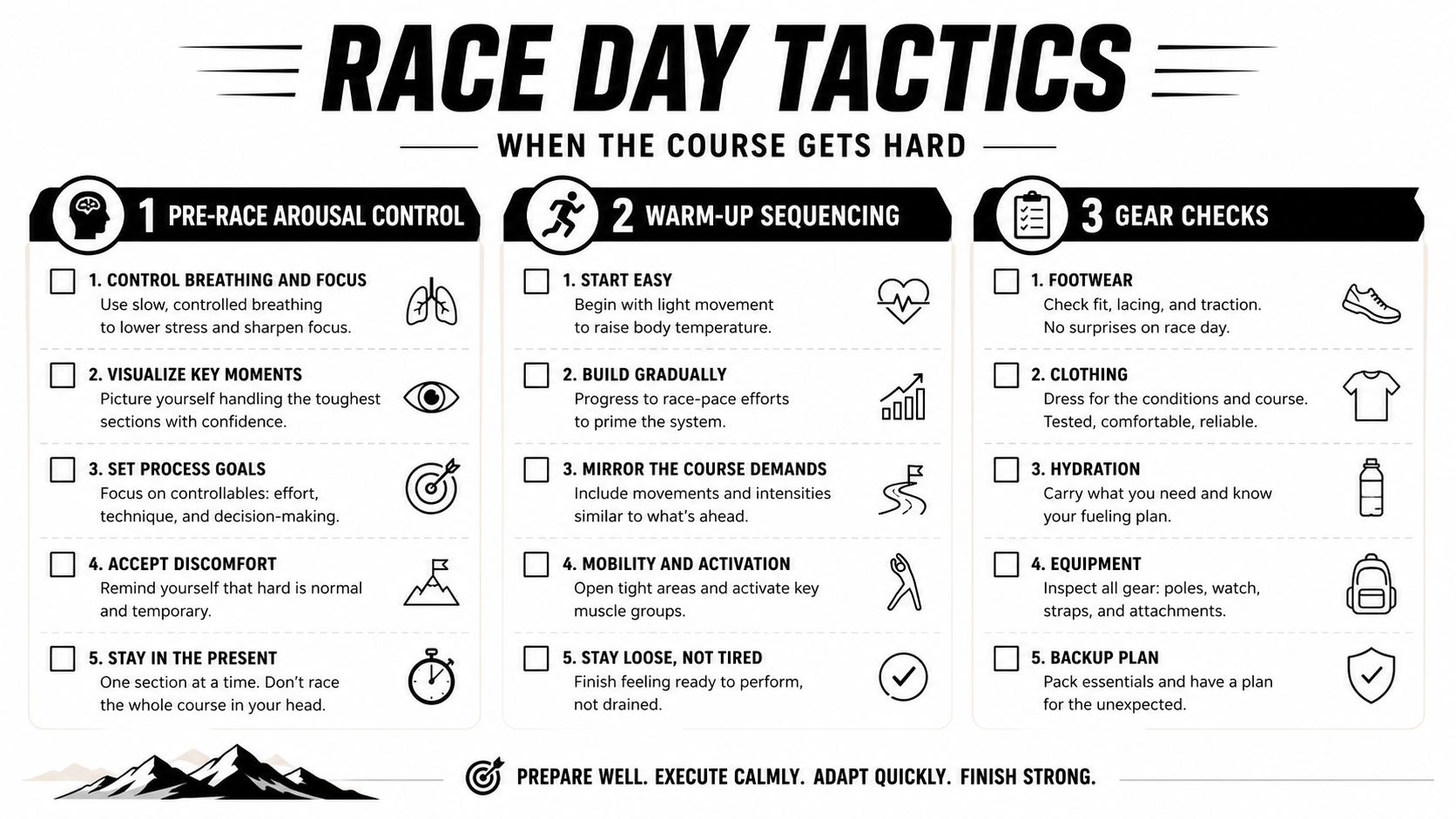
- Read event rules, water-obstacle requirements, penalty procedures and mandatory kit.
- Do not enter water if you cannot meet the organiser’s swimming requirements.
- Start at a sustainable effort and avoid sprinting every transition.
- Use only nutrition and equipment practised in training.
- Give other racers space and follow marshal instructions.
- Do not attempt a height or obstacle that feels unsafe simply to avoid a penalty.
This Corporate Challenge guide to physical-event etiquette offers general commercial event advice. The race organiser’s safety briefing and marshal instructions always take priority.
Stop and seek medical help for chest pain, fainting, severe breathlessness, confusion, weakness, suspected concussion, inability to bear weight or signs of heat illness such as altered mental state. After a head impact, do not return to the course if concussion is suspected.
The content in this article is for educational purposes only and does not constitute medical or dietary advice. If you have an underlying health condition, are taking medication, or are considering significant changes to your diet or exercise regimen, consult a qualified healthcare professional before making any adjustments.