
Performance Benchmarking Your Health: The Ultimate Guide
29 June 2026Updated 4 July 2026
You train consistently. You eat reasonably well. You might even wear a watch that tells you your recovery score, sleep score and readiness score before you've had coffee. Yet your progress still feels vague.
The scale stalls. Your runs feel harder than they should. Strength work is going up in patches, but your waistline, energy, and recovery don't seem to match the effort. That usually isn't a motivation problem. It's a measurement problem.
Performance benchmarking fixes that. It gives you a structured way to measure your body, compare those measurements against your own baseline, and make decisions from evidence instead of hope. For health, performance and longevity, that matters far more than another generic training plan.
Table of Contents
- What Is Performance Benchmarking
- The Core Metrics That Matter Most
- How to Establish Your Personal Baseline
- Sample Benchmarks for Different Goals
- Turning Your Data Into an Action Plan
- How to Implement a Benchmarking Programme
- Beyond the Numbers Your Path Forward
What Is Performance Benchmarking
Performance benchmarking is the disciplined habit of measuring what matters, recording a baseline, and using repeat assessments to judge whether your plan is working. In business, that sounds operational. In health, it's personal. It addresses questions that are often difficult to solve with effort alone: am I losing fat, preserving muscle, improving cardiovascular capacity, or simply working hard without direction?
This isn't a fringe idea borrowed from sport. The UK government's Independent Project Authority uses benchmarking as a required discipline for major projects, comparing cost, duration and carbon against historical data to improve assurance and value for money through its IPA Benchmarking Data Service. The principle is simple. Decisions improve when you compare current performance against a meaningful reference point.
Your body deserves the same standard.
A scale gives one blunt number. A mirror gives mood-dependent feedback. Even training apps can only infer what's happening underneath. Proper benchmarking moves you from guesswork to a model you can act on. If your weight is unchanged but lean mass is up and fat mass is down, that's progress. If your training volume is high but aerobic markers are stagnant, that tells you the current plan isn't targeting the right adaptation.
Practical rule: A useful benchmark doesn't just describe where you are. It changes what you do next.
Performance benchmarking typically starts with a baseline across body composition, metabolism and fitness, then repeats under the same conditions so the comparison is fair. That's why a strong health risk assessment often sits alongside testing. It gives context to the raw numbers and helps identify which findings matter most for health span, not just short-term aesthetics.
The Core Metrics That Matter Most
If you want a complete benchmark, think of your body like a high-performance vehicle. You need the blueprint, the idle speed, and the redline. Miss one, and your interpretation gets distorted.
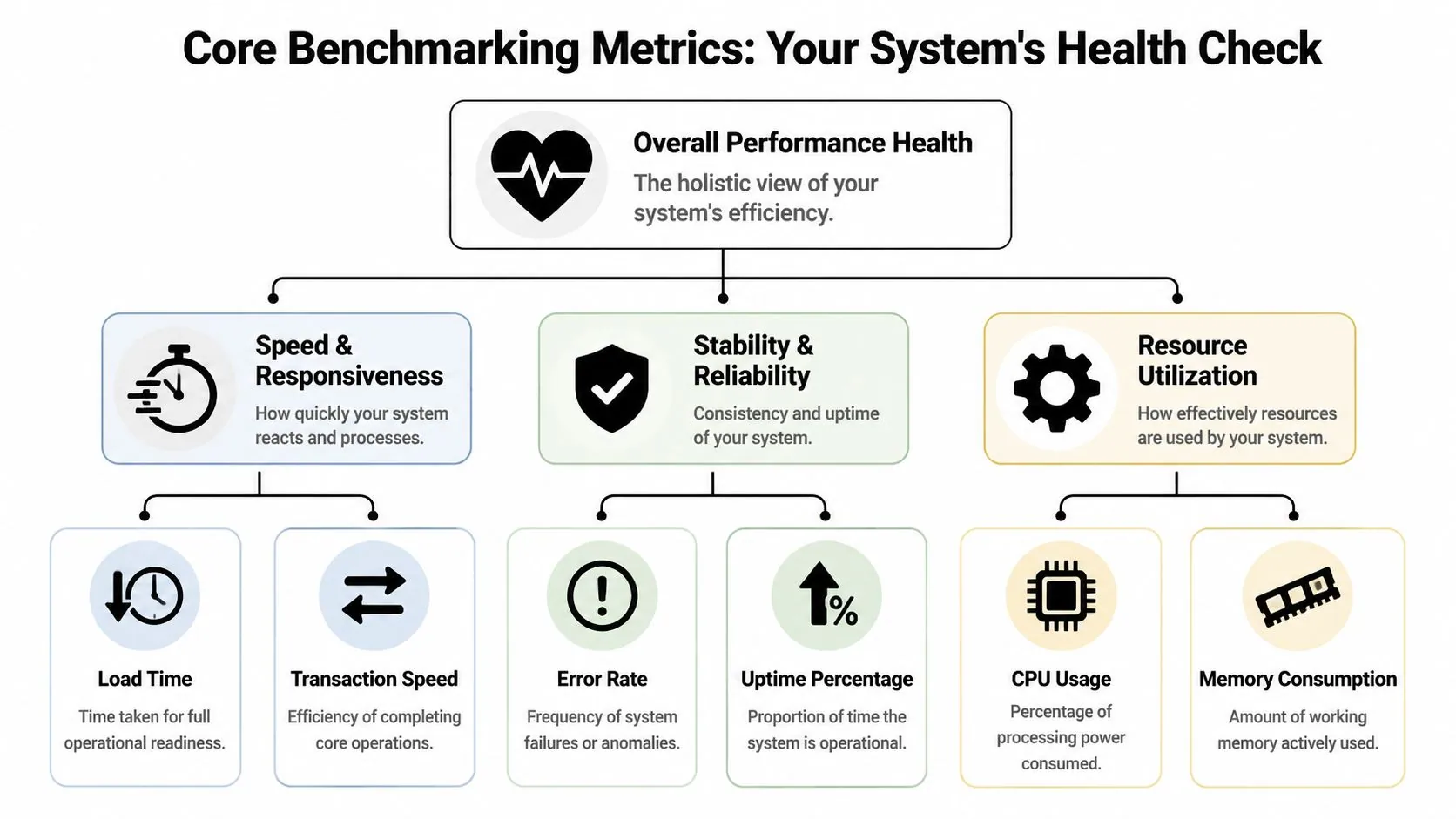
Body composition is the blueprint
DEXA holds significant value. It's the clinical gold standard for body composition, providing hospital-grade precision and distinguishing fat loss from muscle gain. That distinction is highly important in recomposition, where body weight can stay stable while health and performance improve significantly. Aberystwyth University describes DEXA as the gold standard for assessing body composition, noting it is more accurate than bioimpedance, which can be done anywhere but produces less reliable data, through its sport performance and health testing overview.
A DEXA scan gives regional detail, not just a total. You can see fat distribution, lean mass, bone density, and whether one area is lagging behind another. That's far more useful than a bathroom scale telling you that you weigh the same as last month.
If you want a clinical baseline for this part of the picture, a Dexa Body Composition Scan measures total and regional fat mass, lean muscle mass, and bone density with medical-grade precision. In practice, that means you can stop confusing water shifts with real progress.
Metabolic rate is the idle speed
Resting metabolic rate, or RMR, tells you how much energy your body uses at rest. We think of it as the engine idle. It doesn't tell you everything about nutrition, but it stops a lot of bad decisions.
People often under-eat because they assume slower progress means they need to restrict harder. Others over-eat because they overestimate how much training offsets. An RMR test gives you a more grounded starting point for calorie intake, especially when body composition and recovery don't match your expectations.
This is one of the most commonly misread parts of health data. A low reported calorie target isn't automatically virtuous, and a high training load doesn't automatically mean your metabolism is well-functioning. RMR helps you see whether your nutrition plan is supporting the body you're trying to build.
A useful comparison comes from outside health. In event strategy, teams often look beyond headline results and focus on measurement that reflects return. That same logic sits behind experiential marketing ROI. The lesson is transferable. If you only measure what's easy to see, you miss what drives the outcome.
Aerobic capacity is the redline
VO2 Max testing shows how well your system performs under stress. It measures maximal oxygen uptake through breath-by-breath analysis and is used to define training zones and understand endurance capacity. A detailed cardiovascular fitness testing guide is useful if you want the mechanics behind how this testing is applied.
This metric matters beyond endurance sport. Aerobic fitness shapes work capacity, resilience, recovery between efforts, and long-term cardiovascular health. It tells you whether your engine can sustain output, not just whether you can grind through a single hard session.
A strong benchmark pairs structure with function. DEXA shows what the body is made of. VO2 Max shows how that body performs.
What doesn't work is treating these tests as isolated trophies. A good DEXA result with poor aerobic fitness still leaves a major gap. A strong VO2 Max with low muscle mass and poor fuelling also limits what you can do. The value is in combining them.
How to Establish Your Personal Baseline
The first benchmark needs to be clean enough that you can trust it. Not perfect. Just repeatable.
Most bad data comes from inconsistent preparation. People test after a hard session, after poor sleep, at different times of day, or under different nutrition conditions, then compare results as if nothing changed. That turns a physiological test into noise.
Standardisation matters more than enthusiasm
The goal is to reduce variables you can control.
Use a simple routine:
- Test under similar conditions: Keep time of day, hydration, and recent activity as consistent as possible.
- Avoid last-minute heroics: Don't train unusually hard right before testing because you want to “earn” the result.
- Keep nutrition routine stable: A dramatic change in carbohydrate intake, caffeine, or meal timing can alter how the data looks.
- Record context: If sleep was poor, stress was high, or training load was heavy, note it. Interpretation improves when context is honest.
Integrated profiling is effective only when the inputs are comparable. The reason clinicians and performance practitioners combine body composition with aerobic testing is that higher body fat negatively affects endurance performance, while muscle mass gain improves it, as discussed in this VO2 Max and DEXA article. If one test is standardised and the other isn't, the comparison weakens.
What a usable baseline looks like
A good baseline is broad enough to guide action and narrow enough to repeat. That usually means collecting:
- Body composition data for fat mass, lean mass and bone health.
- Resting metabolic data for calorie planning.
- Aerobic performance data for training intensity and endurance capacity.
Then wait long enough for your plan to create actual change before retesting. DEXA shouldn't be done too often, and the wider principle applies to the whole benchmarking process. Constant testing makes people reactive. Measured retesting makes them strategic.
If you want meaningful trend data, keep the testing conditions boring. Consistency beats intensity.
For many people, a baseline followed by periodic review works better than frequent check-ins. It gives training, recovery and nutrition time to produce changes worth measuring. The exact interval should match your goal, but the logic stays the same. Test, intervene, reassess.
If you want to understand the nutrition side before testing, this guide on how to calculate RMR helps frame what resting metabolic rate is telling you.
Sample Benchmarks for Different Goals
The same data point can mean different things depending on the person sitting in front of it. A runner, an executive, a perimenopausal woman and a healthy ageing adult don't need the same interpretation. They need the same discipline.
Here's a practical way to think about it.
Sample Physiological Benchmarks by Goal
| Metric | Endurance Athlete (35M) | Executive (45F) | Perimenopausal Woman (50F) | Healthy Ageing (65M) |
|---|---|---|---|---|
| Primary focus | VO2 Max and lactate threshold | Visceral fat, recovery, resilience | Muscle mass, bone density, metabolic change | Muscle preservation, bone health, aerobic function |
| Most useful body composition question | Is race weight coming from fat loss rather than muscle loss? | Is abdominal fat accumulating despite stable weight? | Am I losing lean mass while scale weight stays similar? | Am I maintaining lean tissue and skeletal health? |
| Most useful aerobic question | Are training zones accurate for current fitness? | Is cardiovascular capacity supporting energy and stress tolerance? | Is fatigue driven by deconditioning, recovery load, or both? | Is aerobic fitness supporting independence and daily function? |
| RMR interpretation focus | Is fuelling sufficient for training load? | Is intake aligned with actual energy needs? | Has energy expenditure shifted enough to require dietary changes? | Is under-eating contributing to muscle loss or fatigue? |
| Progress marker that matters most | Better training quality without unwanted muscle loss | Lower risk profile with steadier energy | Improved body composition and preserved bone and muscle | Maintaining capacity, not just body weight |
The endurance athlete
This client often arrives with decent training data and poor body composition context. Their watch is full of numbers, but they still can't explain why pace stalls or recovery gets worse during a build.
A typical pattern is chasing lower body weight too aggressively. The athlete feels lighter, but their DEXA result later shows lean mass erosion. Performance then suffers even though discipline looked high from the outside. In such instances, a benchmark protects against false progress.
What to look for:
- Lean mass retention: Cutting body mass at the expense of muscle usually backfires.
- Aerobic zone accuracy: Hard sessions set from guessed thresholds often become medium-hard sessions that miss the target.
- Fuel match: If RMR and training demand don't align with intake, the athlete can't absorb the plan.
The high-performing executive
This group often trains with urgency but not always with structure. They're productive, stressed, short on time, and often surprised that visible effort hasn't produced the health profile they expected.
Their scale weight may be unchanged, yet DEXA can reveal a very different story from what they assume. Visceral fat matters more here than vanity metrics. The benchmark isn't about looking athletic in a quarterly burst. It's about protecting energy, cognition and long-term resilience.
For movement outside formal testing, lower-impact consistency can support the wider plan. Someone rebuilding capacity rather than chasing punishment might even look at resources such as find top Evanston pilates classes for an example of how structured, repeatable movement complements harder training when recovery bandwidth is limited.
Women navigating perimenopause
This is one of the clearest cases where scale weight becomes misleading. Hormonal change can alter body composition, recovery, appetite and training response. Many women are doing more work for worse apparent results, which is why objective measurement matters so much here.
The benchmark should prioritise:
- Lean mass trends: Resistance training can be working even when scale weight is static.
- Bone density awareness: This belongs in the conversation, not at the edge of it.
- RMR context: Nutrition needs often need refinement, not blind restriction.
- Aerobic capacity: Fatigue isn't always hormonal. Sometimes cardiovascular conditioning has slipped in the background.
The right benchmark can be reassuring. It often shows that the problem isn't lack of effort. It's that the wrong outcome has been measured.
The healthy ageing adult
This person usually cares less about aesthetics and more about capability. They want to keep lifting luggage, walking hills, playing sport, staying independent, and avoiding the slow drift into frailty.
Here, performance benchmarking shifts the frame from “how much do I weigh?” to “what am I preserving?” A flat body weight can hide a bad trade, where muscle is down and fat is up. Equally, modest improvements in aerobic capacity and strength can have disproportionate value for day-to-day life.
The most useful questions are practical:
- Can you maintain muscle?
- Can you support bone health?
- Can you recover from exercise well enough to keep doing it?
- Is your cardiovascular system strong enough for the life you want to lead?
Turning Your Data Into an Action Plan
A report is only useful if it changes behaviour. The real skill is synthesis.
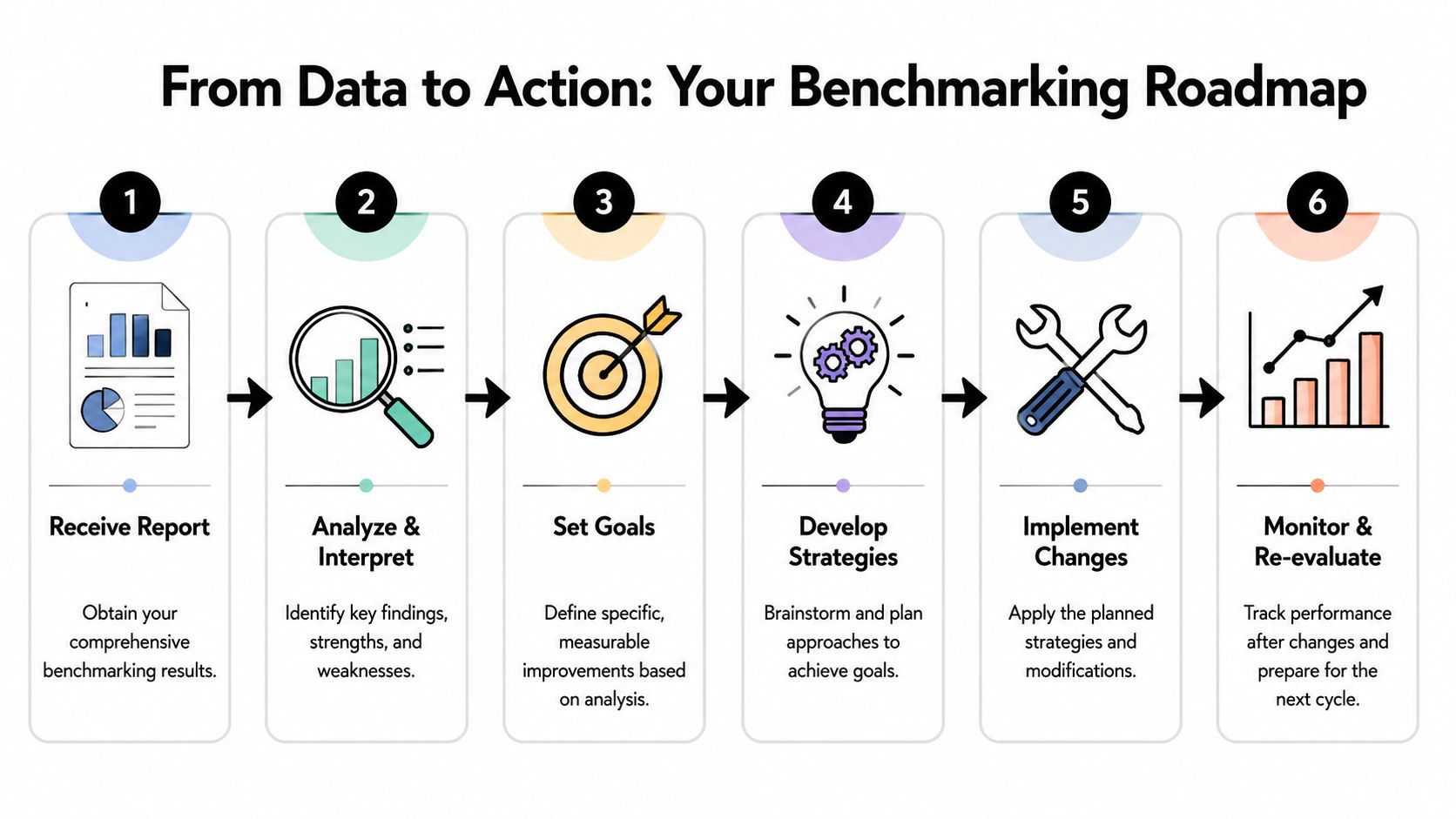
Patterns that change the plan
Single metrics can mislead. Combinations tell the truth.
Use this kind of logic:
- If DEXA shows low lean mass and RMR looks suppressed, prioritise resistance training, recovery quality and adequate protein and energy intake. More cardio is rarely the first fix.
- If VO2 Max is solid but day-to-day endurance still feels poor, look at pacing, threshold placement and whether easy training is easy enough.
- If body fat is high and aerobic fitness is low, don't jump straight to maximal intervals. Build sustainable aerobic volume and improve nutritional consistency first.
- If bone density is a concern and lean mass is drifting down, training needs mechanical loading, not just calorie burn.
Nutrition should also match the adaptation you want. Athletes shifting body composition while preserving performance often do better when protein intake is deliberate and meal structure supports training quality. For readers exploring dietary options, this piece on plant-based protein for athletes is a practical starting point for thinking about protein quality within a broader performance plan.
What not to do
Most failed action plans share the same flaws.
| Mistake | Why it fails | Better response |
|---|---|---|
| Chasing weight alone | It ignores fat, muscle and bone changes | Track composition and performance together |
| Retesting too soon | Normal fluctuation looks like trend | Give the intervention time to work |
| Treating every poor result as a call for more effort | Fatigue and under-fuelling can worsen outcomes | Match the intervention to the pattern |
| Copying someone else's benchmark | Your physiology and goal may be different | Use your own baseline as the anchor |
A strong action plan is specific. It links training, nutrition and recovery to the pattern shown in the data. It also accepts trade-offs. You can't push fat loss aggressively, maximise muscle gain, and expect peak endurance adaptation all at once. Benchmarking helps you choose the priority instead of pretending there isn't one.
How to Implement a Benchmarking Programme
For one person, this can be simple. For an organisation, it needs structure.

For individuals
Start with a complete baseline rather than a single test chosen in isolation. That usually means body composition, metabolic rate and aerobic capacity assessed close together, then interpreted as one profile.
From there:
- Choose one main goal: Fat loss, performance, healthy ageing, or recovery from a plateau.
- Keep preparation standardised: Similar time of day, similar recent training, similar hydration and nutrition routine.
- Write down your intervention: Training changes, calorie target, recovery focus, protein strategy.
- Schedule the retest before motivation fades: A benchmark without follow-up becomes trivia.
This doesn't need to become obsessive. It needs to become organised.
For gyms workplaces and wellness centres
Performance benchmarking becomes particularly compelling. A gym, wellness centre or employer can use objective testing to move beyond generic wellbeing messaging and into measurable health support.
There's also a wider system gap here. In UK healthcare and adjacent settings, there's a recognised lack of peer-driven benchmarking focused on innovation rather than compliance. That gap is discussed in this piece on benchmarking for innovation in healthcare, and it matters because organisations often need a safe, non-regulatory way to compare methods and share what works.
For practical rollout, onsite testing works well when it is tied to a real programme rather than treated as a one-day novelty. A clinic day should lead to education, action plans, retesting and aggregated learning about what members or employees need.
One option in that setup is Telomyx, a mobile advanced body analytics service that brings DEXA, VO2 Max and RMR testing into gyms, wellness centres and workplaces across the UK. For groups or individuals who want a packaged starting point, the ELITE Performance Test Bundle and MEASURE Performance Test Bundle can serve as structured entry points into a benchmarking process.
This video gives a clearer sense of how mobile delivery fits into that model:
What doesn't work is collecting data without interpretation, or offering tests with no pathway for behaviour change. Organisations get more value when benchmarking becomes part of coaching, not just part of marketing.
Beyond the Numbers Your Path Forward
The value of performance benchmarking isn't in chasing perfect scores. It's in removing uncertainty.
When you know your body composition, your resting energy needs, and your aerobic capacity, you stop treating health like a guessing game. You can see whether the plan is producing fat loss, muscle retention, better endurance, or more fatigue. That changes the quality of every decision that follows.
This approach also makes patience easier. Progress feels more believable when you can measure it properly. A stable scale with better lean mass, improved aerobic function, or more appropriate fuelling is not failure. It's evidence that the right adaptation is happening.
Your body is the most important long-term project you'll ever manage. It deserves the same level of rigour you'd expect in any serious system. Measure well, compare fairly, act deliberately, and repeat.
The content in this article is for educational purposes only and does not constitute medical or dietary advice. If you have an underlying health condition, are taking medication, or are considering significant changes to your diet or exercise regimen, consult a qualified healthcare professional before making any adjustments.
If you want hospital-grade body composition, VO2 Max and metabolic testing delivered in a format that supports real decision-making, Telomyx offers mobile advanced body analytics for individuals, gyms, wellness centres and workplaces across the UK.