
How a Personalized Nutrition Plan Works in 2026
29 July 2026Updated 31 July 2026

You've probably been there. You've cleaned up breakfast, stopped grazing at your desk, trained three or four times a week, and still the scale won't budge. Your waistline looks the same, your energy is patchy, and every online plan seems to give a different answer about carbs, fats, fasting, or supplements.
The usual problem isn't effort. It's that the plan was built on averages, not on your body.
A personalized nutrition plan only works when the inputs are real. If the calorie target, macro split, and meal timing are based on guesswork, you end up following someone else's physiology. That's why some people keep pushing harder and see nothing change, while others finally get traction the moment the numbers are tied to actual measurements.
Table of Contents
- Why Your Current Diet Isn't Working
- The Three Measurements That Anchor Any Personalised Nutrition Plan
- Turning Your Numbers Into Real Calorie and Macro Targets
- Building a Flexible Meal Template Around Your Macros
- Matching Your Training Zones to What You Eat and When
- When Personalised Nutrition Falls Short and What to Watch For
- A Four-Week Monitoring Protocol and When to Retest
Why Your Current Diet Isn't Working
The most familiar pattern is the person who has “eaten pretty well” for months, still trains regularly, and still can't shift the last bit of body fat. They've probably tried a calorie calculator, a friend's meal plan, and whatever approach was trending that week. None of it sticks because none of it starts from the same place they do.
A formula can't see your training load, lean mass, or resting energy use. It can't tell the difference between someone who sits all day and someone who covers 12,000 steps and lifts four times a week. It only gives you an average, and averages are a poor fit for a body that isn't average.
Practical rule: if a plan works only when your hunger, training, sleep, and schedule all line up perfectly, it's too fragile to last.
The real issue is usually bad inputs
Generic advice creates two predictable failures. One is under-fuelling, where a person feels flat, loses training quality, and then compensates later. The other is over-fuelling, where the food is “healthy” but the portions are built for someone else's energy needs.
That gap is why personalised nutrition has measurable value in controlled trials. In the EatWellUK trial, UK adults given personalised advice through the eNutri web app improved their diet quality score by 3.5 points out of 100 compared with the control group, a 6.1% relative improvement that was statistically significant at P=.003. Baseline scores were 56.3 in the personalised arm and 58.9 in the control arm (JMIR, 2022). Earlier European work in Food4Me showed the same direction of travel, with personalised advice producing lower intakes of red meat, salt, and saturated fat, alongside higher folate intake and higher Healthy Eating Index scores than standard population advice (International Journal of Epidemiology, 2017).
The point isn't that every plan needs complex testing. The point is that the people who keep results usually know their own numbers. Generic advice can get you started, but it rarely tells you where the error is.
The Three Measurements That Anchor Any Personalised Nutrition Plan
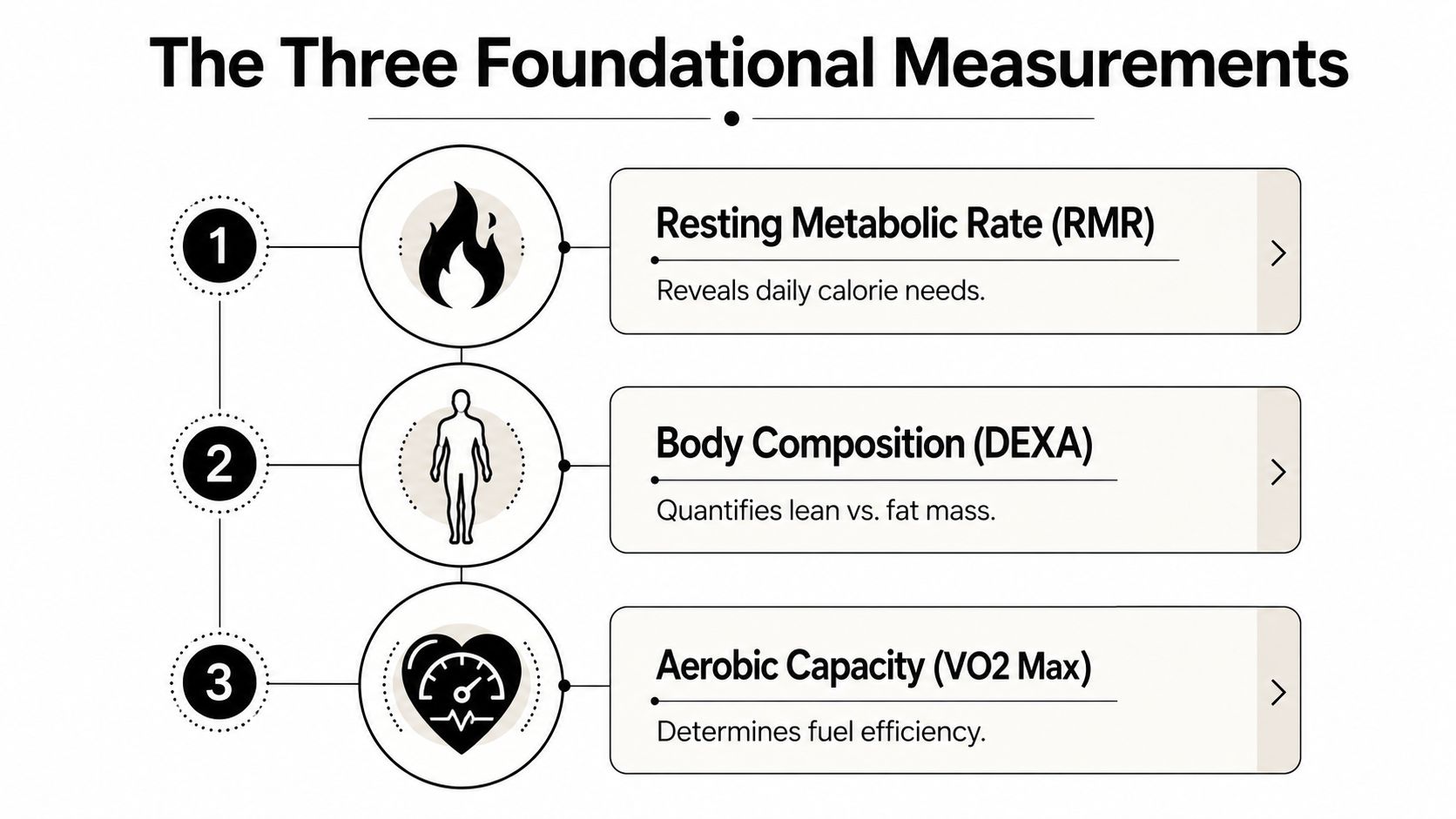
A plan built on guesswork usually fails in the same way. The calories are off, the protein target is vague, and training days are treated like rest days. Start with resting metabolic rate, body composition, and aerobic capacity, and the plan has a real clinical base instead of a template pulled from population averages.
RMR tells you the calorie floor
A Resting Metabolic Rate Test measures the calories your body burns at rest to keep basic functions running. It uses metabolic gas analysis, so you are not relying on a formula that assumes you match a population average. For nutrition planning, that matters because the calorie target should begin with your actual resting needs, then be adjusted for activity, stress, and the size of the deficit or surplus you want.
People often think their “maintenance” intake is obvious until the measured number shows otherwise. A lab-style estimate can still be useful, but a measured baseline is cleaner when you want to stop guessing. If the goal is to compare how body composition changes affect calorie needs over time, it helps to use a repeatable testing pathway, such as the body composition reporting discussed in the DEXA results guide.
DEXA shows what the scale hides
A DEXA scan gives you lean mass, fat mass, and bone density, which is more useful than body weight alone. Two people can weigh the same and still need very different calorie and protein targets because one carries more muscle. That is why DEXA is the bridge between “I want to lose weight” and “I want to change my body composition.”
For food planning, lean mass is the number that helps determine how aggressively you should cut and how much protein you should carry in the plan. The scan also stops people from chasing scale weight when the issue is composition. If someone is holding more lean tissue and less fat, the plan should reflect that rather than forcing the same intake used for a different body type.
VO2 Max links food to training demand
VO2 Max testing tells you aerobic capacity, but the more practical output for day-to-day eating is the training zone breakdown. Once you know whether you are working in Zone 2, Zone 4, or Zone 5, you can match carbohydrate to session demand instead of feeding every workout the same way. For anyone doing mixed training, that is the difference between random fuelling and targeted fuelling.
Genetics can add context, but it does not replace current physiology. If you are comparing test types, Repose Healthcare genetic test info on what genetic testing can show is useful background, but the strongest plan still starts with current intake and measurable physiology rather than a shopping list of speculative markers. For athletes who want the numbers to line up with the body they have, the process should begin with these three measurements and then be translated into food.
The cleanest plans start with repeatable measurements, then use those numbers to set intake instead of copying a generic template.
Turning Your Numbers Into Real Calorie and Macro Targets
A worked example keeps this practical. Take a 38-year-old endurance athlete with an RMR of 1,720 kcal, 68 kg of lean mass, 14 kg of fat mass, and a VO2 Max of 52 ml/kg/min. The first move is not to plug those numbers into a generic app and hope for the best. The first move is to estimate total daily energy expenditure from the measured RMR, then adjust for training and goal.
Step one, build calories from measured RMR
If the athlete's day includes a moderate training load and normal movement outside training, the RMR becomes the base for total intake. From there, the goal decides the direction. Fat loss needs a deficit, muscle gain needs a surplus, and maintenance sits near true energy balance.
For a person like this, the practical question isn't “what should I eat?” It's “what do I need on a training day versus a rest day?” That is where the calculation becomes useful rather than academic. If you want a deeper walk-through of the deficit side, Telomyx has a focused guide on calorie deficit calculation.
Step two, set protein from lean mass
Protein is worth anchoring to lean mass rather than scale weight, because lean tissue is what the protein is there to protect. General athlete guidance sits at roughly 1.6 to 2.2 g/kg of body weight, but when a resistance-trained athlete is in an energy deficit the better-supported target is 2.3 to 3.1 g/kg of fat-free mass, scaled upwards the leaner the athlete and the harder the deficit (Helms et al., IJSNEM 2014). For 68 kg of lean mass, that gives a working band of roughly 155 to 210 g a day rather than a random daily number.
That range matters because lean tissue is what you're trying to protect during a cut and support during heavy training. It also stops people from under-eating protein on days when their appetite drops. If your intake is built around actual lean mass, the plan is harder to derail.
Step three, let carbs follow the training week
Carbohydrate should move with training demand, not stay fixed year-round. A hard interval day needs more carbohydrate than a steady Zone 2 session, and both need more than a low-stress rest day. Fat then fills the remainder after protein and carbohydrate are set.
If you're calculating food at the recipe level, a tool that helps you get precise recipe nutrition makes the whole process less approximate. That's especially useful when you're trying to keep calorie totals accurate without weighing every ingredient forever.
| Sample Day Macros by Training Intensity | Daily kcal | Protein (g) | Carbs (g) | Fat (g) |
|---|---|---|---|---|
| Lower-carb endurance day | 2,400 | 170 | 250 | 80 |
| Higher-carb strength day | 2,610 | 175 | 320 | 70 |
The numbers above are examples of how the structure changes, not a universal prescription, and each row is balanced so the macros add up to the stated calorie total. The method stays the same: start with measured RMR, anchor protein to lean mass, and let carbohydrate rise and fall with the actual work you're doing.
Building a Flexible Meal Template Around Your Macros
Rigid meal plans fail when work runs late, kids need collecting, or training gets moved. A better personalised nutrition plan uses a template, not a script. The template protects the numbers while leaving room for real life.
Build the day around anchors
A strong day usually has five anchors: breakfast, lunch, a pre-training snack, a recovery meal, and dinner. Each one should include a clear protein source, enough fibre to improve satiety, and carbohydrate scaled to the session. You don't need every plate weighed to the gram to do that well.
For a 2,600 kcal day, we'd usually start with roughly one palm-sized protein serving at breakfast, another at lunch, and a larger serving after training. Lunch needs to travel well, so leftovers, wraps, or a bowl format work better than fragile meal-prep box food. Dinner should be the least complicated meal, because adherence improves when the evening plate is built around familiar UK ingredients rather than novelty.
Use food structure, not food rules
A lower-carb endurance day can look like eggs and oats at breakfast, chicken and rice at lunch, a banana or yoghurt before a Zone 2 ride, then salmon with potatoes and greens at dinner. A higher-carb strength day shifts the carbohydrate forward and back around the workout, with more starch at breakfast and in the recovery meal.
Useful check: if you can't describe the meal in terms of protein, fibre, and training demand, it's probably too vague to hold up under a busy week.
Seasonal ingredients help because they make the plan cheaper and easier to repeat. In the UK, that usually means building around root vegetables, berries when they're in season, frozen veg when time is tight, and simple protein sources that don't require chef-level prep. The goal is not culinary perfection. The goal is a structure that survives a Monday through Sunday cycle without friction.
Matching Your Training Zones to What You Eat and When
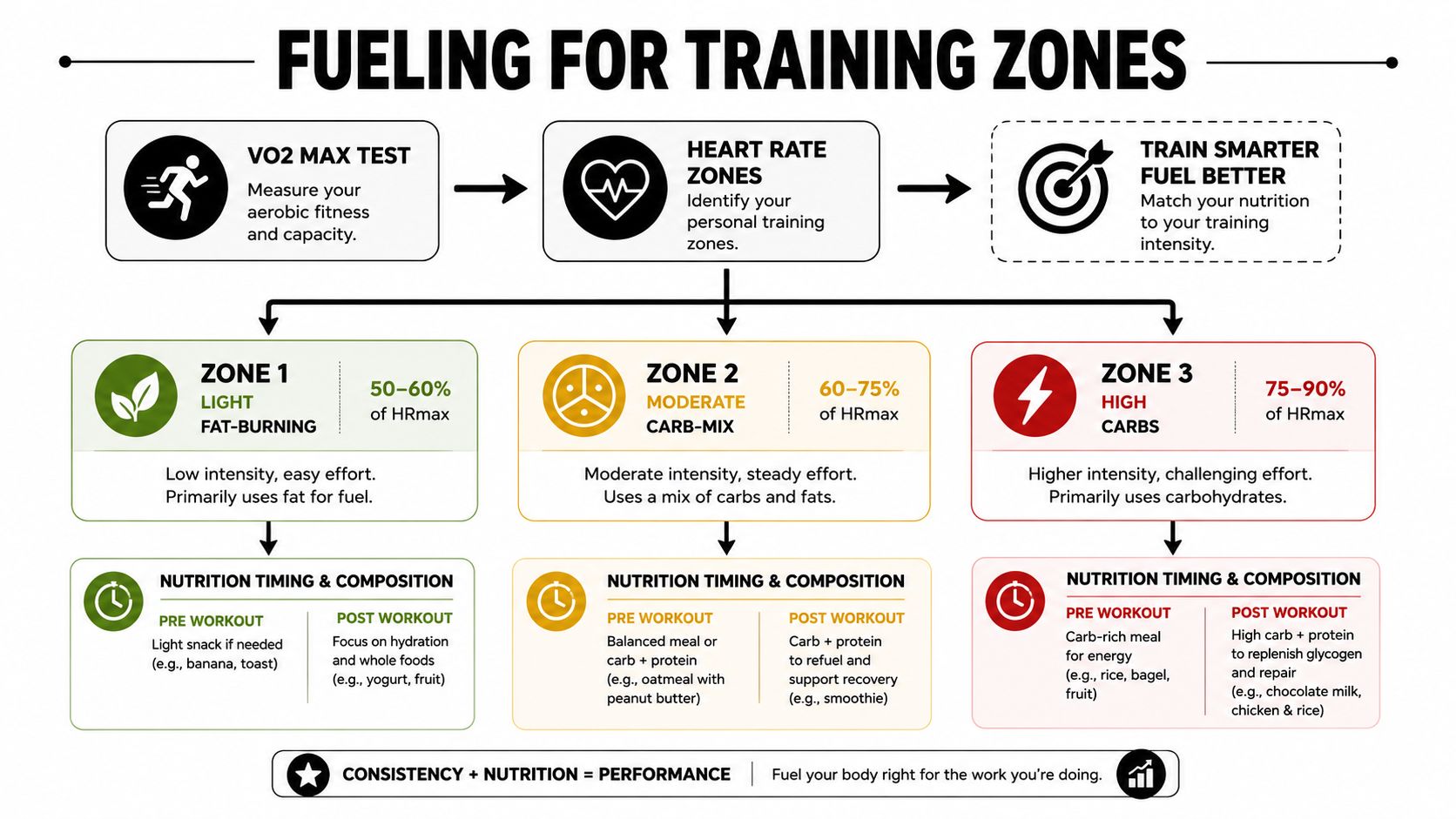
A nutrition plan that ignores training intensity is just a calorie plan in running shoes. Once you know your zones, you can stop feeding every session the same way and start matching food to the job.
Zone 2 doesn't need the same fuel as intervals
Zone 2 sessions are usually more forgiving from a fuelling standpoint. They still need energy, but they do not demand the same carbohydrate emphasis as threshold or sprint work. A steady ride or easy run can work with moderate carbohydrate intake, while a hard interval day needs a more deliberate carb plan before and after.
For a practical explanation of where Zone 2 sits in the wider training picture, see this guide to zone 2 training heart rate basics. If you want a concise breakdown of the full zone structure, the fat loss with heart rate zones resource is a useful companion for understanding why the same athlete can eat differently on different days. The key is to stop averaging the week so much that hard sessions are under-fuelled and easy sessions are over-fed.
Time carbohydrate to the session
For a harder session, eat a carb-containing meal in the two hours beforehand if you tolerate it well. Keep the meal lower in fat and fibre if you train soon after eating, because digestion matters just as much as calories. After the session, bring protein back in quickly and include carbohydrate if the next workout is soon or the session was especially demanding.
The same logic applies to long Zone 2 work, only less aggressively. You are not chasing a large pre-load every time. You are matching intake to session cost so recovery stays ahead of fatigue, and the plan stays practical enough to repeat on a busy week.
Read the week, not just the day
A good weekly pattern looks different from a generic athlete menu. The easy days carry less carbohydrate, the hard days carry more, and protein stays steady across the week. That is how the plan stays lean where it can and supportive where it needs to be.
The best question is simple. Which sessions need carbohydrate density, and which sessions only need enough to keep the work productive? That answer usually fixes more than another supplement ever will.
When Personalised Nutrition Falls Short and What to Watch For
Not every person needs high-cost testing on day one. Cost is the barrier researchers keep returning to, with much of what is sold under the personalised nutrition banner priced beyond what most of the population can afford, so the people who might benefit most are often the least able to access it (Guiding Principles for the Implementation of Personalized Nutrition Approaches). In practice, shift work, a tight food budget, a chronic condition, or a history of disordered eating will all change what a realistic plan looks like. A plan that looks elegant on paper can fall apart the moment it meets a chaotic rota or a tight food budget.
The other failure is information overload. Some people collect too many metrics, chase too many rules, and end up making no consistent changes at all. The fix is usually not more complexity, it's fewer targets, better adherence, and one clear goal at a time.
If sleep is poor, stress is high, and protein is missed most days, no amount of testing will rescue the result.
The UK evidence is useful precisely because it's honest. Personalised approaches can improve dietary quality and sometimes body composition and metabolic markers, but the effect on weight loss is often smaller and less consistent than the marketing suggests. A 2026 review of 24 randomised controlled trials found that personalised nutrition consistently improved dietary quality and produced significant improvements in metabolic markers such as HbA1c, triglycerides, and insulin sensitivity, yet few trials showed a significant between-group difference in weight loss (Food & Function, 2026, JMIR remote RCT, 2026). That's why the plan should be framed around specific use cases, such as better adherence, better training fuel, or better metabolic control, not around vague transformation language.
A Four-Week Monitoring Protocol and When to Retest
Week by week tracking
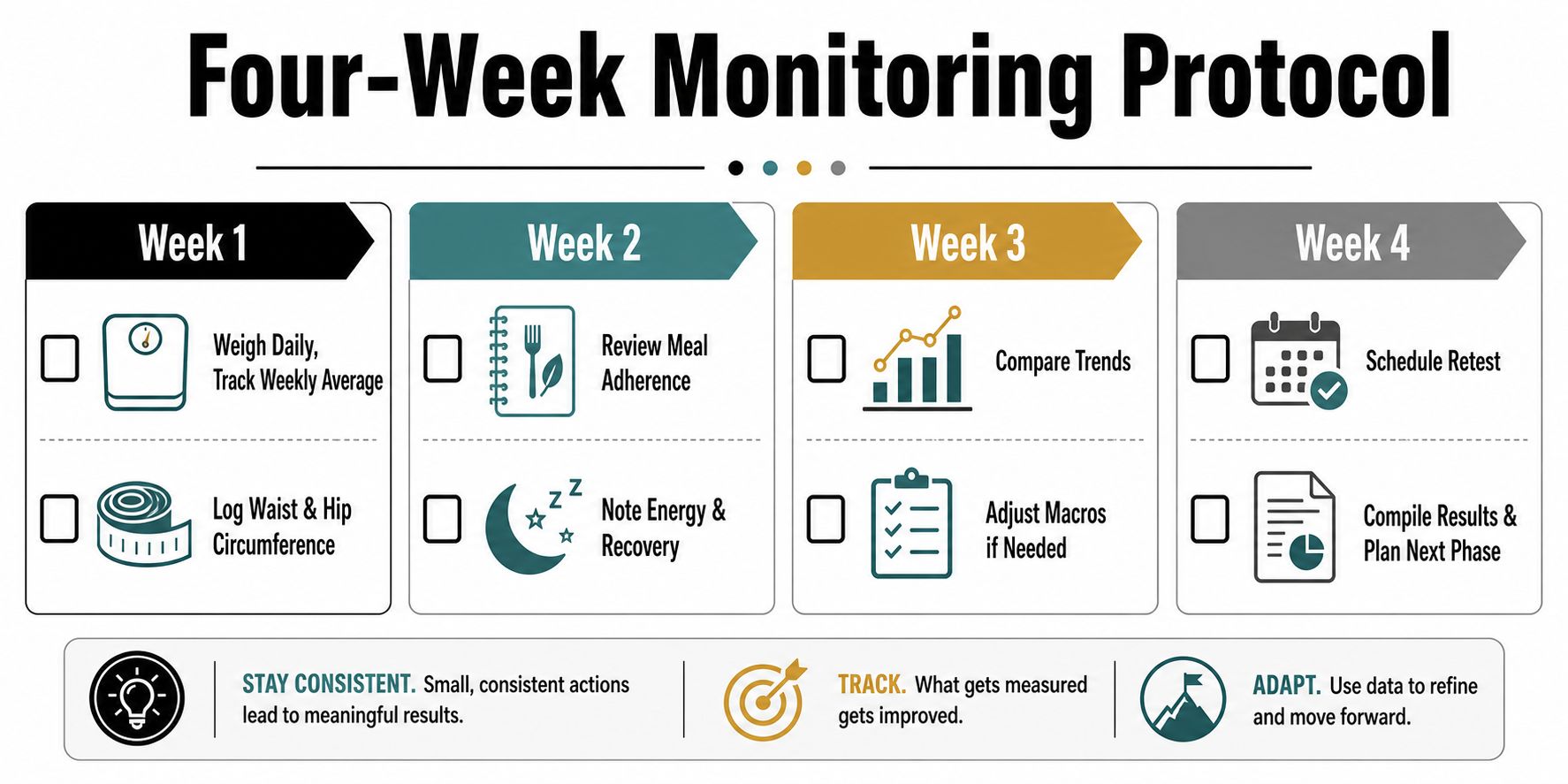
Weigh daily, then use the weekly average. Measure waist and hip circumference every two weeks. Log session effort, track whether you hit the protein target, and note whether the planned training zone was executed.
- Week 1: Weigh daily and record the weekly average, then log waist and hip circumference.
- Week 2: Review meal adherence and note energy, recovery, and hunger.
- Week 3: Compare the trend against the target and adjust macros if needed.
- Week 4: Schedule a retest if the data has stalled or the goal has shifted.
When to retest
A retest makes sense after 8 to 12 weeks if body composition hasn't changed, or after about 6 weeks if performance has plateaued despite consistent training. It also makes sense after a meaningful life change, such as a new training block, recovery from injury, or a major shift in routine.
The point of retesting is not to collect more data for its own sake. It's to make the next decision cleaner than the last one. That's how a personalized nutrition plan stays useful instead of becoming a file you never open.
One caution on the deficit itself. Aggressive calorie restriction carries real risks for endurance athletes, perimenopausal women, and anyone with a history of disordered eating, where under-fuelling can cost bone density, hormonal function, and training quality rather than just fat mass. If any of that applies to you, set the target with a clinician or registered dietitian rather than on your own.
The content in this article is for educational purposes only and does not constitute medical or dietary advice. If you have an underlying health condition, are taking medication, or are considering significant changes to your diet or exercise regimen, consult a qualified healthcare professional before making any adjustments.
Telomyx brings RMR testing, DEXA scans, and VO2 Max testing into one practical pathway for people who want their nutrition targets anchored to real measurements. If you're ready to stop guessing and build your plan from your own physiology, visit Telomyx and look at the testing options that fit your training, body composition, and health goals.