
Resilience Building Strategies for 2026
13 August 2026Updated 19 August 2026
Resilience is the capacity to adapt to difficulty, maintain or regain useful functioning, and recover without pretending that stress has no effect. It is not a fixed personality trait and it is not a score produced by a fitness test.
The need for practical support is clear. In Great Britain, the Health and Safety Executive estimated that 964,000 workers experienced work-related stress, depression or anxiety in 2024/25, resulting in 22.1 million lost working days (HSE 2025 statistics). A commercial overview from Zoe Talent Solutions discusses earlier workplace-resilience figures, but the HSE is the primary source for current UK statistics.
Resilience-building strategies work best when they reduce avoidable load, strengthen coping resources and make recovery easier. They cannot compensate for unsafe work, discrimination, financial insecurity, illness or inadequate staffing. Individual habits matter, but organisations and leaders also have responsibilities.
Table of Contents
- What Resilience Training Can and Cannot Do
- 1. Identify the Load Before Trying to Cope With It
- 2. Protect Connection and Social Support
- 3. Use Regular Physical Activity as a Support
- 4. Build a Repeatable Sleep Opportunity
- 5. Plan Recovery and Set Workload Boundaries
- 6. Practise Evidence-Based Psychological Skills
- 7. Keep Food and Hydration Predictable
- 8. Maintain Meaning, Learning and Contribution
- 9. Track a Small Number of Useful Signals
- 10. Know When Self-Management Is Not Enough
- Resilience Strategies Comparison
What Resilience Training Can and Cannot Do
The New Economics Foundation's Five Ways to Wellbeing, developed for the UK Government's 2008 Foresight work, highlights five broad actions: connect, be active, take notice, keep learning and give. These are population-level wellbeing messages, not a treatment protocol or guarantee against mental illness.
Structured interventions may help. A systematic review and meta-analysis of 11 studies reported a moderate pooled improvement in resilience scores, with a standardised mean difference of 0.44 and a 95% confidence interval of 0.23 to 0.64. Only four individual studies found a statistically significant effect, sample sizes were often small, and different resilience measures were used. A Mayo Clinic resilience overview provides accessible general advice, but it is not the source of that effect estimate.
Practical rule: resilience is not enduring unlimited pressure. It includes recognising when the demand, environment or plan needs to change.
1. Identify the Load Before Trying to Cope With It
Start by naming the problem accurately. Work overload, caring responsibilities, illness, loneliness, financial pressure, relationship conflict and excessive training need different responses. A generic instruction to meditate more may distract from a workload or safety problem that requires practical change.
Use a short weekly review:
- Demands: What is consuming time, attention or physical capacity?
- Control: What can be changed, delegated, delayed or stopped?
- Support: Who can provide practical, emotional or professional help?
- Warning signs: Are sleep, concentration, mood, appetite, relationships or work quality deteriorating?
At work, resilience should sit alongside risk management. The HSE's approach to work-related stress focuses on demands, control, support, relationships, role and change. Employers should address those conditions rather than transferring the full burden to employees.
2. Protect Connection and Social Support
Social support is both practical and emotional. It can provide information, shared workload, perspective and a sense that difficulty is not being carried alone. Connection does not require constant socialising; it requires relationships in which help can be requested and received.
Choose small, repeatable actions: arrange one regular conversation, train with another person, join a group linked to a genuine interest, or tell someone clearly what kind of support would help. For teams, predictable one-to-one meetings and psychologically safe escalation routes matter more than one-off wellbeing events.
Isolation can be a cause and a consequence of declining mental health. If withdrawal is persistent or accompanied by low mood, anxiety or loss of function, treat it as a reason to seek support rather than a personal failure.
3. Use Regular Physical Activity as a Support
Physical activity can support mood, sleep, physical health and a sense of capability. The appropriate dose depends on health, training history and current stress. When someone is exhausted, injured or severely under-recovered, adding more high-intensity work may worsen the total load.
A simple plan can combine walking or other moderate activity, two weekly strength sessions where appropriate, and harder aerobic work only when recovery supports it. Exercise is a support for resilience, not a substitute for psychological treatment or safer working conditions.
For people with a specific endurance goal, a Telomyx VO2 max test can measure aerobic capacity and help define training zones. It does not measure psychological resilience, diagnose stress or prove that a person is coping well.

4. Build a Repeatable Sleep Opportunity
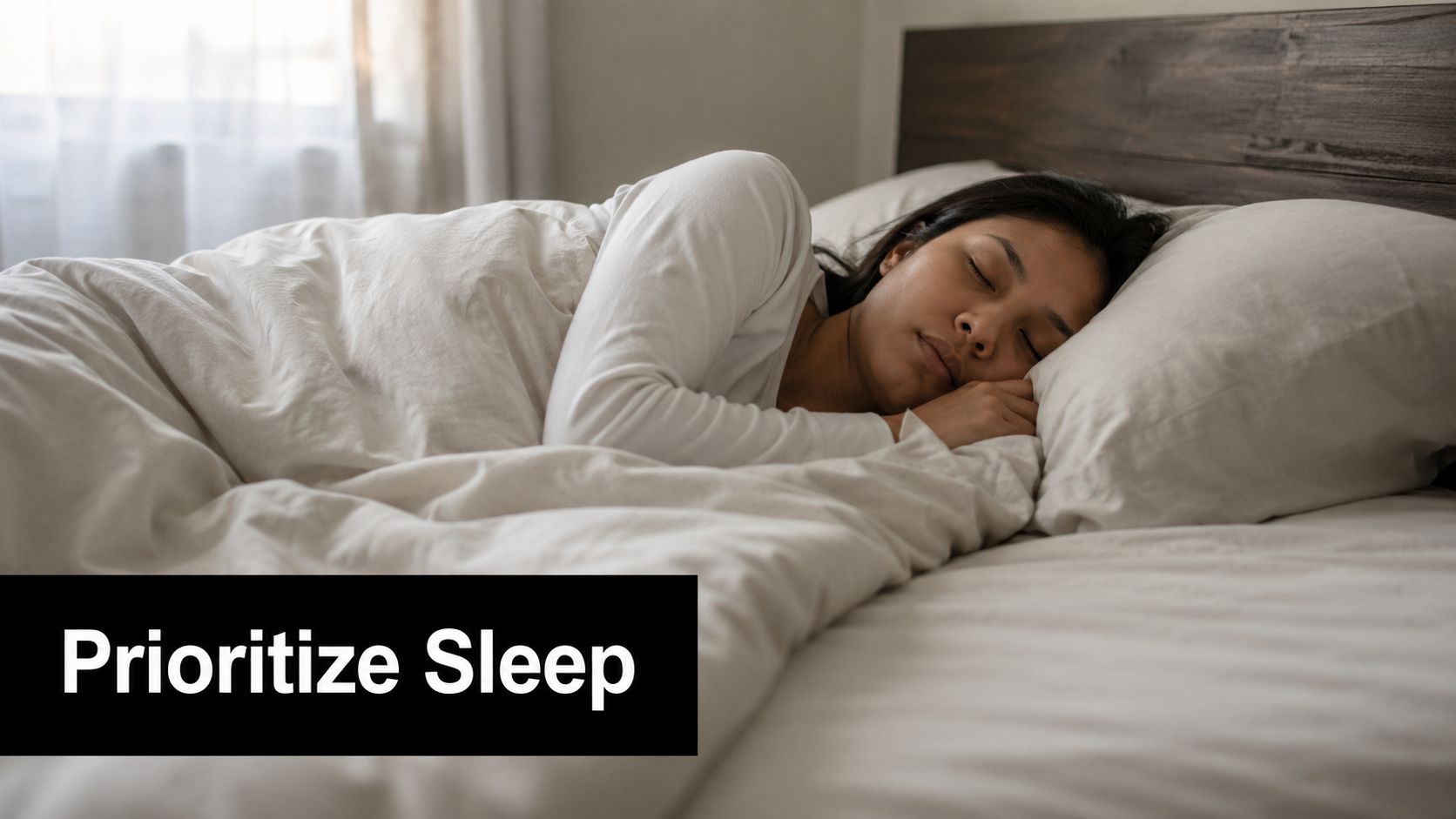
Sleep affects attention, mood, appetite, reaction time and perceived effort. A useful starting point is a consistent wake time, enough protected time in bed, a dark and comfortable room, and a wind-down routine that is realistic on workdays.
Sleep hygiene is not a cure for every sleep disorder. Loud snoring, witnessed pauses in breathing, severe daytime sleepiness, persistent insomnia, restless legs or sleep disruption linked to menopause symptoms deserve clinical assessment. Shift workers and carers may need changes to schedules or support, not advice that assumes full control over bedtime.
5. Plan Recovery and Set Workload Boundaries
Recovery is not only time away from the gym. It includes breaks, manageable deadlines, protected leave, task switching, periods without alerts and enough space between demanding events. A boundary is useful when it changes exposure to stress, not merely when it is written in a planner.
For training, reduce volume or intensity when performance, sleep and motivation deteriorate together. For work, identify which deadline, meeting or responsibility can be renegotiated before errors accumulate. A planned lighter period is not evidence of weakness; it is a way to keep the overall system functional.
6. Practise Evidence-Based Psychological Skills
Cognitive behavioural techniques, mindfulness and structured problem-solving appear in many resilience interventions. They serve different purposes:
- Problem-solving: define a controllable problem, generate options and choose the next action.
- Cognitive skills: examine whether an automatic conclusion is accurate, helpful and supported by evidence.
- Mindfulness: practise noticing thoughts, sensations and emotions without immediately acting on them.
- Grounding or paced breathing: reduce acute arousal for some people, while recognising that breath-focused practices can feel uncomfortable for others.
Start with a brief practice that can survive a difficult week. More is not automatically better, and persistent anxiety, panic, trauma symptoms or depression should not be managed only through an app or self-help routine.
7. Keep Food and Hydration Predictable
Regular meals and adequate energy can reduce avoidable hunger, fatigue and distraction. Aim for a sustainable pattern containing protein sources, fibre-rich carbohydrate, vegetables or fruit, and appropriate fats. Athletes and highly active people should pay particular attention to under-fuelling.
Food does not make someone immune to stress, and ordinary fluctuations in concentration or mood should not be attributed automatically to “blood sugar crashes”. People with diabetes, eating disorders, gastrointestinal disease or significant weight change need individual advice from an appropriately qualified professional.
8. Maintain Meaning, Learning and Contribution
Learning and contribution can widen life beyond the immediate stressor. The activity should be proportionate: a short course, creative practice, volunteering, mentoring or returning to an abandoned interest may be enough. Turning every hobby into another performance target can remove the benefit.
Ask which activities provide curiosity, competence, connection or purpose. Keep one in the week even during busy periods, but do not use volunteering or self-improvement to conceal exhaustion that requires rest.
9. Track a Small Number of Useful Signals
Tracking can reveal patterns, but it can also create anxiety. Choose two or three signals that lead to action, such as sleep opportunity, perceived stress, completion of planned movement, social contact or a simple work-demand rating.
Heart-rate variability can be influenced by sleep, illness, alcohol, training, breathing pattern, device and measurement conditions. A Qaly consumer explanation of low HRV may help readers understand the metric, but one low value does not diagnose stress or poor resilience. Compare data under consistent conditions and prioritise symptoms and function over a wearable score.
A weekly note can be more useful than a complex dashboard:
- What helped this week?
- What repeatedly increased the load?
- What is the smallest change that would make next week safer or more workable?
10. Know When Self-Management Is Not Enough
Seek professional support when stress, anxiety or low mood is persistent, worsening, impairing work or relationships, disrupting sleep or appetite, or causing reliance on alcohol, drugs or unsafe behaviours. NHS talking therapies and a GP can help assess the problem and discuss treatment options.
If there is immediate danger, an inability to stay safe, thoughts of self-harm or suicide, or severe mental-health symptoms, use urgent NHS mental-health support, call 999 in an emergency, or go to A&E. A resilience plan is not crisis care.
Resilience Strategies Comparison
| Strategy | Useful starting action | Main limitation |
|---|---|---|
| Identify the load | Name one demand that can be changed | Some pressures require organisational or social action |
| Connection | Schedule one reliable contact | Contact is not helpful if the relationship is unsafe |
| Physical activity | Choose a recoverable weekly routine | Exercise is not a mental-health diagnosis or cure |
| Sleep | Protect a repeatable sleep opportunity | Sleep disorders need assessment |
| Boundaries and recovery | Remove or renegotiate one avoidable demand | Individual boundaries may need leadership support |
| Psychological skills | Practise one brief, specific technique | Self-help is not enough for severe or persistent symptoms |
| Nutrition | Keep meals regular and adequate | No food pattern prevents all effects of stress |
| Meaning and learning | Protect one valued activity | Do not turn recovery into another achievement test |
| Tracking | Review two actionable signals weekly | Wearables and scores are non-specific |
| Professional support | Contact a GP or talking-therapy service early | Urgent risk needs crisis services, not a routine appointment |
Putting Your Resilience Plan into Practice
Choose one pressure to reduce, one source of support to strengthen and one recovery habit to protect. Review the effect after two weeks using function rather than perfection: Is sleep more stable? Are important tasks getting done? Is distress less disruptive? Is help easier to request?
The aim is not to become unaffected by difficulty. It is to recognise load earlier, respond with a broader set of resources and recover without allowing preventable stress to become chronic.
The content in this article is for educational purposes only and does not constitute medical or psychological advice. If stress, anxiety, low mood or sleep problems are persistent, worsening or affecting daily life, consult a qualified healthcare professional. Seek urgent help immediately if you may harm yourself or cannot stay safe.
Visit Telomyx for evidence-led health and performance information. Physical testing can support specific fitness goals, but it should not be used as a score of psychological resilience.