
TDEE Calculator Accuracy: What the Numbers Really Mean
17 August 2026Updated 19 August 2026
You enter your age, height, weight and activity level into a TDEE calculator, receive a neat calorie target, and follow it carefully. Yet weeks later, your weight trend doesn't match the prediction. A runner may find that a target no longer supports training, while someone trying to lose weight sees a plateau despite consistent meals and macros.
That mismatch doesn't automatically mean you've failed, miscounted everything or damaged your metabolism. TDEE calculator accuracy is limited by the chain used to produce the number, and each link relies on assumptions. The resting metabolic rate equation may miss your individual physiology, the activity multiplier may not reflect your real movement, and the calorie intake you compare against may itself be incomplete.
Table of Contents
- Why Your TDEE Number Stopped Making Sense
- How a TDEE Calculator Actually Builds a Number
- Where the Error Creeps In
- Formula Estimates vs Clinical Measurements
- Practical Steps to Sharpen Your Calorie Target
- When Clinical Testing Becomes the Smart Move
- Why the Number Keeps Changing Through Life
- Common Questions About TDEE Calculator Accuracy
Why Your TDEE Number Stopped Making Sense
Consider a familiar situation. You've chosen an activity setting that seems reasonable, logged your food, and expected your weight to move in a predictable direction. Instead, the scale has stayed broadly unchanged, your gym sessions feel harder, or your weight has dropped faster than planned.
The tempting conclusion is that your metabolism is “broken”. A more useful explanation is that the calculator produced a population-based estimate, then applied a broad activity assumption to it. The final number looks precise because it's displayed as a single figure, but the calculation underneath is less personalised than the screen suggests.
Practical rule: Treat a TDEE result as a starting zone for observation, not as a metabolic verdict.
The problem has several layers. Most tools begin with an equation that estimates resting energy expenditure from details such as age, sex, height and weight. Some also use body-fat information to estimate lean mass. They then multiply the resting estimate by an activity factor intended to represent exercise, work, walking and other movement.
That process is convenient, but it can't see whether you spend most of the day seated after training, walk extensively during your commute, sleep poorly, or have recently lost weight. It also can't measure your breathing gases or observe the energy cost of your actual daily routine.
Research also shows why self-reported intake must be treated as another source of uncertainty. A large doubly labelled water analysis derived an expected-expenditure equation from 6,497 measurements and applied it to UK and US dietary survey datasets. It classified 27.4% of the combined survey reports as misreported. That is a population-level screening result, not the average size of an individual's logging error and not a direct accuracy score for an online TDEE calculator.
Your effort may be consistent while the estimate is not. The useful question becomes less “Why can't I follow the number?” and more “Which assumption in the number needs checking?”
How a TDEE Calculator Actually Builds a Number
A typical calculator follows a simple two-stage process.
First it estimates resting needs
The first stage estimates resting metabolic rate, or RMR. This is the energy your body uses at rest for essential functions such as breathing, circulation and maintaining temperature. Online tools may use equations including Mifflin-St Jeor, Harris-Benedict or Katch-McArdle.
The inputs usually include:
- Age and sex, which influence the equation's prediction.
- Height and weight, which provide a basic estimate of body size.
- Body-fat percentage, sometimes, allowing a lean-mass-based formula to be used.
- Activity level, which is applied after the resting estimate has been produced.
RMR isn't the same as the total energy you use across a day. It forms the base, while eating, walking, working, training and other movement add to the total.
Then it applies an activity multiplier
The second stage multiplies the estimated RMR by a category such as sedentary, lightly active or very active. Think of a house with central heating. The boiler output represents resting metabolism, the minimum energy required to keep the system running. The thermostat setting represents the activity factor, which attempts to account for how much extra energy the household uses throughout the day.
The analogy breaks down because a calculator doesn't observe your actual routine. It can't distinguish between a desk worker who trains hard but barely moves afterwards and someone whose job keeps them on their feet.
The result is useful as a rule of thumb. It isn't a direct reading of your daily energy expenditure, because the calculator has estimated both the base and the way you live around it.
Where the Error Creeps In
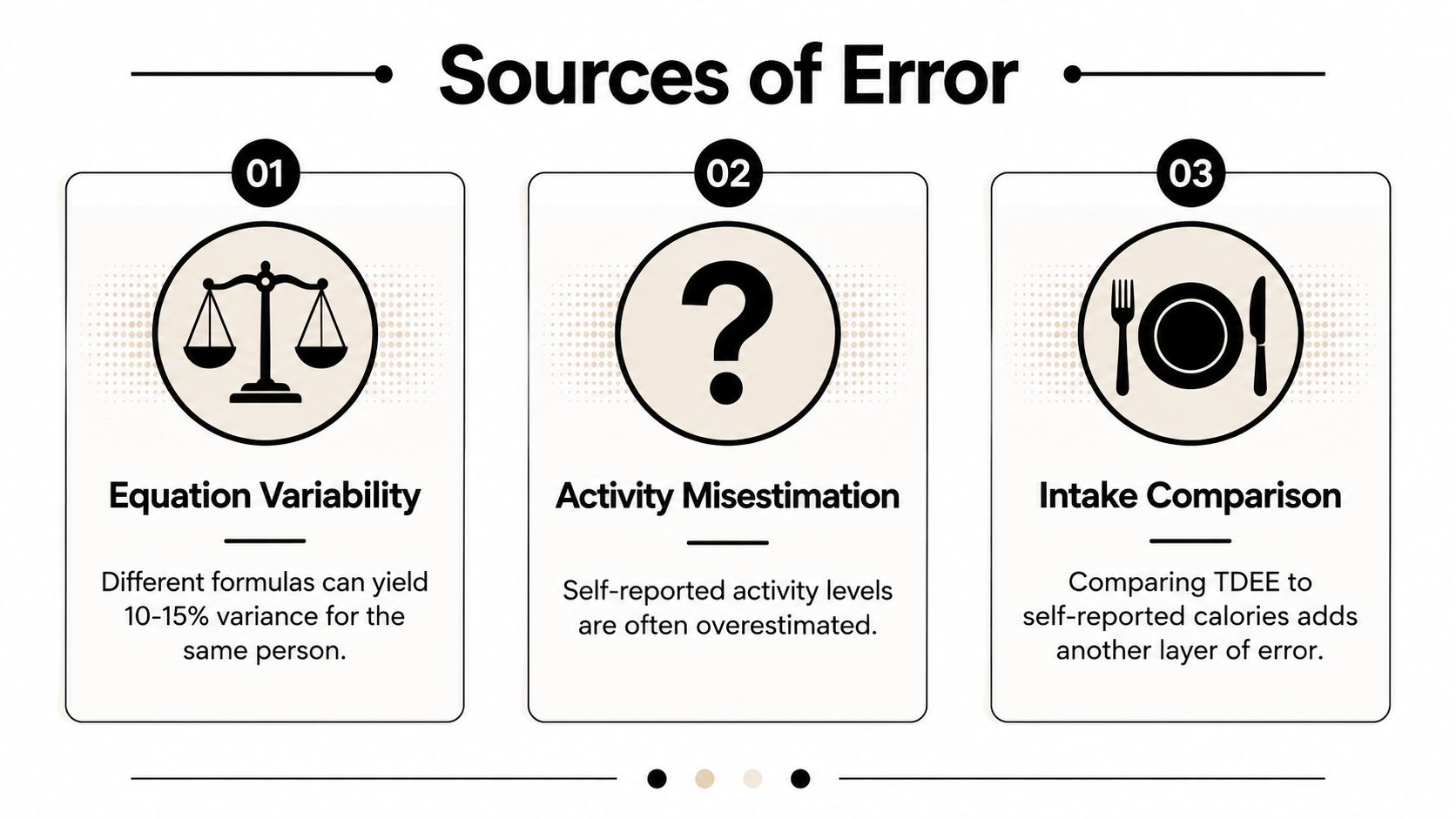
The error chain starts with the RMR equation. These formulas are validated across groups, but an equation that performs reasonably for a population can still miss an individual. In athlete research, the best-performing formula predicted measured RMR within 10% for about 80.2% of participants, while other equations achieved figures ranging from 40.7% to 63.7% (exercise-science review). In practical terms, even the stronger formula left some people outside that error band.
The next link is the activity multiplier. “Moderately active” can describe very different lives. Two people may complete similar training but differ substantially in walking, standing, commuting, occupational movement and post-exercise fatigue. A multiplier compresses those differences into one category.
The comparison problem
The third link appears when you compare the calculator's output with your food log. Dietary records depend on accurate portions, forgotten extras, cooking ingredients and consistent recording. In an experimental population-level analysis of 197 UK adults, the Office for National Statistics Data Science Campus reported that self-reported intake was, on average, 32.0% lower than doubly labelled water expenditure, with individual reporting error ranging from -16.5% to 72.2% (ONS Data Science Campus methodology). These figures describe that small research sample and do not quantify the error in any one person's food log.
Among people who under-reported, the same source found gaps of 598 to 3,671 kcal per day, showing how widely the difference varied in that sample. These values concern self-reported intake rather than calculator performance, so they cannot tell you how inaccurate your own TDEE estimate is.
The final number inherits uncertainty from the equation, the multiplier and the comparison data.
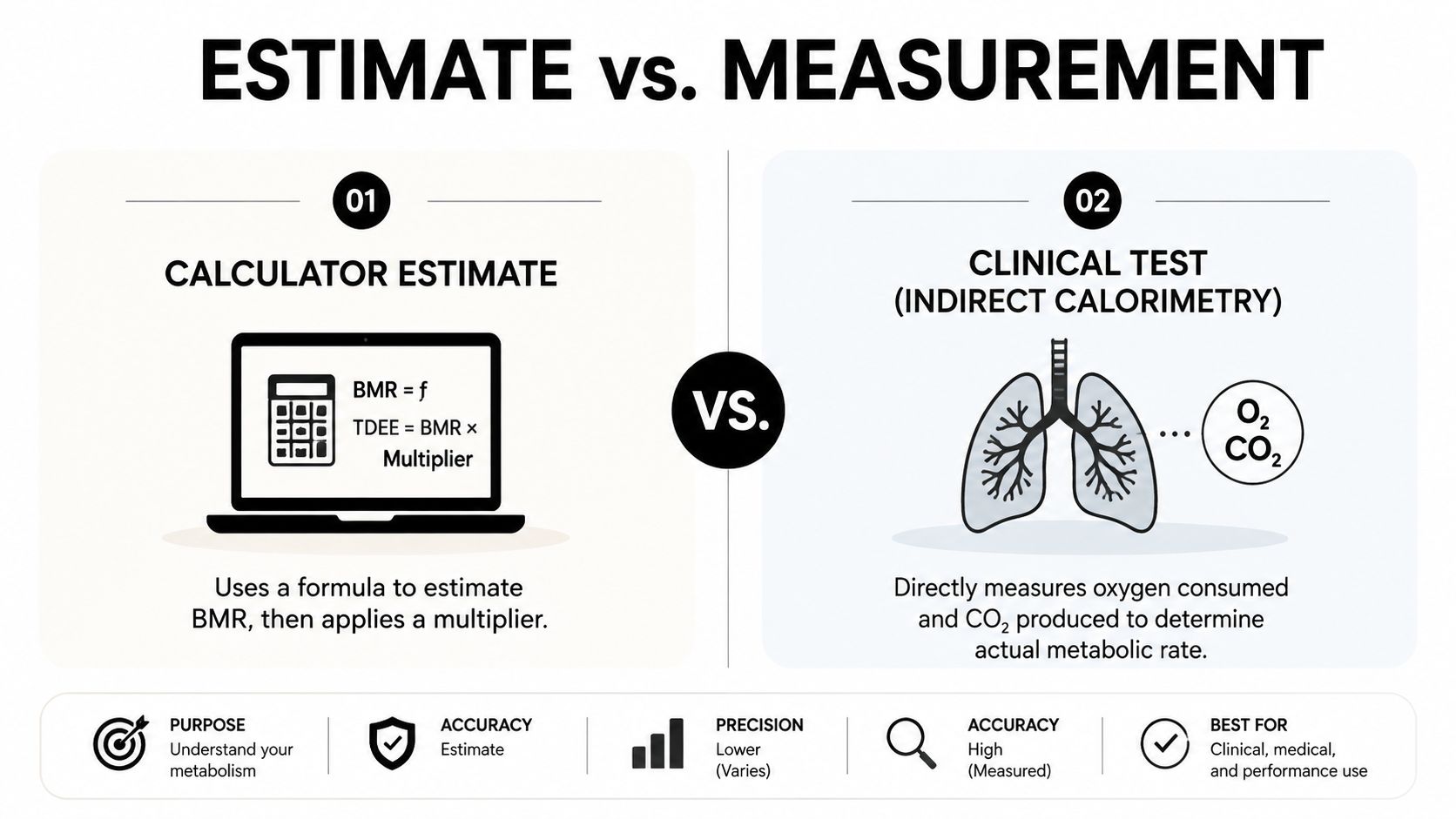
The practical consequence is simple. Use the estimate to establish a sensible starting point, then test it against your weight trend, performance, recovery and hunger. If you need to identify the largest source of uncertainty, measurement can replace one of the assumptions.
A Telomyx DEXA body-composition scan estimates total and regional fat mass and lean soft tissue. Lean soft tissue is not identical to skeletal-muscle mass, and whole-body bone data is not equivalent to diagnostic hip-and-spine osteoporosis assessment. The scan does not measure TDEE directly, but it can provide more informative body-composition context than weight alone.
Formula Estimates vs Clinical Measurements
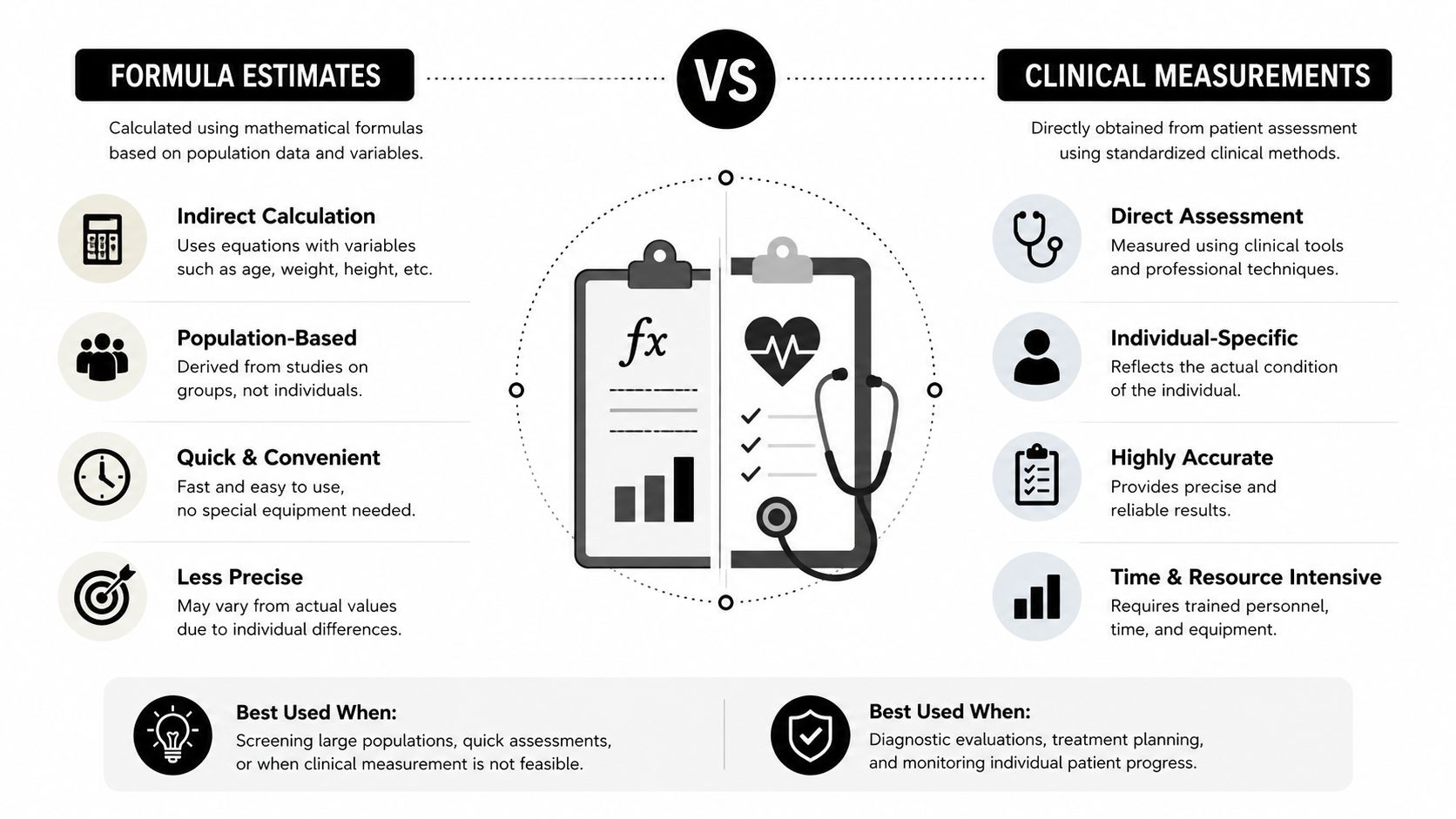
A formula asks, “What would someone with these characteristics typically require?” A clinical measurement asks, “What is this person's resting energy expenditure under the test conditions?”
Indirect calorimetry addresses the second question by analysing oxygen consumed and carbon dioxide produced while you rest. The test converts gas exchange into a measured estimate of resting energy use. It still represents a defined testing condition, not every calorie burned during work, exercise or household activity, but it removes the equation from the resting component.
What body composition adds
Body-composition measurement provides a separate kind of information. It estimates fat mass and lean mass across the body, giving context that height and weight cannot provide. A lean-mass-based equation such as Katch-McArdle can use fat-free mass, but its usefulness still depends on the quality and consistency of that input.
That distinction matters for someone whose body weight doesn't tell the full story. Two people can weigh the same while carrying different amounts and distributions of lean tissue and fat. A calculator using weight alone may treat them as more alike than they really are.
The guide to calculating RMR helps clarify the difference between a predicted resting value and a measured one. That doesn't make clinical testing necessary for everyone. If your weight trend aligns with your target and your training feels sustainable, a basic estimate may be adequate for your purpose.
Clinical data becomes more valuable when the gap affects decisions. Examples include a persistent plateau, unexpectedly rapid weight change, under-fuelling concerns, high training demands, or a major change in body composition. In those situations, replacing the resting estimate with a measured value can make the rest of the calculation easier to interpret.
The point isn't to dismiss calculators. It's to judge them against the right standard. A formula is efficient and accessible. Indirect calorimetry and body-composition testing provide different individual measurements that can reveal which assumptions deserve less trust.
Practical Steps to Sharpen Your Calorie Target
Start with the calculator you have, but turn its output into a testable hypothesis. Choose a calorie intake that fits your goal, keep your routine reasonably consistent, and record enough information to identify a trend rather than reacting to one weigh-in.
Build a useful baseline
Track food, body weight and relevant training for a practical observation window of around two to three weeks, an approach also described in general maintenance-calorie tracking guidance. This is not a validated clinical threshold: extend the period when short-term fluid, menstrual-cycle, illness or training-related changes make the trend hard to interpret. Use consistent weighing conditions where possible and record oils, drinks, sauces and small items that are easy to overlook.
Compare the direction of your real-world trend with what your calorie target predicted. A single fluctuation may reflect normal changes in fluid, digestion or training, so look for the broader pattern.
Adjust the assumption, not your whole plan
If your weight is falling faster than expected, your actual expenditure may be higher than estimated, so the activity multiplier may be too low, or intake may be lower than recorded. If loss is slower than expected, the multiplier may be too high, intake may be under-recorded, or your current routine may involve less movement than the category implies.
| What you notice | Likely source of error | Practical next step |
|---|---|---|
| Weight is stable when loss was expected | Intake or activity assumptions don't match reality | Audit portions and movement, then make a modest adjustment |
| Weight is dropping faster than intended | The target may be too low for your actual needs | Review intake consistency, recovery and the activity setting |
| Training feels increasingly difficult | The target may not support your training load | Review fuelling and seek professional advice if under-fuelling is a concern |
| Results change after a routine shift | The old activity factor no longer describes your week | Recalculate the estimate and restart a consistent observation period |
Use the scale trend as feedback about the estimate, not as a judgement about your discipline.
The calorie deficit calculation guide can help you connect a target with the outcome you're seeing. Keep the benchmark personal. Your calibrated maintenance estimate may change when your weight, training or daily routine changes. Avoid aggressive restriction if you are an athlete, are pregnant or breastfeeding, are navigating perimenopause with under-fuelling concerns, or have a current or previous eating disorder. Seek advice from an appropriately qualified clinician or dietitian rather than repeatedly cutting intake when recovery, menstrual function, mood or training performance is deteriorating.
If careful tracking still leaves a substantial unexplained gap, don't keep adjusting blindly. That's the point at which a measured RMR can identify whether the first term in the calculator is the main problem.
When Clinical Testing Becomes the Smart Move
Clinical testing makes sense when you need to replace selected assumptions with measurements. Resting metabolic rate testing addresses the base of the TDEE chain, while body-composition assessment can add context that helps explain why a weight-based estimate may not fit.
A Telomyx RMR test estimates energy use at rest through indirect calorimetry. The result provides an individual resting value rather than one generated solely from age, sex, height and weight. It still does not measure TDEE; daily movement, exercise and the thermic effect of food remain additional components.
Two measurements, different jobs
Body-composition testing does not measure total daily energy expenditure. Its role is to show relevant physical context, including lean mass and fat mass. That information can help a clinician, dietitian or appropriately qualified practitioner interpret a resting result and track whether changes reflect fat loss, lean-mass change or both.
Together, the tests answer different questions:
- Resting measurement: How much energy does your body use at rest under the test conditions?
- Body-composition assessment: How are fat mass and lean mass distributed?
- TDEE planning: How should those measurements be combined with your actual routine?

Telomyx provides mobile clinical assessment services across UK gyms, wellness centres and workplaces. Individual measurements can improve the starting information without turning any single result into a complete daily energy-expenditure answer.
Testing isn't automatically required because a calculator has uncertainty. It becomes a sensible escalation when your decisions carry more weight, such as persistent unexplained results, demanding athletic training, repeated dieting, changing body composition or a life-stage transition. The aim is recalibration, not perfection. You measure, update the starting point, and continue validating it against real life.
Why the Number Keeps Changing Through Life
Many calculators assume that your resting baseline stays stable until you change the visible inputs. Human physiology doesn't work that neatly. Resting energy use can shift with body size, body composition, age and life stage, while daily movement and training also change around it.
Weight loss is a clear example. As body mass changes, the energy required to move and maintain the body can change too. People may also experience metabolic adaptation, where measured energy expenditure doesn't follow the simple prediction from body weight alone. A target that once produced a predictable response can therefore become less useful after a prolonged diet.
Life stage changes the context
During perimenopause and menopause, body composition, sleep, symptoms and activity may change together. A calculator sees age and weight but does not observe that wider context. This does not mean hormones make energy balance unknowable; it means an unexplained or symptomatic change should be assessed in context rather than attributed automatically to a “broken” metabolism.
Across adulthood, changes in body size, lean mass, health, work and spontaneous movement can alter the balance between resting and total expenditure. Age alone does not explain every change, and standard calculator inputs cannot capture every relevant difference between people.
A calculator can be consistent while your physiology and routine are changing.
That doesn't mean you need to test every minor fluctuation. Revisit the estimate after meaningful changes in body weight, training, health or routine, and seek clinical review for persistent fatigue, menstrual disturbance, unexplained weight change or other concerning symptoms.
Clinical testing can act as a checkpoint. It provides a snapshot under defined conditions, which can then be interpreted alongside changes in body composition, routine and symptoms rather than assuming the first estimate remains valid indefinitely.
Common Questions About TDEE Calculator Accuracy
How often should I recalculate my TDEE?
Recheck it when your weight, training or daily activity has changed meaningfully, rather than changing the figure after every small fluctuation. Start with a consistent tracking period, then adjust from the trend.
Are wearable calorie estimates more accurate?
A wearable adds personal sensor data, but it still estimates energy expenditure through algorithms and available signals. It may be useful for observing patterns, but it shouldn't automatically be treated as a direct measurement of TDEE.
Should I combine RMR testing with a DEXA scan?
They answer different questions. Resting testing estimates energy use under defined resting conditions, while body-composition assessment estimates fat mass and lean mass. Combining them can provide more context when a generic estimate is not explaining your results, but neither directly measures free-living TDEE.
What if the calculator and scale disagree?
Check your recording consistency, activity assumptions and trend window before making a major change. If the mismatch persists, resting and body-composition measurements can help identify whether the equation, the activity factor or the comparison data is driving the problem.
Is a calculator useless?
No. It provides an accessible starting point. The sensible sequence is track, recalibrate, then escalate to clinical testing when the gap is large enough to affect your health, performance or progress.
The content in this article is for educational purposes only and does not constitute medical or dietary advice. If you have an underlying health condition, are taking medication, have a current or previous eating disorder, or are considering significant changes to your diet or exercise regimen, consult a qualified healthcare professional before making any adjustments.
Visit Telomyx to explore whether objective clinical measurements could support a professionally guided nutrition or performance plan.