
VO2 Max for Athletes: The Complete Performance Guide
28 July 2026Updated 31 July 2026

You're on the track, the bike, or in the gym, and the same frustrating pattern keeps showing up. The work feels harder, the sessions are neatly logged, but race pace, repeatability and recovery don't seem to move. That's the point where VO2 Max for Athletes stops being an abstract lab number and becomes a practical way to understand what your body can sustain.
For a club runner, that might mean the easy runs still feel too hard. For a triathlete, it might mean you can hold power in one block of intervals, then fade later in the session. For a HYROX athlete, it often looks like strong station work followed by a run that never quite comes back. Aerobic capacity sits underneath all of those problems, but it's only one part of the performance picture.
Table of Contents
- Why Aerobic Capacity Matters More Than You Think
- What VO2 Max Actually Means
- Lab Tests, Field Tests and Wearable Estimates Compared
- How to Read Your Score by Age, Sex and Sport
- Turning Test Results into Personalised Training Zones
- Sample Protocols to Raise VO2 Max Without Burning Out
- Where VO2 Max Meets Body Composition and Resting Metabolic Rate
- Your Next Step From Data to Performance
Why Aerobic Capacity Matters More Than You Think
A runner adds mileage for six weeks and still hits the same hill at the same place. A cyclist keeps repeating hard group rides, then wonders why the final quarter of an event still feels messy. A HYROX competitor can smash the sled and the rower, but the next run rep tells the truth. That's usually not a motivation problem, it's a signal that the aerobic engine underneath the work needs attention.
What the engine is doing
Aerobic capacity is the system that helps you keep producing energy when the effort lasts long enough to expose weaknesses in oxygen delivery, muscle fuel use and recovery between surges. In endurance sports, it matters because it supports not just steady pace, but also how quickly you clear the feeling of strain between hard efforts. That's why lab-based VO2 max testing still has real value for athletes, it gives a direct look at the ceiling of that system, rather than a guess from a watch or a track session.
The practical benefit is simple. When your aerobic base is stronger, easy training tends to stay easier, threshold work becomes more controllable, and repeated efforts stop feeling like separate emergencies. For athletes balancing work, training and family life, that matters as much as a race result, because it changes how much quality you can absorb week to week.
Practical rule: if your hard sessions are getting harder without a matching lift in pace, power or recovery, you probably need better data rather than more effort.
The idea here isn't to worship a number. It's to understand where VO2 max for athletes fits inside the bigger performance puzzle, so you can use it to guide training instead of chasing random tiredness. A strong aerobic system also matters for long-term health, which is why performance testing and health testing often overlap in the same athlete.
What VO2 Max Actually Means
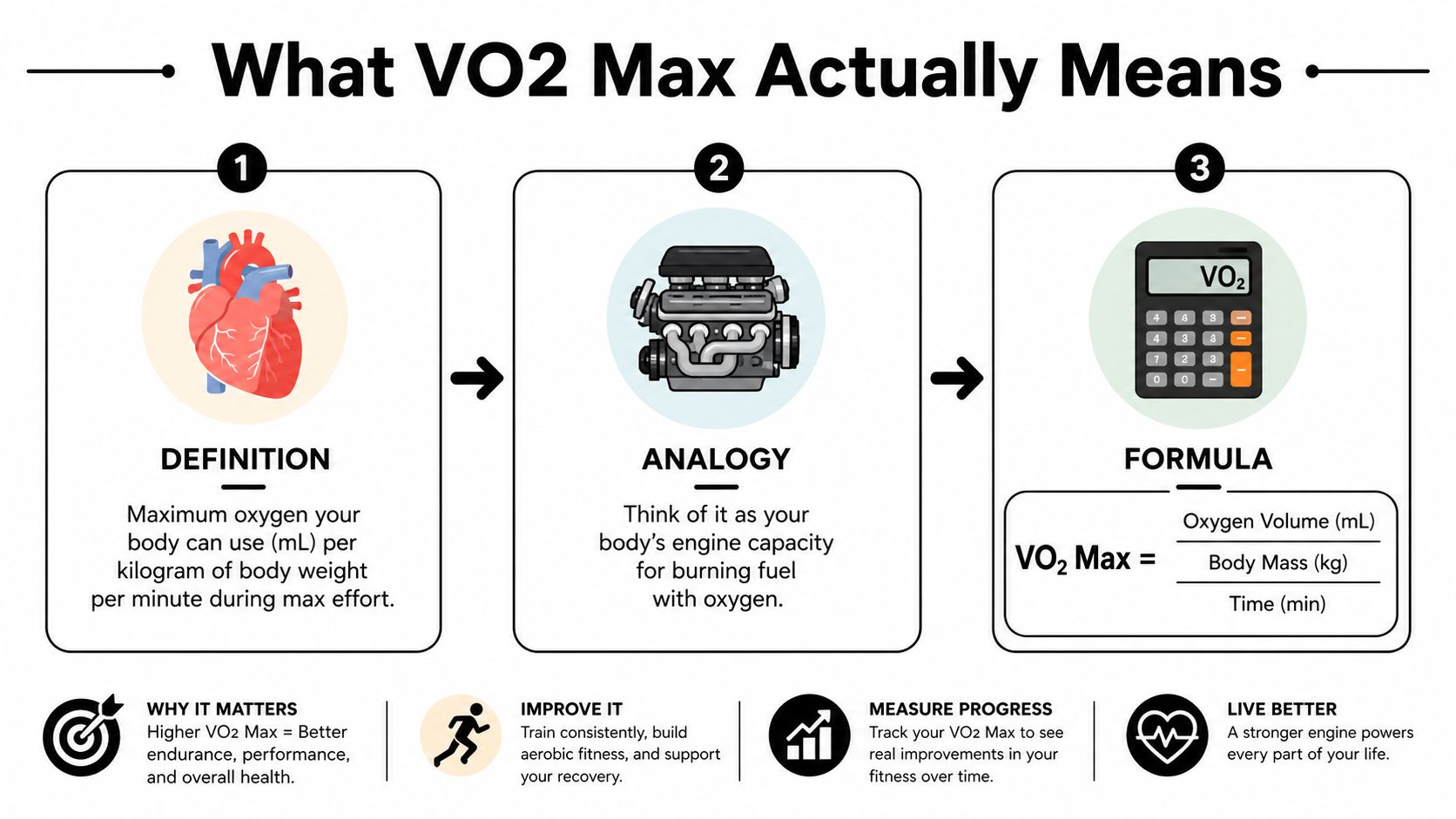
VO2 max is the maximum amount of oxygen your body can use per kilogram of body mass per minute during exhaustive exercise, and it's the laboratory-standard measure of maximal aerobic capacity, used to set training zones and compare athletes across sports and cohorts (VO2 max definition). That sounds technical, but the idea is straightforward. Oxygen enters through the lungs, gets carried by the blood, reaches the muscles, and is used to make energy. VO2 max is the rate limit of that whole chain.
The supply chain idea
Think of your body like an engine with several connected parts. The lungs load oxygen, the heart pumps oxygen-rich blood, the blood vessels deliver it, and the muscles pull it out and turn it into work. If any link in that chain is limiting, your output drops.
The Fick equation is the physiology version of that idea. In plain language, it says oxygen use depends on how much blood the heart can move and how much oxygen the muscles can extract from that blood. You don't need to memorise the equation to use the concept. You just need to know that VO2 max reflects the whole transport-and-use system, not one organ in isolation.
That's why it's useful to separate VO2 max from other endurance terms. Lactate threshold and ventilatory thresholds tell you where effort starts to become harder to sustain. VO2 max tells you how big the ceiling is above those thresholds. Two athletes can share a similar ceiling yet race very differently if one can hold a higher fraction of it for longer.
The number matters, but the shape of the curve matters too.
Because VO2 max is expressed relative to body mass, mL/kg/min is especially relevant in running and cycling, where extra body mass has to be carried or turned uphill. That's also why body composition matters later in this guide. A DEXA scan can separate fat mass from lean mass with clinical precision, and the DEXA body composition scan gives a direct baseline for that part of the picture without relying on rough guesswork.
Lab Tests, Field Tests and Wearable Estimates Compared
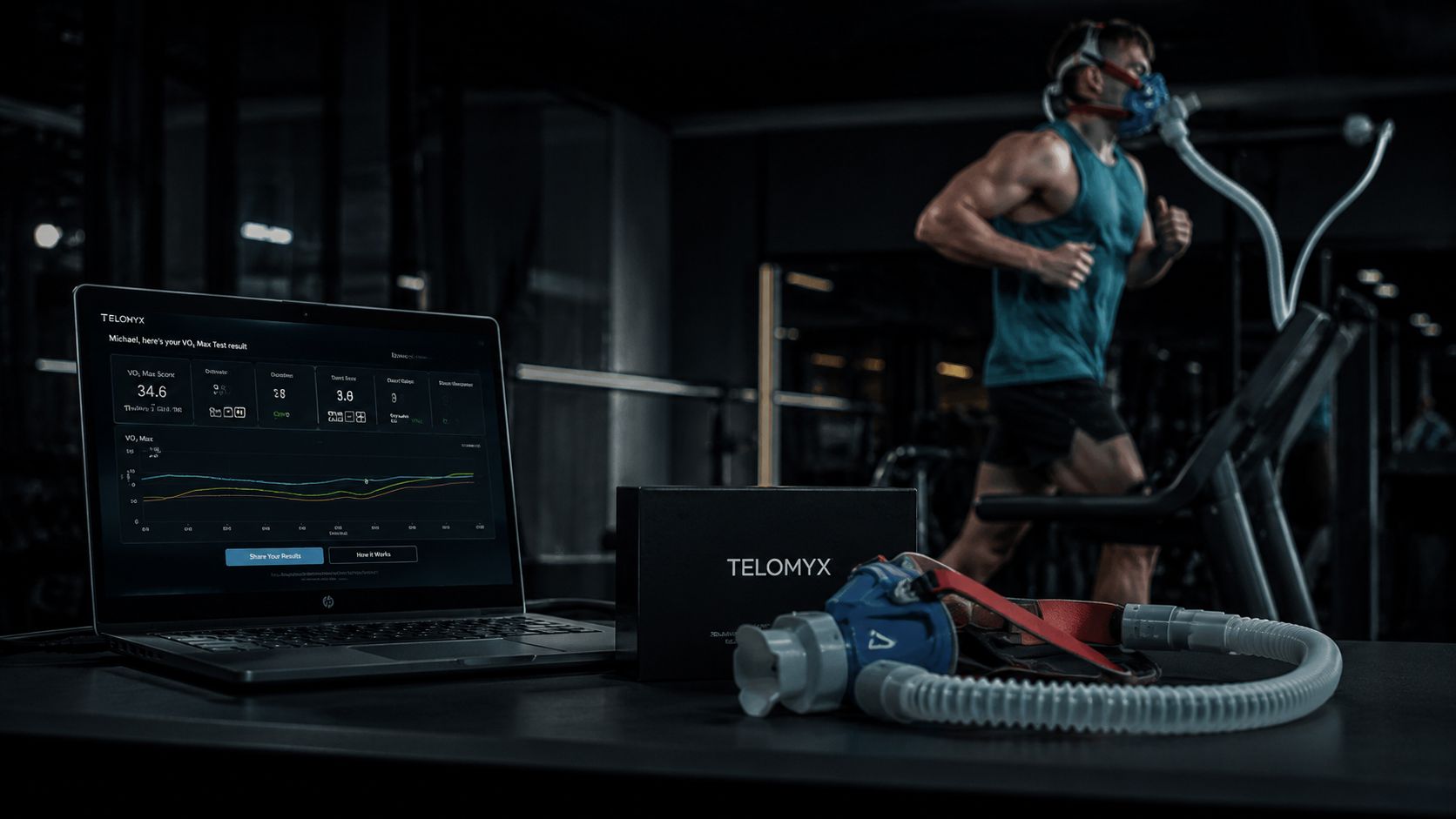
The most accurate assessment of aerobic capacity remains a maximal incremental lab test with a mask measuring oxygen uptake and carbon dioxide output, while field protocols and wearable estimates can drift with body mass, pacing, heat and fatigue (test accuracy and drift). That's the key distinction to keep in mind. Some methods estimate VO2 max well enough for trend tracking. Others measure it directly.
Which method fits which athlete
A lab test on a treadmill or cycle ergometer is the gold standard because the workload rises in stages until oxygen uptake plateaus despite higher effort. That plateau is what defines the ceiling. In practice, plenty of athletes stop before a clear plateau appears, and the value reported is then a peak VO2 rather than a verified VO2 max. A good report will say which one you got, and will show the secondary criteria used, such as a respiratory exchange ratio above 1.10 and a heart rate close to age-predicted maximum. It's also why a proper test needs a mask, gas analysis and someone who knows how to interpret the data. The same logic applies whether you're a runner, cyclist or mixed-modality athlete, because the lab test captures the physiology rather than the guess.
Field tests have value when access or budget is limited. The Cooper 12-minute run and the Rockport walk test are both established estimation methods, and they can be useful for rough comparisons over time. They're not the same as a gas-analysis test, though. Pacing strategy, heat, fatigue and body mass can all distort the result.
Wearables sit in a different category again. They're convenient, and they can be helpful for spotting trends, but they estimate VO2 max from heart-rate response and workload data. A watch can say you improved when what really changed was conditions, load or how fresh you were on the day.
| Method | Accuracy | Equipment | Best for |
|---|---|---|---|
| Lab incremental test | Highest | Metabolic cart, mask, treadmill or bike | Race zones, precise benchmarking |
| Field protocol | Moderate | Track, measured route, stopwatch | Simple screening, rough tracking |
| Wearable estimate | Variable | Watch, heart-rate and pace or power data | Day-to-day trend monitoring |
For athletes who want a practical benchmark, a clinical service such as VO2 Max Test can anchor the zones far more reliably than a wrist estimate. If you want the testing context in a broader performance setting, the internal guide on cardiovascular fitness testing shows where VO2 max sits alongside other measures. The right choice depends on your goal, but the principle is constant, use the most direct method you can access for the decision you need to make.
How to Read Your Score by Age, Sex and Sport
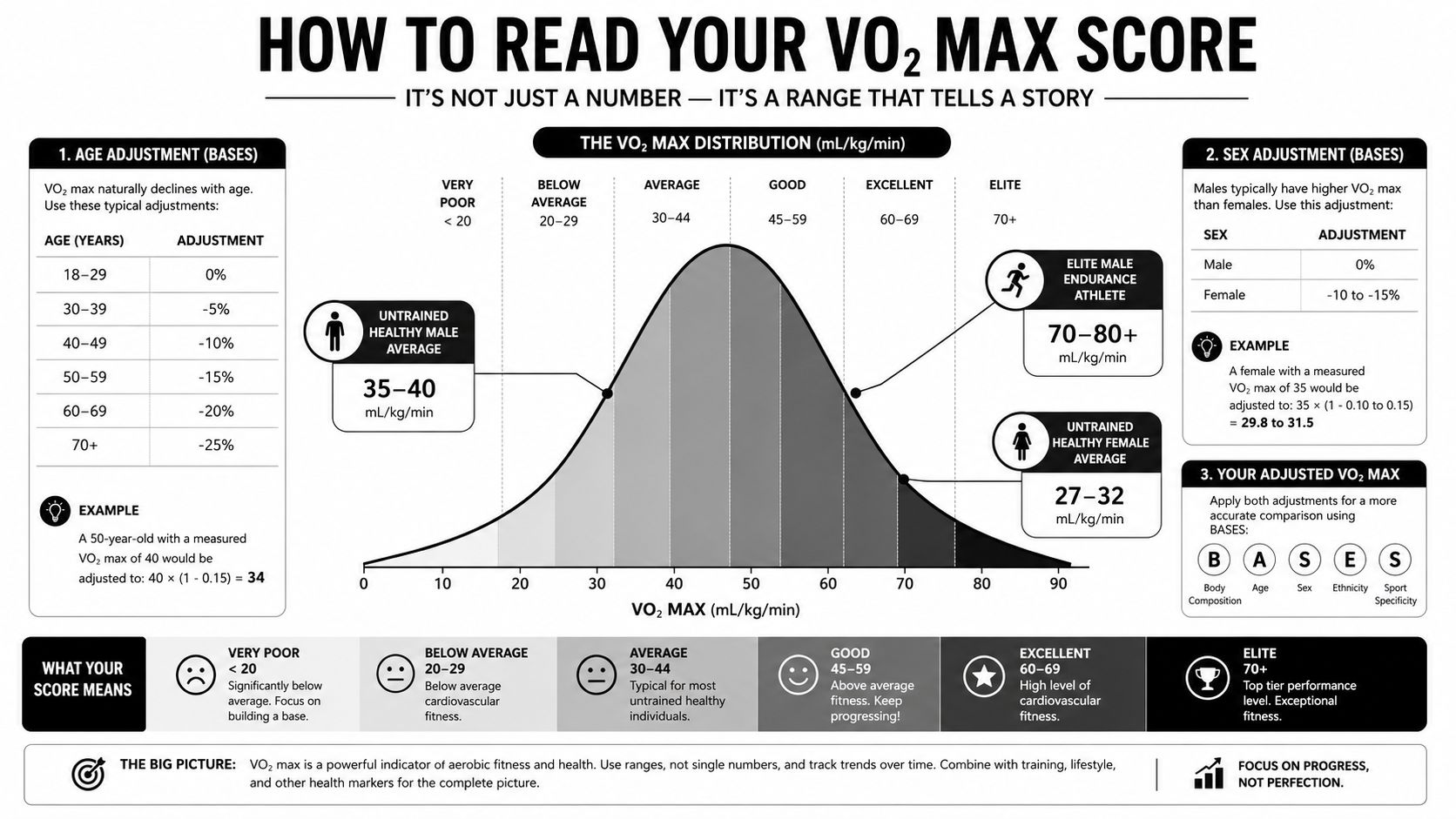
In the UK, the most useful baseline comes from age- and sex-specific reference data used in sports science practice. Untrained healthy men average about 35 to 40 mL/kg/min, while untrained healthy women average about 27 to 31 mL/kg/min. Competitive endurance athletes are usually far higher, often above 60 mL/kg/min, and elite endurance performers typically land around 70 to 85 mL/kg/min in men and 60 to 75 mL/kg/min in women, with a handful of outliers recorded above 90 (endurance physiology reference ranges, performance benchmarks).
Read the number in context
A score only makes sense when you know what it's comparing against. A recreationally fit runner and an amateur cyclist can land in similar territory, but the meaning changes if one sport rewards repeated surges and the other rewards long steady power. Even within endurance sports, women typically score 5 to 10 mL/kg/min lower at comparable competitive levels, so direct comparisons need care (training-status ranges).
That's why a single reading is less helpful than a trend. If your score rises, it suggests a real shift in aerobic capacity, especially if the protocol stayed the same. If it doesn't move, that doesn't automatically mean training failed. Performance can improve through better thresholds, better economy or better pacing even when VO2 max stays flat.
For club athletes, that's a useful reality check. A runner might not need a bigger ceiling if their threshold pace improves enough to hold a faster race speed. A cyclist might win more from improved repeatability and fatigue resistance than from another small bump in VO2 max. A HYROX athlete might need all three, but not in the same order.
Rule of thumb: don't ask whether your score is “good” in isolation, ask what it lets you do in training and racing.
For cyclists in particular, the way VO2 max interacts with sustained effort is often easier to see when the score is interpreted alongside event demands, which is why the article on VO2 Max for Cyclists is a useful companion. The number is a signal. Your sport decides how loud that signal should be.
Turning Test Results into Personalised Training Zones
A good VO2 max test does more than hand you a score. It gives you anchor points for the work that changes performance. Those anchors usually come from ventilatory threshold 1, ventilatory threshold 2, and either maximal heart rate or maximal power, depending on the sport and test setup.
From a test to five zones
The simplest way to think about zones is this. Zone 1 is recovery, Zone 2 is easy aerobic work, Zone 3 sits in the middle and is often too hard to be easy, Zone 4 is threshold work, and Zone 5 is VO2 max intensity. The precise numbers should come from your own test, not from a generic age-predicted formula.
Take a runner with a max heart rate of 188 bpm and a first ventilatory threshold at 154 bpm. That athlete can use the threshold as the upper limit for easy aerobic running, then keep threshold and interval sessions tied to the next anchor points from the same test. The result is a clearer map than “run at 70 percent” or “do some hard reps”. The body doesn't adapt to vague instructions very well.
| Zone | What it feels like | Typical use |
|---|---|---|
| Zone 1 | Very easy, fully conversational | Recovery, warm-up, cool-down |
| Zone 2 | Easy but purposeful | Aerobic base, volume, durability |
| Zone 3 | Moderately hard, deceptively costly | Tempo work, used sparingly |
| Zone 4 | Hard, controlled, sustainable | Threshold development |
| Zone 5 | Very hard, limited duration | VO2 max intervals |
Zone 2 matters because it lets you build volume without turning every session into a race. That's where a lot of endurance adaptation lives. Threshold work matters because it raises the pace or power you can sustain before fatigue accumulates rapidly. Zone 5 work matters because it pushes the ceiling that VO2 max reflects.
A common mistake is to use one formula for everybody and call it precision. In reality, the test gives you the right denominator, your own physiology. Re-testing every few months keeps the zones honest as fitness changes.
Sample Protocols to Raise VO2 Max Without Burning Out
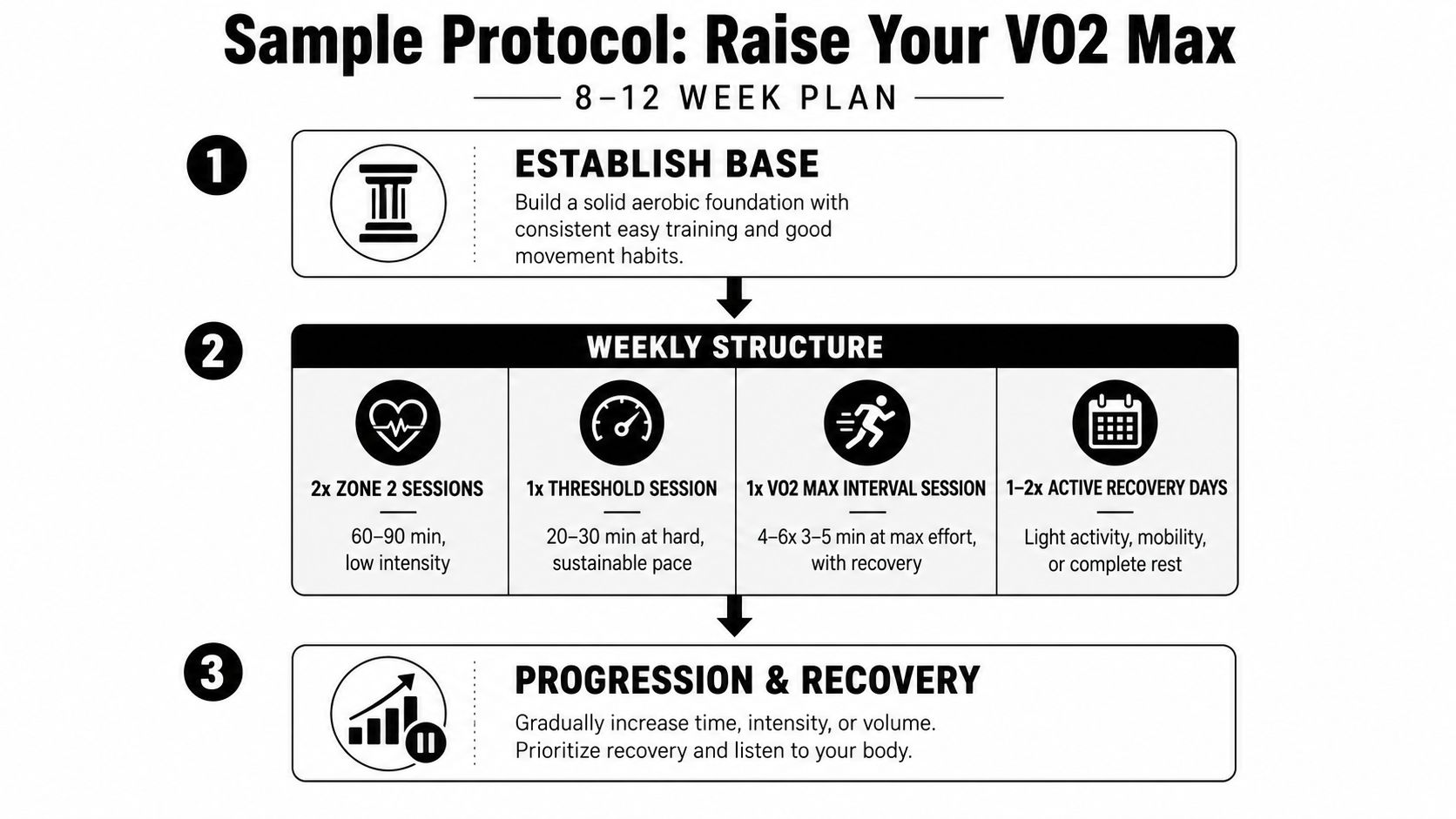
A sensible block for an already-trained athlete usually starts with consistency, not heroics. Two easy aerobic sessions, one threshold session and one VO2 max interval session give you enough stimulus to move without piling every stressor into the same week. Add strength work where it fits, then protect recovery as if it were another session, because adaptation happens after the work, not during it.
Two interval formats that actually get used
One classic format is 4 by 4 minutes at about 90 to 95 percent of max heart rate. That suits runners and cyclists who can settle into a hard but repeatable pace without blowing up early. Another is 8 by 2 minutes at roughly 100 percent of the pace or power you hit at VO2 max, which is useful when the event demands sharp repeated surges, as in mixed-modality racing. Both formats should be prescribed from your own test values, not from an age-predicted maximum heart rate.
Neither format works because it is magical. It works because the intervals are long enough to force a serious oxygen demand, but short enough that you can complete enough quality work to matter. The recovery between reps should let you hit the next interval properly, not turn the session into a slow collapse.
A 2023 meta-analysis of randomised trials in 176 elite athletes found that VO2 max rose significantly more after HIIT than after conventional training, so advanced athletes aren't automatically stuck at a ceiling (VO2max in elite athletes under HIIT: a meta-analysis, 2023). The catch is that gains tend to get harder to earn as training age rises. That's where coaching judgement matters more than stacking extra sessions.
For athletes who want a wider nutrition and recovery context around that workload, the resource on boost performance and recovery is a useful starting point because it sits alongside the training decision rather than replacing it. Supplements can't rescue a badly structured block. Sleep, fatigue control and session spacing still do the heavy lifting.
Watch the effort pattern in the video, then match that principle to your own sport rather than copying the exact workout. If the week starts to feel flat, leave the extra session out and keep the quality high. A deload is often smarter than a forced breakthrough.
Where VO2 Max Meets Body Composition and Resting Metabolic Rate
VO2 max is powerful, but it doesn't explain everything on its own. Two athletes can post the same oxygen uptake and perform differently because one carries less excess body fat, preserves more lean mass, or recovers better between sessions. That's where the metabolic puzzle becomes useful rather than merely interesting.
Relative score, lean mass and the weight you carry
Because VO2 max is expressed per kilogram of body mass, reducing excess body fat can improve the relative score even if absolute oxygen uptake doesn't change. That's not a cheat, it's how the metric works. Less non-functional mass means less load to move in running and less dead weight to accelerate in races with repeated changes of pace.
Lean mass matters for a different reason. It supports force production, helps you train harder over time, and protects the tissues that let endurance work stay sustainable. That's one reason body composition should sit next to VO2 max, not after it. A DEXA body composition scan gives total and regional fat mass, lean mass and bone density with medical-grade precision, which is more useful than guessing from body weight alone.
Why resting metabolic rate belongs in the same conversation
Resting metabolic rate, or RMR, tells you how much energy the body burns at rest. That matters because training zones guide intensity, body composition guides how those adaptations show up in race weight, and RMR guides fuelling. If you undereat, recovery suffers. If you overeat, body composition goals stall. If you guess, you're usually chasing symptoms instead of causes.
The internal guide on how to calculate RMR is relevant here because it shows why calorie planning becomes more accurate when the number comes from testing rather than formula estimates. VO2 max tells you how hard you can go. Body composition and RMR help explain how that fitness translates into the athlete you become.
Practical takeaway: the best aerobic number in the world won't feel very useful if your race weight, lean mass and fuel plan are all working against it.
Your Next Step From Data to Performance
A useful next step is simple. Get a clinical VO2 max test to anchor your real training zones, then add body composition and RMR testing if you want the metabolic picture to match your performance goals. That gives you three different lenses on the same athlete, one for aerobic ceiling, one for physical make-up, and one for energy needs.
The reason that matters is not abstract. A treadmill estimate, a watch number and a rough calorie formula can all be off in different directions at the same time. Direct testing cuts through that noise and gives you something you can train from. For runners, cyclists, triathletes and HYROX athletes, that usually means fewer wasted sessions and clearer decisions about when to push and when to back off.
If you're testing in the North West, mobile services can bring hospital-grade assessment to a gym, club or workplace, which makes it easier to fit around training and work. Appointments are typically under an hour, and the report gives you a proper benchmark rather than a vague fitness score. Re-test every three to four months if you want to see whether the changes are real.
One safety point before you book. A VO2 max test is a maximal effort taken to the point of exhaustion, so it is not appropriate for everyone. Known coronary artery disease, chest pain on exertion, an uncontrolled arrhythmia, severe aortic stenosis, decompensated heart failure, a recent heart attack, or a recent pulmonary embolism are all reasons to stop and get medical clearance first. If you have a cardiac history, symptoms during exercise, or uncontrolled high blood pressure, speak to your GP or cardiologist before testing rather than after.
Telomyx offers VO2 Max testing, DEXA body composition scanning and RMR testing in one mobile service, which makes it easier to connect training intensity with the body's actual energy demands. If you want a clearer performance baseline and a more honest view of your metabolic profile, visit Telomyx and book the tests that fit your sport and your season.
The content in this article is for educational purposes only and does not constitute medical or dietary advice. If you have an underlying health condition, are taking medication, or are considering significant changes to your diet or exercise regimen, consult a qualified healthcare professional before making any adjustments.