
Exercises for Osteoporosis of the Spine: Safe Moves
7 August 2026Updated 11 August 2026
You've just left a scan room with a printout in your hand, or maybe a doctor has said the word osteoporosis and your exercise routine suddenly feels less simple than it did last week. The instinct is either to back off completely or to keep training exactly as before and hope for the best. Neither response is good enough for the spine.
For exercises for osteoporosis of the spine, the question isn't whether to move, it's how to load the spine smarter. The UK consensus approach is clear, people with osteoporosis should be doing resistance exercise, impact exercise, and spinal extension exercise, alongside strength and balance work to reduce falls, because fracture risk is shaped by posture, balance, and fall risk as much as by bone density alone (British Journal of Sports Medicine). That means this isn't a “give up lifting” article. It's a spine-specific plan for staying strong, keeping posture, and using the gym, the floor, and your DEXA results in the same conversation.
Table of Contents
- When the Spine Starts to Feel Fragile
- What Spinal Osteoporosis Actually Changes in Your Training
- The Safe-Movement Toolkit for the Osteoporotic Spine
- Movements to Avoid and Why They Load the Spine Wrong
- Building Your Weekly Programme Around the Spine
- Red Flags, Pain Patterns and When to Get Cleared First
- Tracking Progress with DEXA Scans and RMR Context
When the Spine Starts to Feel Fragile
A common moment is this. You've been active for years, you thought you were doing everything right, then a DEXA result lands lower than expected and suddenly a sit-up, a deadlift, even a class you used to trust feels loaded with risk. The fear isn't abstract, it's a vertebra giving way during a bad rep, or a posture that keeps getting rounder because you stopped loading anything properly.
That second fear matters just as much. People don't just want to avoid fracture, they want to keep their back strong enough to lift luggage, carry shopping, and stay upright without thinking about it all day. A sensible response is to get specific about movement, not timid about it.
Practical rule: if the spine can stay long, supported, and well braced, training usually has a place. If a movement keeps putting you into loaded rounding, it needs a rethink.
A quick posture and movement screen is worth doing before you assume your whole plan is broken, and a structured assessment such as postural assessment can show whether you're dealing with a mobility problem, a strength problem, or a pattern you've repeated for years. That matters because the safest next step for one person is a modified hinge, while for another it's a clear pause and a clinician review.
The rest of this guide is built around that idea. You'll get a safe-movement toolkit, the lifts and positions that should be dropped or changed, a weekly structure that fits real life, the red flags that mean stop and get checked, and a way to use DEXA as a progress marker rather than a scary verdict.
What Spinal Osteoporosis Actually Changes in Your Training
A person can feel fine on a calm day, then discover the problem the first time they hinge to pick up a box, twist to reach the back seat, or brace for a squat that used to feel ordinary. Vertebral bone loss often stays quiet until posture changes, height drops, or a fracture forces the issue into view. The thoracic spine is the area people worry about most, because it is often involved in spinal fracture patterns and it is also where posture can drift into more kyphosis. Training for the osteoporotic spine has to address bone, trunk shape, and control together.
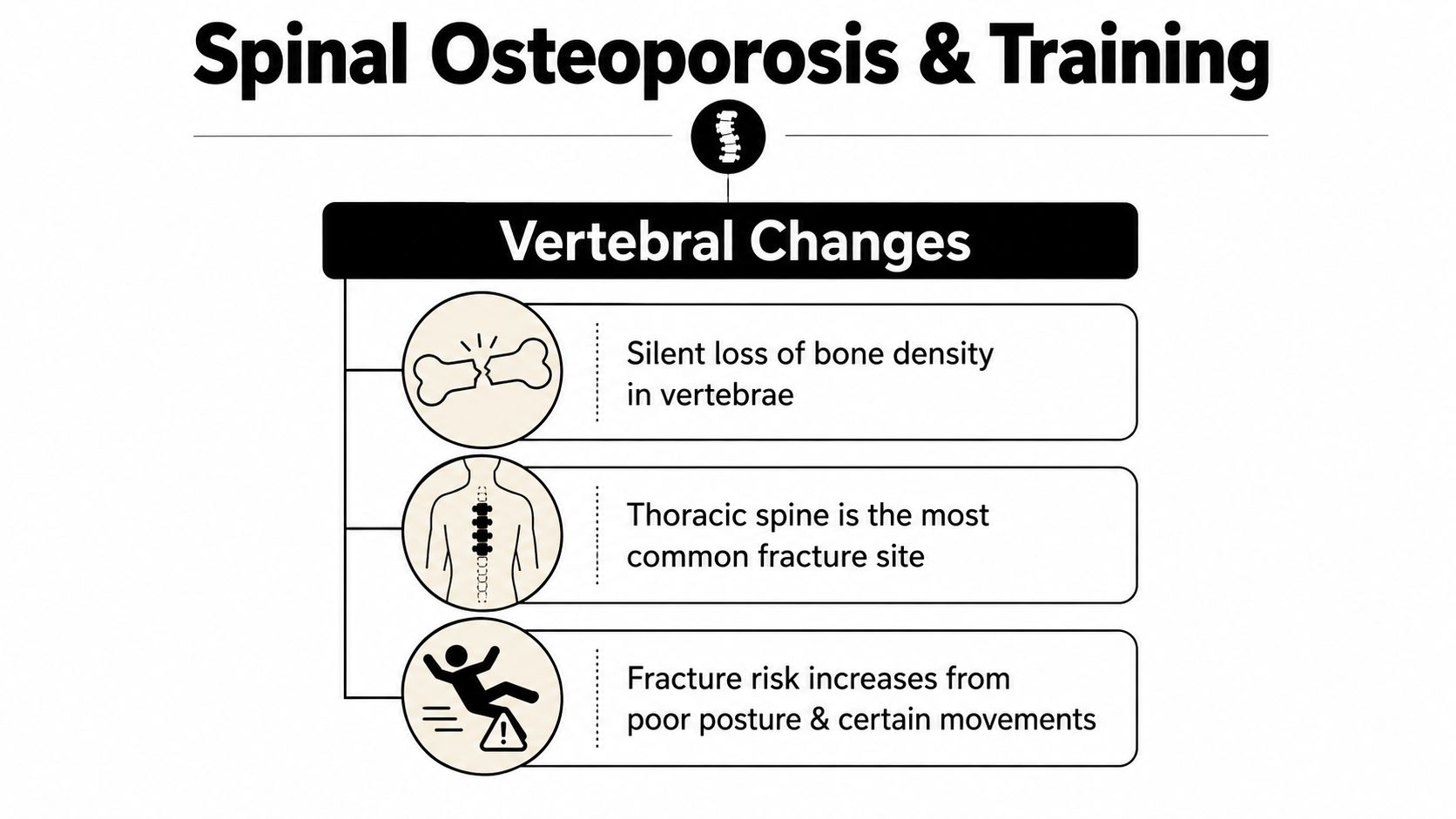
The UK consensus statement puts spinal extension, resistance training, and impact loading near the centre of spinal osteoporosis exercise because each one addresses a different weakness. Extension work supports posture and the back extensor muscles, resistance work gives the skeleton and surrounding muscle system a useful load, and impact work gives bone a stimulus that walking alone often fails to provide. The same UK guidance also notes that a combination of high-load resistance or weight-bearing exercise with impact appears most effective for bone strength (British Journal of Sports Medicine).
Bone density matters, but it does not make the whole decision. The same spine can behave very differently depending on posture, muscle strength, balance, and fall risk, so two people with similar scans may need different plans. A cautious walker with poor single-leg control may need more balance and extensor work than a strong lifter who keeps flexing through the spine under load. Neck and upper-back symptoms can limit how well you hold an extended posture during training, and general back and neck stretches of the kind LifeWorks publishes may help with that comfort side, though they are not a substitute for the loading work described below.
Walking still has a place, but it is not enough on its own. It can help with general activity and tolerance, yet it does not reliably challenge the thoracic and lumbar spine enough to build the kind of strength that supports posture, or make the back extensors work hard enough to matter. In practice, that gap is filled by targeted loading rather than endless low-intensity volume.
The exercise literature points in the same direction, and it is worth being honest about the size of the effect. A position statement on exercise for osteoporosis management reports that improving lumbar spine and femoral neck bone density through exercise is associated with roughly a 10% reduction in osteoporotic fracture risk, with individual exercise trials showing lumbar spine BMD gains in the region of 2.9% to 4.9% (Position Statement: Exercise Guidelines for Osteoporosis Management and Fall Prevention). Those are real, worthwhile changes. They are not a reversal of osteoporosis, and anyone promising you that is overselling. The value of the numbers is that they keep the plan honest, and they mean progress should be tracked against a scan rather than judged by feel.
The training target shifts from exercising more to strategically loading the right tissues, in the right direction, without folding the spine into risky positions.
The Safe-Movement Toolkit for the Osteoporotic Spine
Start with the move that sits near the centre of spinal fracture rehab, prone back work. Lie face down with support under the stomach if needed, keep the neck neutral, squeeze the shoulder blades back, then lift the head and chest gently. The Royal Osteoporosis Society's posture exercises are prescribed in the region of 3 to 5 repetitions, or holds of 3 to 5 seconds, and can be done daily provided symptoms stay settled (Royal Osteoporosis Society). If you have had a spinal fracture, get the specific version and dose from your physiotherapist rather than working from a generic description.
Build the back first
A strong spinal extensor pattern changes posture and helps counter the rounded shape that makes people feel fragile. If prone work is easy, progress by removing the support under the stomach, then by lengthening the hold, then by adding a tiny hand weight only if the neck stays quiet and the ribcage doesn't flare. The cue is simple, lengthen up, don't crank back.
Keep the neck long, keep the ribs down, and stop the set before you start to hinge through the low back.
For lower-body loading, wall-supported squats and sit-to-stands are the cleanest starting points. Sit-to-stands teach leg drive without forcing the spine into a rounded start position, and the wall gives feedback so the chest stays open. Once those feel smooth, progress by adding a dumbbell goblet hold, then a slower descent, then more load.
A hip hinge belongs in the plan too, but it has to stay a hinge. Romanian deadlifts with light dumbbells or kettlebells are useful because they train the posterior chain while you keep a neutral spine, soft knees, and the weight close to the body. If the back rounds, the load is too heavy or the range is too deep.
Farmer carries are underrated for spinal osteoporosis. Walk tall, hold the weights by your sides, keep the gaze level, and let the trunk work against the load while you breathe steadily. This gives posture, grip, and trunk stiffness a practical challenge without the flexion collapse that people often bring to bent-over work.
For brief impact loading, heel drops or controlled step-downs are the safer place to start. These aren't dramatic jumps, they're short bouts of ground contact that cue the skeleton to respond while still letting you monitor symptoms closely. If a person is ready for more, small step hops or brisk stair work may be discussed in clinic, but they don't belong in a generic home plan.
One boundary here is not negotiable. The UK consensus is explicit that anyone who has already had a vertebral fracture, or multiple low-trauma fractures, should usually limit impact to no more than the equivalent of brisk walking (British Journal of Sports Medicine). If that describes you, heel drops and hopping are not your starting point, and the impact question belongs with your clinician rather than with an article.
If stiffness in the neck or upper back is what keeps pulling you out of position, a short mobility routine such as these back and neck stretches can be a reasonable warm-up addition. The rule during the loading work itself does not change, though. If the neck juts forward or the spine starts to round, the set has drifted off target.
If you want to know where you actually stand before you start, a DEXA scan gives you spine and hip bone density alongside lean mass, which is the pairing that matters most here. Use the exercise plan to shape the training stimulus, then use scan results and symptom response to judge whether the loading is doing the job. That keeps prescription and bone-density monitoring tied together instead of treated as separate decisions.
Movements to Avoid and Why They Load the Spine Wrong
Loaded spinal flexion is the first thing to remove from the plan. Sit-ups, crunches, toes-to-bar, and heavy loaded sit-up variations repeatedly ask a spine with reduced reserve to bend under resistance, which is exactly the pattern you don't want when vertebral bodies are the concern. A safer swap is prone extension work, sit-to-stands, or a supported hinge.
Flexion, twist, compression
Heavy conventional deadlifts with a rounded back belong in the avoid pile too. The issue isn't deadlifts as a concept, it's the combination of spinal flexion and axial load, especially when fatigue makes the back collapse. If the bar starts close to the floor and the chest can't stay proud, switch to Romanian deadlifts from a higher start, kettlebell deadlifts from blocks, or a machine-based pull that lets the spine stay neutral.
Rotational loading under resistance needs similar honesty. Russian twists with a medicine ball, aggressive woodchops, and fast combined rotation-flexion patterns can create a messy load path through the trunk, especially if the spine is already sensitive. A better substitute is anti-rotation work, such as carries, split-stance cable holds, or braced marching.
Yoga and Pilates need screening too. If a class spends time in deep spinal rounding, end-range twisting, or loaded curls through the trunk, modify it or skip it. The quick filter is simple, if the spine rounds under load, it's not a default yes.
The neck can be the weak link
End-range cervical flexion gets overlooked because people assume the neck is separate from the back. Neck sit-ups and heavy neck curls can be a poor trade when the upper spine is already vulnerable, because they load a region that often compensates for thoracic stiffness and poor posture elsewhere. Neutral neck positions during prone work and carries give you much more control with less risk.
A cleaner rule beats a long banned list. Ask whether the exercise keeps the spine long, the ribcage stacked, and the load where the hips and legs can handle it. If the answer is no, the movement probably needs regression before it belongs in a spine-protective programme.
Building Your Weekly Programme Around the Spine
A sensible week starts with a repeatable pattern, not a heroic one. Two resistance sessions, daily back extension work if tolerated, a short walk on most days, and balance practice spread through the week is enough to build a steady spine-focused routine. On strength days, pick one squat pattern, one hinge pattern, one carry, and one extension drill. Keep most sets in the 8 to 12 rep range, work at about RPE 6 to 8, and stop with a rep or two left so posture and control stay intact.
A practical weekly layout
- Monday: sit-to-stands or goblet squats, Romanian deadlifts, farmer carries, prone extensions.
- Tuesday: short walk, tandem stance, heel-to-toe walking, single-leg stand with support.
- Thursday: repeat the resistance session, then finish with wall-supported squats or step-downs.
- Saturday: repeat the balance block, then take a brisk walk.
- Daily: prone back work, unless symptoms say otherwise.
That structure sits comfortably alongside UK consensus guidance, which points towards muscle-strengthening work on 2 to 3 days per week, with gentler daily back work reasonable when painful vertebral fractures are part of the picture. The point is not to chase a fixed prescription for everyone. The point is to match loading to the spine you are treating, then watch whether the body tolerates it.
A programme like this works best when it is tied to measurable follow-up. If someone is loading well, symptoms are stable, and DEXA tracking later shows the expected bone-density response, the exercise dose can stay steady or progress. If the scan stays flat and the person is still deconditioned, the answer is usually better adherence, better exercise selection, or clearer loading targets, not abandoning training.
If you want a short daily habit that keeps the plan realistic, the bone strength routine guide can sit alongside a clinician-led programme as a consistency tool. It should not replace a spinal assessment when pain, fracture history, or posture changes are part of the picture.
Progression rule: if the last two sessions felt easy with perfect form, add a small increment next time. Build control before you build load.
For readers who already use single-leg training in lower-body work, the relevance is straightforward. Unilateral strength and balance reduce trunk compensation, which can make spine loading cleaner and give you a better test of how much control the person really has. That matters because fall risk, hip strategy, and trunk control often shape the outcome as much as the scan number does.
Red Flags, Pain Patterns and When to Get Cleared First
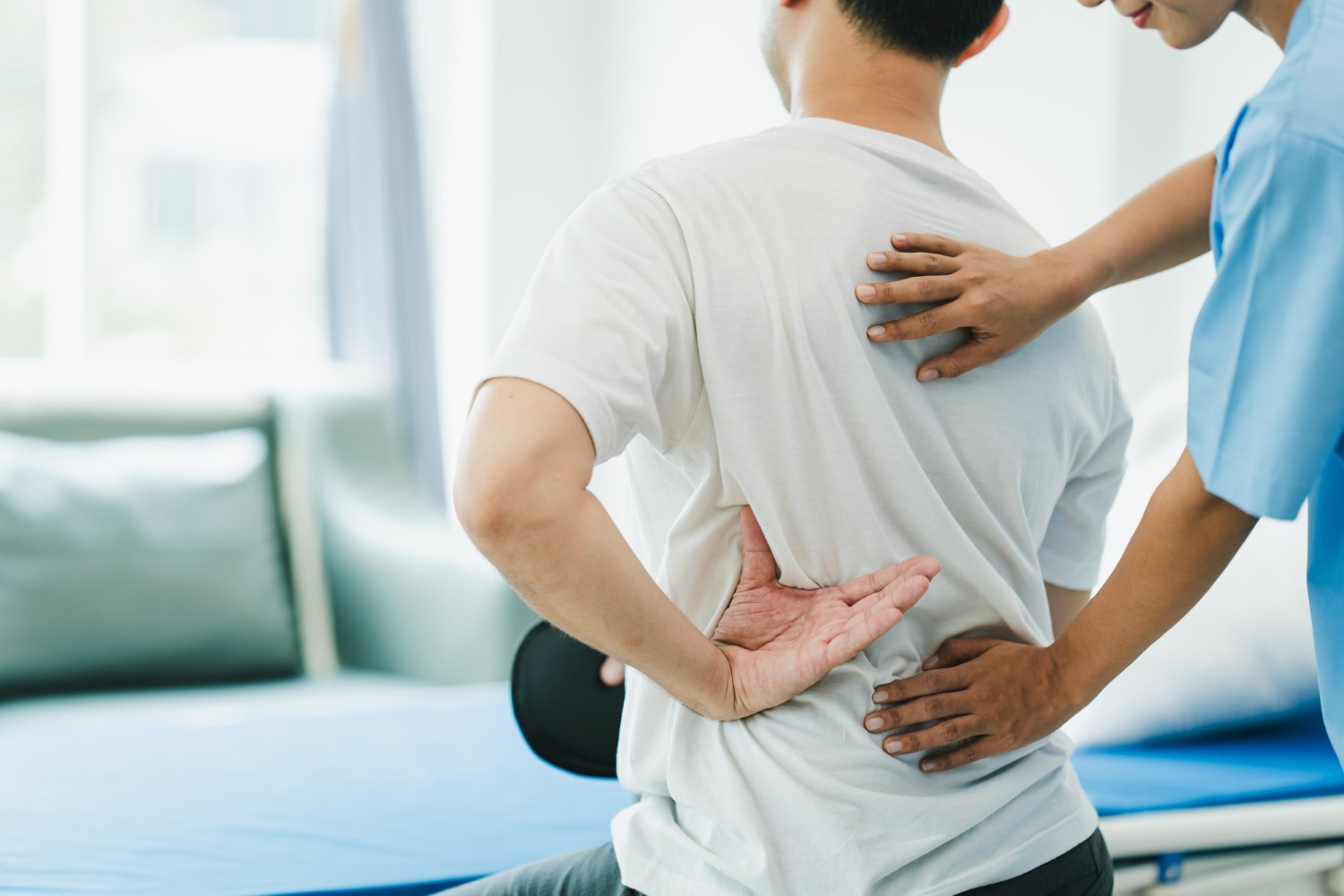
A back that already feels fragile needs a careful start. A recent vertebral fracture, unexplained back pain, loss of height, a wedged vertebra seen on imaging, planned or ongoing osteoporosis medication changes, or a clear history of falls all justify assessment before you load harder. A physio, GP, or osteoporosis clinician can decide whether you need imaging, a repeat DEXA, or a slower start.
Pain during exercise needs a different filter from ordinary muscle soreness. Local sharp back pain, pain that radiates, tingling, dizziness, or pain that does not settle within 24 hours after the session means the exercise was too much or the pattern was wrong. Exercise should continue only if it does not increase symptoms.
When people ask what “cleared first” means, the answer is usually less dramatic than they fear. It is a review of symptoms, movement, fracture history, and current treatment, then a decision about whether you need a modified plan, an imaging review, or a more confident loading progression. Getting assessed does not mean being told to stop. It usually means being told how to load with better information, and how to match that loading to what the spine is tolerating.
Hands-on practitioners such as Bayside Osteopathic Health work on how the shoulder girdle and upper back influence these patterns, which can be a useful adjunct when symptoms sit in the upper back, neck, or shoulder rather than the hips and legs. One caveat matters more than usual with osteoporosis: high-velocity spinal manipulation is generally avoided where bone density is low, so tell any manual therapist about your diagnosis before treatment. Use that kind of input to refine movement, never to replace medical review when fracture risk is on the table.
A sensible follow-up plan also needs a way to check whether the programme is doing what you asked of it. If symptoms settle, movement quality improves, and the next scan shows the lumbar spine is responding, you have a clear reason to keep the current dose or progress it with care. The bone density scan UK page explains how a repeat scan can fit into that kind of review when you want objective tracking rather than guesswork.
Tracking Progress with DEXA Scans and RMR Context
A DEXA scan gives you a measurable baseline for the lumbar spine, and that matters because the spine is often the place where exercise changes show up first. In practice, you are looking for a trend, not a dramatic reversal. With spinal osteoporosis, exercise usually produces modest, measurable gains in BMD, so the scan becomes part of the training plan rather than an afterthought.
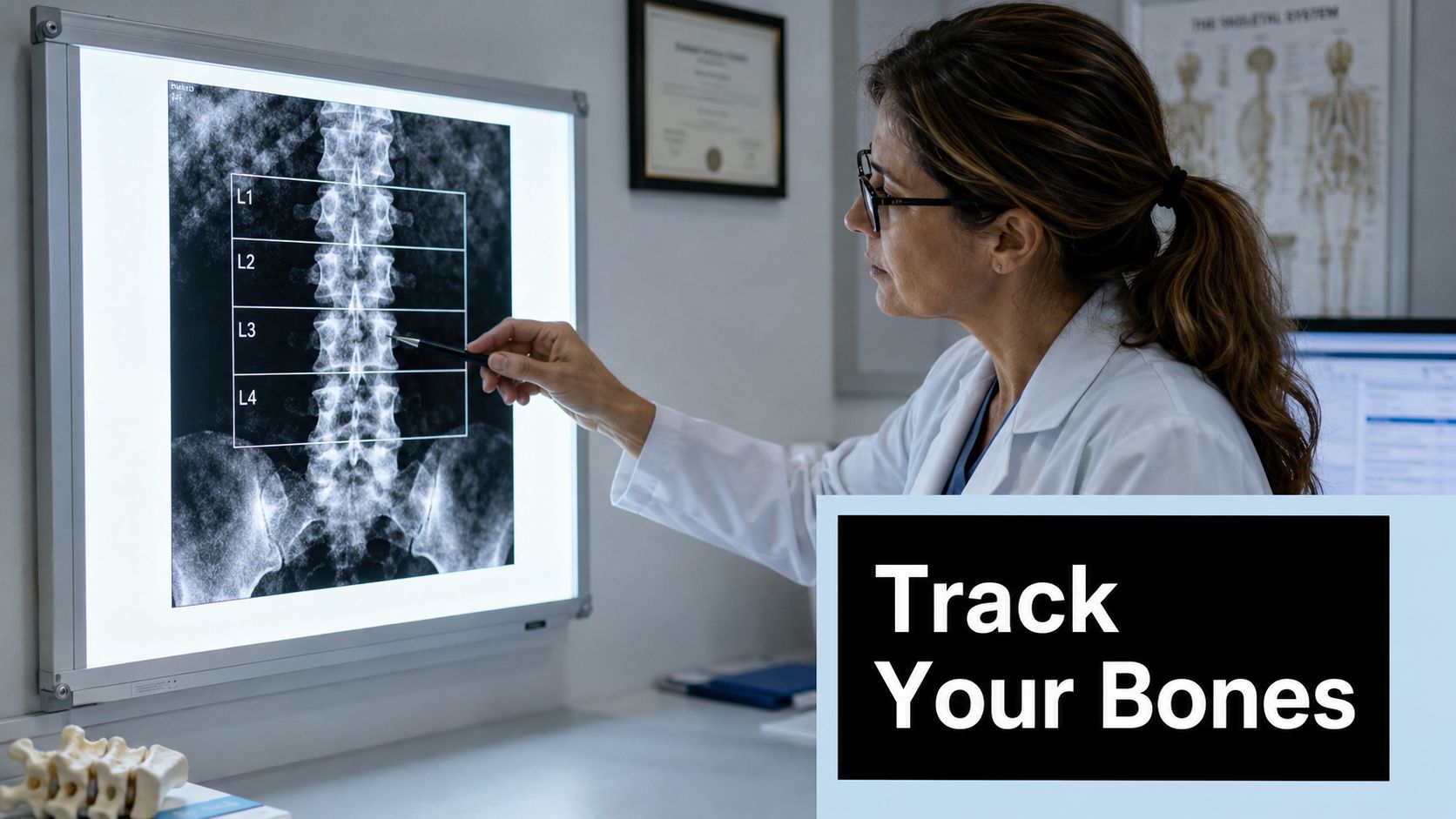
A repeat scan is usually most useful after a stretch of consistent training, often around 12 to 18 months later. That gives enough time to see whether the loading, balance work, and extension-based exercises are helping the lumbar spine tolerate stress more confidently, or whether the prescription needs adjusting. If you want to see how a repeat scan fits into a practical follow-up plan, the bone density scan UK page sets out how that kind of check can be used without turning every decision into guesswork.
Don't ignore energy availability
Bone work stalls quickly when under-fuelling is part of the picture, especially in perimenopausal and postmenopausal women. RMR testing helps show whether intake matches the work you are asking the body to do, so it belongs in the same conversation as exercise prescription rather than being treated as a separate nutrition extra. If energy intake is too low, even a well-built loading plan can plateau.
Telomyx offers mobile DEXA and RMR testing, which gives you a practical way to get those numbers without a hospital visit and then compare them over time. That is useful if you want an objective starting point before changing training, and it is just as useful if you want to check whether the lumbar spine is responding to the programme you have put in place.
Your one-page action list stays simple. Keep prone extensions, sit-to-stands, hip hinges, carries, and balance work. Drop or modify loaded spinal flexion, rounded deadlifts, loaded twisting, and anything that pushes the spine into end-range flexion under load. Track symptoms, review red flags, and book the next DEXA before you finish the current training block.
Telomyx brings DEXA and RMR testing to you, which makes it easier to connect your exercise plan with real numbers instead of guesses. If you are trying to protect the spine, improve posture, and see whether your programme is working, visit Telomyx and book a scan that gives you a proper baseline for the next training block.
The content in this article is for educational purposes only and does not constitute medical or dietary advice. If you have osteoporosis, a history of spinal fracture, or any underlying health condition, are taking medication, or are considering significant changes to your diet or exercise regimen, consult a qualified healthcare professional before making any adjustments.