
Fall Risk Assessment: Key Screening Steps for 2026
19 August 2026
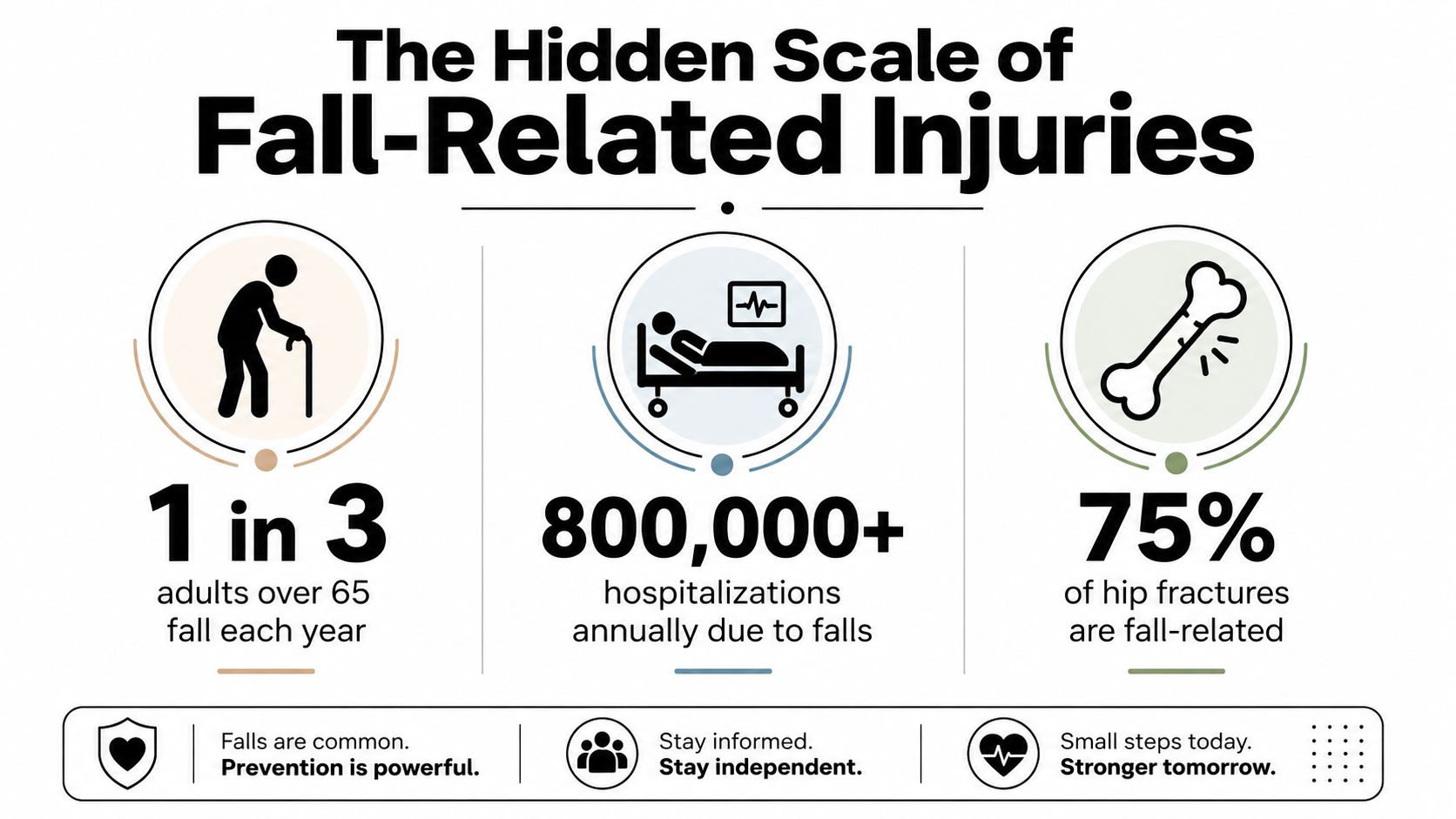
Around 30% of people aged 65 and over fall at least once each year, rising to about 50% among people aged 80 and over, according to NICE guidance on falls assessment and prevention. That makes a fall risk assessment more than a checklist for preventing trips at home. It's a clinical opportunity to identify frailty, medication effects, cardiovascular problems, impaired balance, low muscle reserves and fragile bones before a single incident changes someone's independence.
A useful assessment connects external hazards with internal physiology. It asks not only whether someone has fallen, but why they might fall, what injury a fall could cause, and which interventions are most likely to preserve strength, confidence and mobility.
Table of Contents
- The Hidden Scale of Fall-Related Injuries
- Core Components of a Clinical Fall Risk Assessment
- Validated Screening Tools and Physical Tests
- The Role of DEXA Scans in Fracture Risk Prediction
- Environmental Hazards and Home Safety Audits
- Targeted Prevention Strategies and Referrals
The Hidden Scale of Fall-Related Injuries
Falls are often called accidents, yet the event may reflect several measurable vulnerabilities. A trip over a rug can occur alongside dizziness, impaired vision, reduced lower-body strength, orthostatic hypotension, sedating medication or osteoporosis. The hazard is external, while the likelihood and consequences of falling are often shaped by internal physiology.
The scale is substantial. In the context section of NICE NG249, NICE reports around 234,800 emergency hospital admissions in England related to falls among people aged 65 and over in 2019/20, including around 157,370 admissions among people aged 80 and over.
Why age changes the clinical question
Government data shows the hospital burden is concentrated in very old adults. In 2017–2018, around 220,160 emergency hospital admissions in England involved falls among people aged 65 and over, with approximately 146,665 admissions, or 66.6%, among people aged 80 and over, as reported in the Government's falls guidance.
Age should therefore change the depth of assessment, not end the discussion. Frailty, confidence with balance, muscle capacity, walking pattern, blood pressure responses and bone health all affect risk. The same fall can be a temporary setback for one person and a loss of independence for another, depending on recovery capacity and fracture susceptibility.
The current NICE approach extends beyond a narrow geriatric screen. The 2025 guideline covers prevention and assessment for everyone aged 65 and over, together with people aged 50 to 64 who have higher risk. This supports proactive testing as part of healthy ageing. Clinical measures such as bone density and metabolic health can identify vulnerabilities that a home-safety checklist cannot show.
Clinical rule: A fall is an event. Recurrent vulnerability is the condition that needs assessment.
Assessment should also separate a mechanical trip from a medical warning sign. Dizziness, loss of consciousness, delirium, difficulty getting up, injury or repeated falls may indicate a more complex problem. For people living with frailty who've fallen in the past year, and for people with these warning features or multiple falls, NICE recommends a detailed assessment in community settings. Hospital inpatients aged 65 and over and care-home residents aged 65 and over are included in the current pathway.
Fall prevention belongs in longevity planning before an emergency occurs. Preserving strength, cardiovascular stability, balance and bone resilience reduces the chance that an ordinary misstep becomes a life-altering injury.
Core Components of a Clinical Fall Risk Assessment
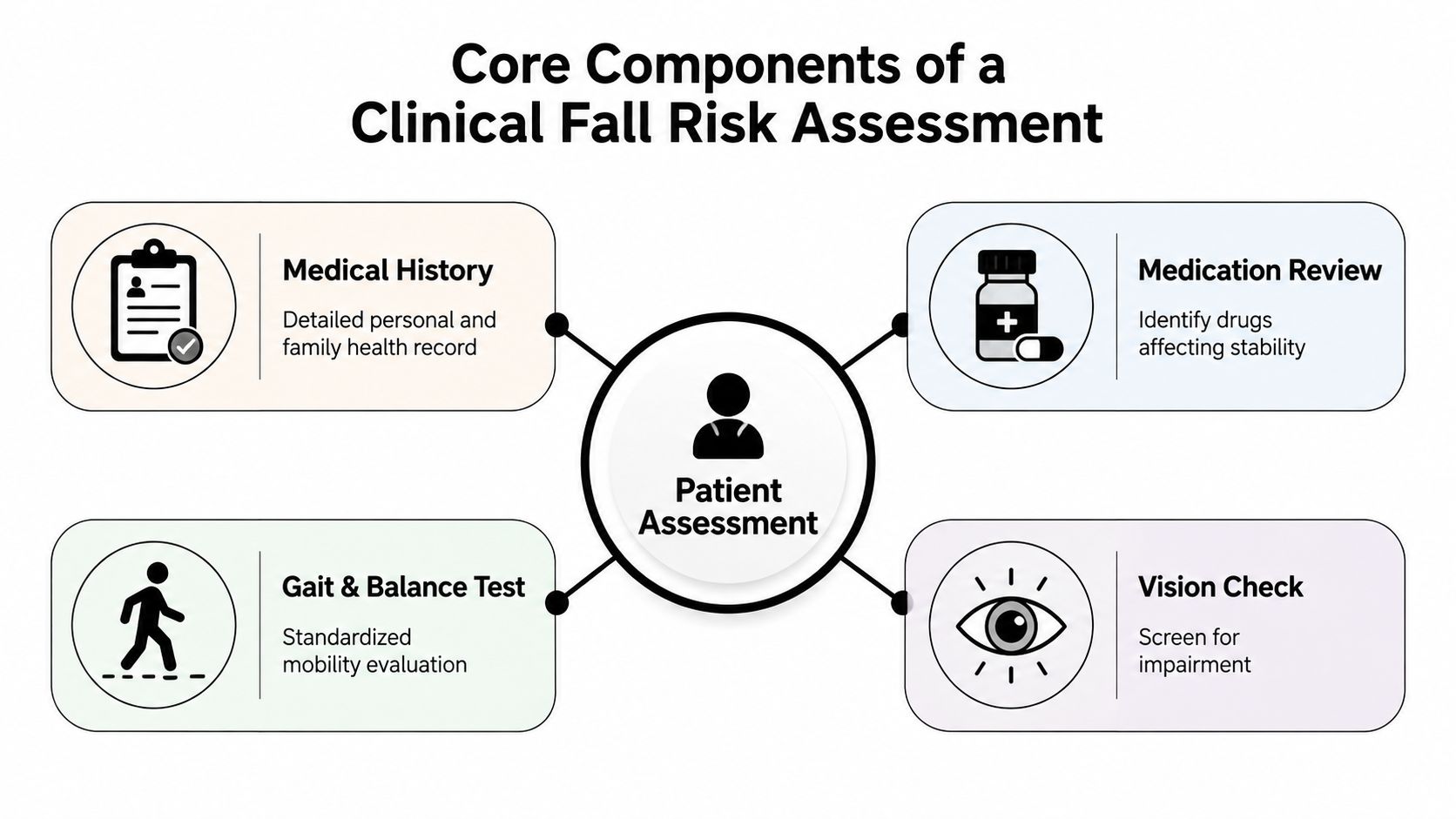
A proper fall risk assessment begins with an account of the person, not a score. The clinician needs to understand what happened, what the person felt beforehand, whether they could get up, and whether the same pattern has appeared during other activities.
Start with the event and the person's baseline
A detailed history should cover the circumstances of each fall, including whether it happened during walking, turning, standing, reaching or using the stairs. It should record symptoms such as dizziness, palpitations, blurred vision, weakness or confusion, alongside footwear, walking aids and the surrounding environment.
The assessment also needs a baseline. Has walking slowed? Is the person avoiding outings or stairs? Can they rise from a chair without using their arms? Have they lost confidence after a previous fall? These observations often reveal a developing decline before someone describes themselves as unsteady.
The wider medical history matters because conditions affecting the heart, nervous system, vision, joints, muscles and bones can interact. NICE's falls assessment and prevention recommendations include cardiovascular examination, dizziness assessment, neurological examination, medication review and osteoporosis risk assessment.
Medication and cardiovascular review
Medication can alter alertness, coordination or blood pressure. The review should consider prescribed medicines, over-the-counter products and how the person takes them in practice. A clinician may identify drugs that contribute to sedation, postural blood pressure changes or confusion, but medication must never be stopped abruptly without professional advice.
Orthostatic hypotension deserves specific attention. A person may feel fine while seated yet become light-headed after standing. Checking the cardiovascular system and investigating symptoms can help separate a household hazard from a physiological trigger that needs medical management.
Vision, hearing and neurological function should be assessed alongside gait and balance. The point isn't to collect isolated findings. It's to identify combinations, such as reduced sensation in the feet alongside poor lighting, or dizziness alongside a medication change.
A health risk assessment can help health-conscious adults organise broader preventive questions, but a suspected medical cause of falls needs assessment by an appropriately qualified clinician.
Body composition can add useful context where muscle and bone health are concerns. A Dexa Body Composition Scan measures regional and total fat mass, lean muscle mass and bone density, offering clinical data that scales, calipers and bioimpedance cannot provide. It supports a baseline and ongoing tracking, but it doesn't replace the history, examination or functional tests that explain how someone moves.
Validated Screening Tools and Physical Tests
Subjective confidence can mislead in both directions. Some people minimise instability because they've adapted their movement, while others become fearful despite having relatively good function. Standardised tests give clinicians a repeatable way to examine mobility, transfers, gait and balance. However, NICE advises against using falls-risk prediction tools to predict whether an individual will fall; test findings should inform a comprehensive clinical assessment rather than produce a stand-alone risk label.
The Timed Up and Go, commonly called the TUG, observes how a person rises from a chair, walks, turns, returns and sits down. Clinicians look at the whole performance, not only the time. Hesitation, use of the arms, short steps, instability during the turn or difficulty sitting safely can all matter.
The Berg Balance Scale examines balance across functional tasks. It can reveal problems that a straight-line walk misses, such as reaching, changing position or maintaining stability when the centre of gravity shifts. Its strength is breadth, although it takes more time and requires trained administration.
Gait speed is simpler. Walking pace can act as a broad marker of functional capacity, but it's highly dependent on the testing protocol, footwear, walking aid and the person's understanding of the instruction. A single result shouldn't be treated as a diagnosis.
Choosing the right test
| Tool | What it observes | Main limitation |
|---|---|---|
| Timed Up and Go | Transfers, walking, turning and sitting | A summary result can hide the movement pattern |
| Berg Balance Scale | Functional balance across several tasks | Requires more time and consistent administration |
| Gait speed | Walking performance under a defined protocol | Sensitive to testing conditions and context |
The best assessment uses the test to answer a clinical question. If turning is unsafe, the intervention may need to address dynamic balance and direction changes. If rising from a chair is difficult, lower-body strength and movement strategy deserve attention. If walking deteriorates with fatigue, the assessment should consider endurance and the environments where symptoms appear.
A postural assessment can add information about alignment and movement habits, but posture alone doesn't establish fall risk. Good posture in a static position doesn't guarantee safe reactions while walking, turning or recovering from a perturbation.
The Role of DEXA Scans in Fracture Risk Prediction
A fall becomes especially dangerous when the skeleton can't tolerate the force. That means fall prevention shouldn't stop at balance and home safety. Bone strength changes the consequence of the same event, so osteoporosis risk belongs inside a thorough assessment.
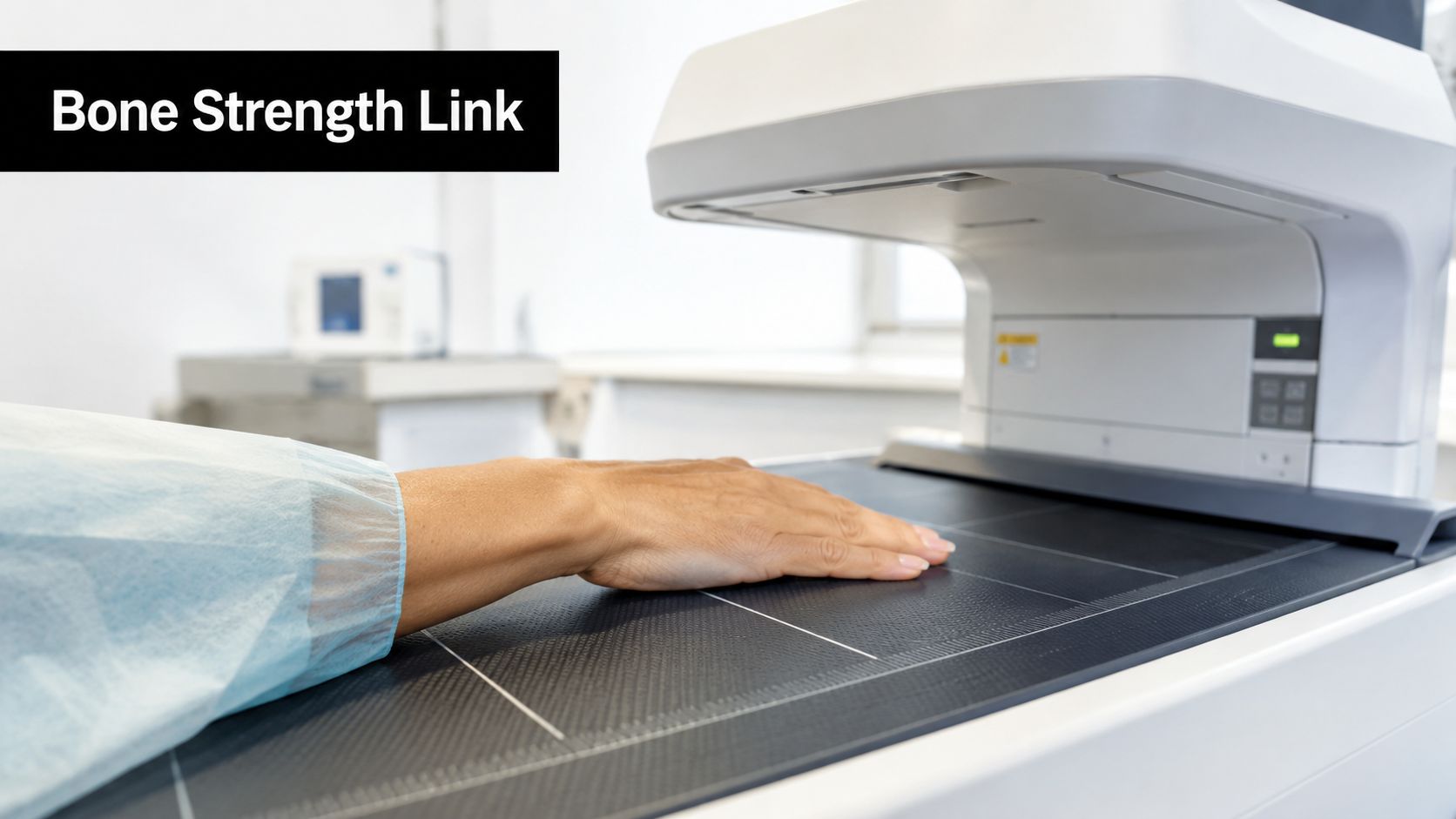
DEXA technology can measure body composition and bone mineral density, but the type of scan matters. A whole-body body-composition scan can quantify lean mass and provide bone-related data, whereas diagnostic osteoporosis assessment ordinarily relies on central DXA measurements at the lumbar spine and hip. A body-composition result cannot predict when someone will fall or replace a formal fracture-risk and osteoporosis assessment.
Connecting bone, muscle and movement
Lean muscle mass affects the ability to rise, stabilise the trunk, recover from a stumble and control a descent. Bone density affects the potential severity of an impact. These are related prevention targets, but they need different responses.
Someone with reduced strength may benefit from progressive resistance and balance work under suitable supervision. Someone with suspected osteoporosis may need clinical review, fracture-risk evaluation and exercise choices that respect spinal and skeletal vulnerability. A person with both issues needs a coordinated plan, not an isolated gym programme.
NICE includes osteoporosis risk assessment in its current falls pathway because the assessment must address consequences as well as causes. The FRAX score interpretation guide can help readers understand how fracture-risk tools fit into broader clinical decision-making, although a calculated risk estimate should be discussed with a healthcare professional.
Why trends matter
One scan is a baseline, not a verdict. The useful question is whether objective findings align with function and whether they change as training, nutrition or medical treatment changes. A person can feel fit while losing lean mass, or walk confidently while carrying a clinically important fracture risk.
DEXA data can therefore sharpen the next decision. It may prompt a referral, support a strength plan, encourage more deliberate protein and energy management, or justify closer monitoring. The scan doesn't replace the clinician's judgement. It makes the conversation more specific.
Where clinically indicated, a sensible fall risk assessment combines skeletal information with observed movement. Bone density alone does not explain the trigger, while a mobility test alone may not reveal fracture susceptibility. Used in the right context, these measures support prevention that addresses both the likelihood and possible consequences of a fall.
Environmental Hazards and Home Safety Audits
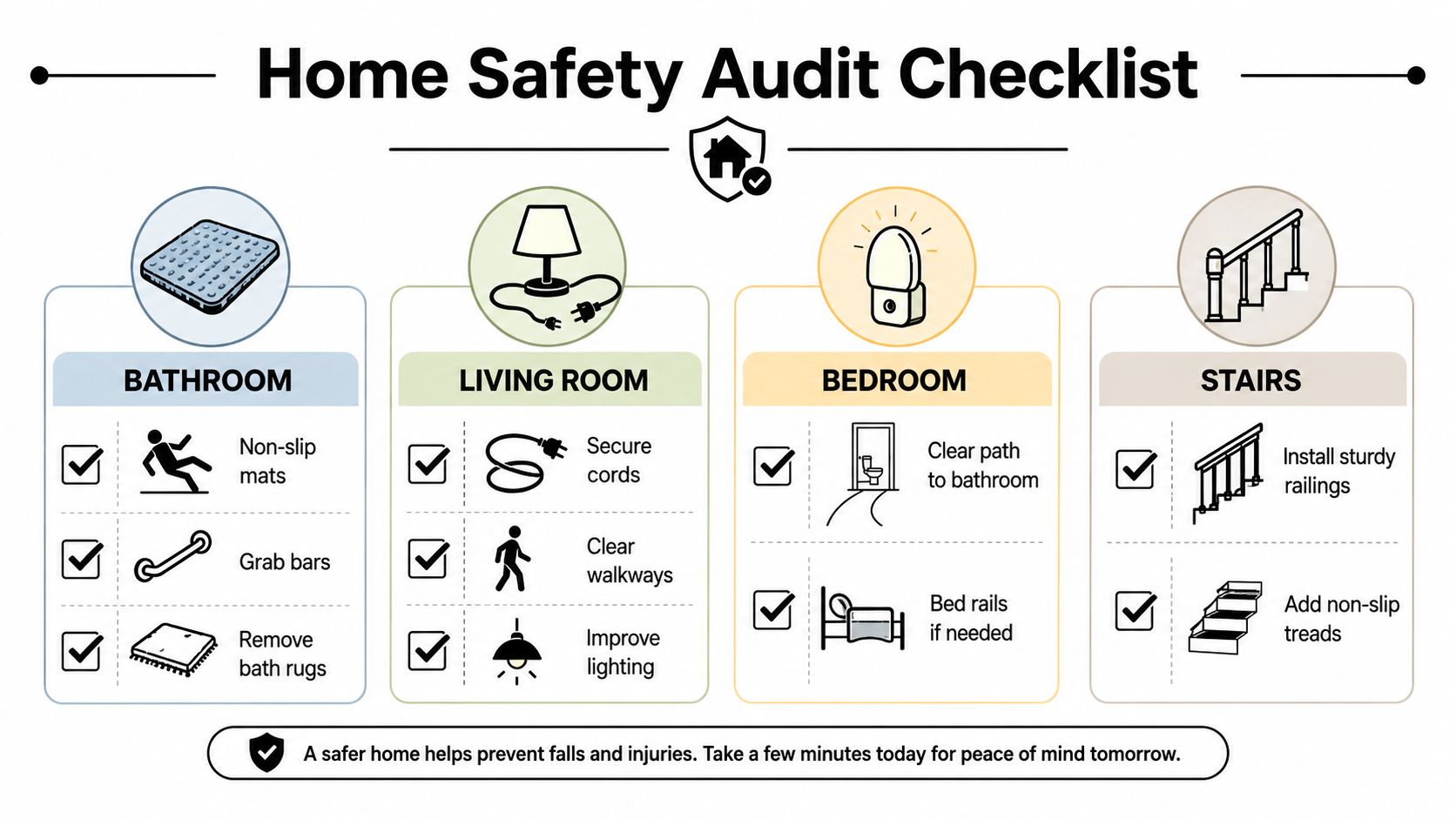
Home safety advice works best when it responds to a person's actual impairment. Generic instructions to “be careful” don't tell a family whether to improve lighting, remove a rug, install a rail or address a bathroom transfer problem. A room-by-room audit turns broad concern into practical action.
Audit the route, not just the room
Start with the routes used most often, particularly between the bed, bathroom, kitchen and front door. Check whether lighting is adequate at the point where someone stands up, whether cords cross walking paths, and whether furniture forces tight turns.
In the bathroom, inspect wet surfaces, bath mats, transfer points and the position of grab rails. In the bedroom, clear the path to the bathroom and consider whether a night light gives enough visibility without creating glare. On stairs, check the stability and reach of the handrail, the condition of the steps and whether the person can see each tread clearly.
The home safety tips from DME Superstore provide a useful checklist for organising this review. The audit should still be personalised, especially when a person uses a frame, has visual impairment or struggles with turning.
Quick fixes include securing loose cords, removing unstable rugs, improving lighting and clearing clutter. Structural changes, such as installing sturdy rails or adapting the bathroom, may take more planning but can be essential when the assessment identifies a persistent transfer or stair problem.
Practical rule: Match the modification to the failed task. If the risk appears during a turn, clear turning space. If it appears during standing, address support and transfer height.
Environmental changes shouldn't create a sterile home. The aim is to preserve normal routines while removing predictable obstacles. This short video can help families think through common household risks:
A safe environment supports physical improvements, but it can't compensate for untreated dizziness, medication effects or severe weakness. The strongest plan combines targeted home changes with clinical follow-up.
Targeted Prevention Strategies and Referrals
Prevention becomes useful when every finding leads to a decision. Consider a person who reports a fall while turning, shows hesitant transfers and has reduced confidence outdoors. The plan shouldn't be “exercise more”. It might include supervised strength and balance training, practice with turning and transfers, footwear review, a medication discussion and a home audit focused on tight spaces.
Another person may walk steadily but show low lean mass or reduced bone density on objective testing. Their priorities differ. Resistance training may need to progress gradually, nutrition may require professional review, and skeletal findings may justify referral for fracture-risk assessment. A DEXA result informs the conversation, but it doesn't prescribe treatment on its own.
Build the roadmap around the cause
A clinician may refer to physiotherapy for gait retraining, balance work, strength progression or walking-aid assessment. Occupational therapy can help with daily activities and environmental adaptations. A pharmacist or prescriber can review medicines, while an optometrist or ophthalmologist may address visual contributors.
Medical referral becomes particularly important when there's loss of consciousness, unexplained dizziness, neurological change, delirium, injury or a pattern of recurrent falls. These features need more than a home checklist because they may indicate a condition requiring investigation.
The exercise plan should be specific enough to measure. It might track the ability to rise from a chair, walk safely while turning, maintain independence on stairs or tolerate a defined training session. Progress should be reassessed rather than assumed.
Families and carers can also use practical fall prevention guidance from Cream Home Care when organising support at home. Care planning works best when it preserves autonomy, encourages appropriate movement and identifies when supervision is needed.
For people whose assessment raises concerns about low muscle reserves, a Telomyx full-body DEXA scan can provide an objective lean-mass baseline. It should sit alongside functional assessment and, where fracture risk is suspected, appropriate clinical osteoporosis evaluation.
The practical standard is simple. Test what matters, interpret it in context, act on the finding and repeat the assessment when the person's function or health changes.
The content in this article is for educational purposes only and does not constitute medical or dietary advice. If you have an underlying health condition, are taking medication, or are considering significant changes to your diet or exercise regimen, consult a qualified healthcare professional before making any adjustments.
Visit Telomyx to learn how objective body-composition testing can complement, but not replace, a comprehensive fall-risk assessment and qualified clinical advice.