
Period and Weight Gain: What's Really Happening to Your Body
14 August 2026Updated 19 August 2026
In a study of 42 women measured twice weekly across one menstrual cycle using bioelectrical impedance, body weight was on average 0.450 kg higher during menstruation, alongside a 0.474 kg increase in estimated extracellular water (PubMed study). This small study supports fluid as one contributor to short-term scale change, but it does not establish the amount or timing every person should expect. The useful question is whether a change reflects fluid, gut contents or a longer-term tissue trend.
For many people, period and weight gain is less a fat-gain problem than a timing problem. Cyclical changes in fluid balance, appetite, bowel habits and symptoms can distort what a single weigh-in means, which is why panic dieting is unhelpful. A commercial overview of “hormone optimisation” may provide general background, but this concept is not a diagnosis or a substitute for NHS assessment of persistent symptoms, suspected PCOS, thyroid disease or perimenopause.
Table of Contents
- Why the Scale Lies During Your Period
- The Four Physiological Drivers Behind Period Weight Changes
- Mapping the Fluctuation Across Your Cycle
- When It Is Not Just Your Period, Perimenopause and Metabolic Drift
- Actionable Strategies to Minimise Unwanted Gain
- How to Measure What Is Really Changing
- When to Stop Reassuring and Start Investigating
Why the Scale Lies During Your Period
A period can make the scale look unreliable because several short-term body shifts are happening at once. Water, glycogen, gut contents, and normal hormonal changes can all move the reading without any meaningful change in fat mass. That is why a weigh-in during menstruation often reflects timing more than tissue.
The body-composition research linked earlier found that the average increase in its small sample coincided with greater estimated extracellular water rather than a significant change in measured fat. This supports a calm interpretation of short-term fluctuation while recognising that bioelectrical impedance and a single-cycle study have limitations.
Fluid is not fat
Fat gain requires a sustained energy surplus, whereas fluid distribution can change more quickly. Oestrogen and progesterone interact with thirst, vasopressin and the renin–angiotensin–aldosterone system, but the net effect varies and is not a simple “progesterone causes retention” switch. Symptoms and scale changes can peak at different points for different people.
A single weigh-in can be especially misleading if it lands during this part of the cycle. Someone can step on the scale in the morning and see a jump that feels dramatic, even though the change is mostly water and not adipose tissue. The body is responding to a cyclical hormonal environment, not suddenly storing large amounts of fat overnight.
Practical rule: if the number climbs for a few days around your period and then drops again, treat that pattern as physiology first, not failure.
A simple way to frame it is this. Body weight includes fat, lean tissue, water, glycogen, food in the gut, and waste. During menstruation, the water part shifts enough to distort the total, which is why a short-term gain can be normal even when your habits have stayed consistent.
That is also why the bathroom scale is a poor tool for judging progress in that window. If the underlying question is whether tissue has changed, you need a way to separate fluid shift from composition change. The sections below show how to do that without spiralling into restriction or guesswork.
The Four Physiological Drivers Behind Period Weight Changes
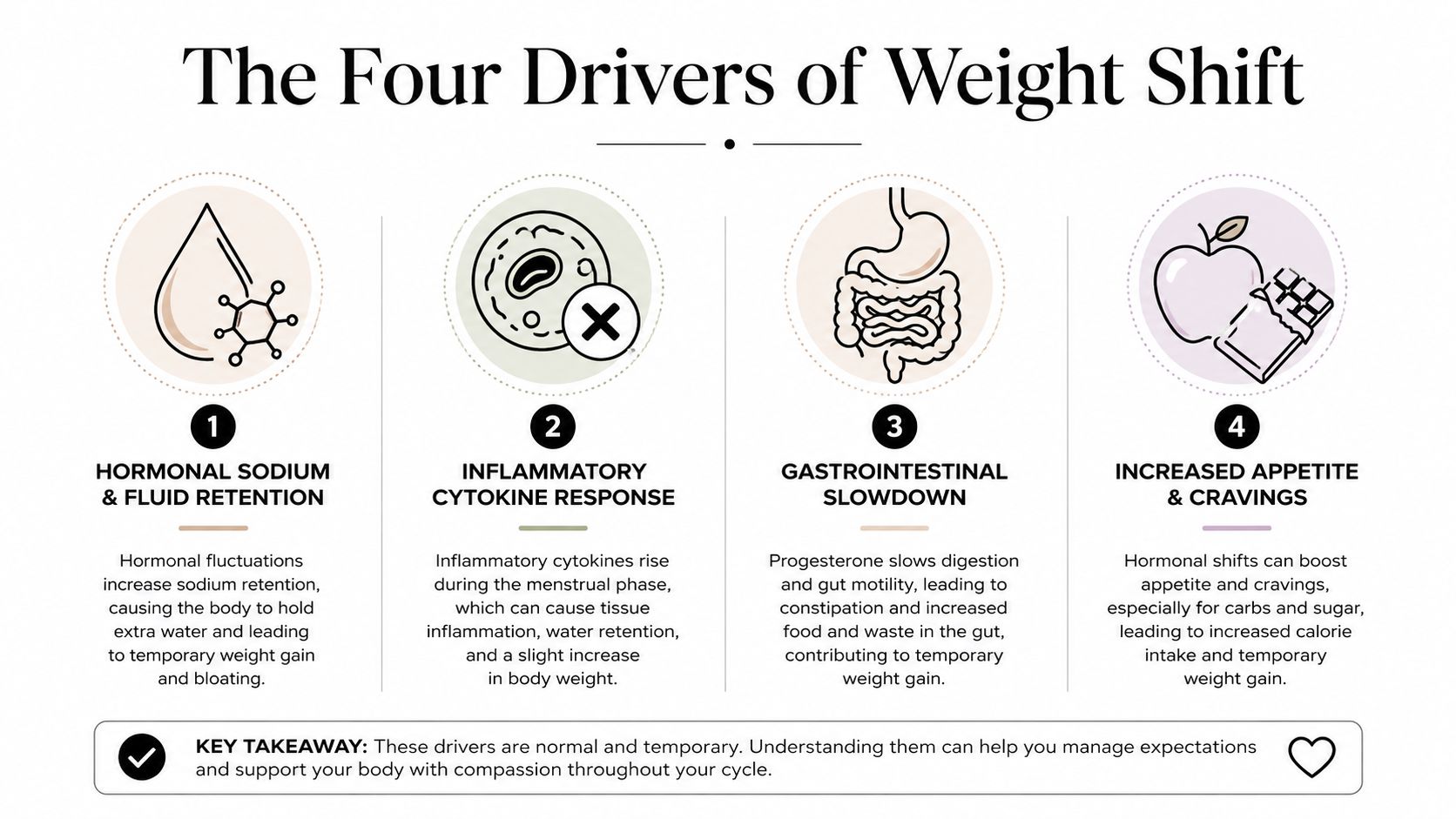
The main drivers of period-related weight change overlap, which is why the experience can feel messy. One day it is puffiness, another day it is cravings, then it is bloating, and the scale may rise even when your routine has not changed. Separating the drivers gives you a clearer read than calling everything “water retention.”
Hormones shift fluid balance
Oestrogen and progesterone influence several systems that regulate thirst, sodium and water distribution. Studies have found cycle-related changes in plasma volume, osmolality and extracellular fluid, but findings are not uniform and the underlying pathways remain complex. A short-lived heavier or puffier feeling therefore may reflect fluid without implying new adipose tissue.
This is the mechanism behind the puffy ring, the snug waistband, and the feeling that your face looks fuller by evening. The body is not building new tissue at that pace. It is changing where water sits.
Inflammation adds to the feeling of heaviness
Some inflammatory markers and symptoms vary across the cycle, but the evidence is incomplete and does not support labelling every premenstrual sensation as inflammation. Pain, bloating, sleep and fluid shifts can all affect the subjective feeling of heaviness even when scale change is small.
Appetite rises for a reason
Cravings are not a character flaw. Reviews suggest that energy intake may be higher in the luteal than the follicular phase on average, but the size of the difference is not well established and individual cycles vary. Sleep, premenstrual symptoms, food availability and dietary restraint may all contribute; the pattern cannot be attributed to progesterone alone.
Cravings may show up as extra snacks, larger portions or a stronger urge to graze. A commercial collection of “oestrogen balance” products is not a diagnostic tool, and supplements should not be used to self-treat irregular periods, PCOS, thyroid symptoms or perimenopause. Check ingredients and interactions with a pharmacist or clinician before taking them.
The gut slows down
Bloating often comes from slower gastrointestinal transit and constipation, not from fat gain. If food moves more slowly through the gut, the abdomen can feel fuller and tighter, and the scale may edge up because of contents in the digestive tract. That is a different mechanism from adipose gain, and it usually resolves as the cycle moves on.
This is the part many people miss. A swollen abdomen after meals, fewer bowel movements, or a sense of “fullness” low in the belly points to gut slowdown. A puffier face or hands points more towards fluid shift. Strong cravings point towards appetite signalling. General achiness and a heavy, puffy feeling point towards inflammatory changes. When you match the symptom to the mechanism, the pattern becomes much easier to read.
Here is a simple way to sort it.
| Cycle phase | Dominant hormones | Typical scale change | Common symptoms |
|---|---|---|---|
| Late luteal phase | Progesterone higher, oestrogen changing | Small rise, often fluid-led | Cravings, puffiness, bloating |
| Menstruation | Hormones dropping | Often still elevated briefly | Heaviness, abdominal discomfort |
| Early follicular phase | Hormones lower | Scale often settles | Less bloating, less water retention |
| Mid-cycle | Oestrogen rising then shifting | Often steadier | More stable appetite and gut comfort |
If your waistband feels tight, your face looks fuller, and you are craving salty food, fluid shift and appetite signalling are likely doing the work. If the main issue is abdominal pressure with constipation, the gut is probably the bigger driver. If the feeling is more like heaviness and soreness, inflammation is likely part of the picture. That kind of symptom mapping is more useful than blaming one vague “period weight gain” label.
Mapping the Fluctuation Across Your Cycle
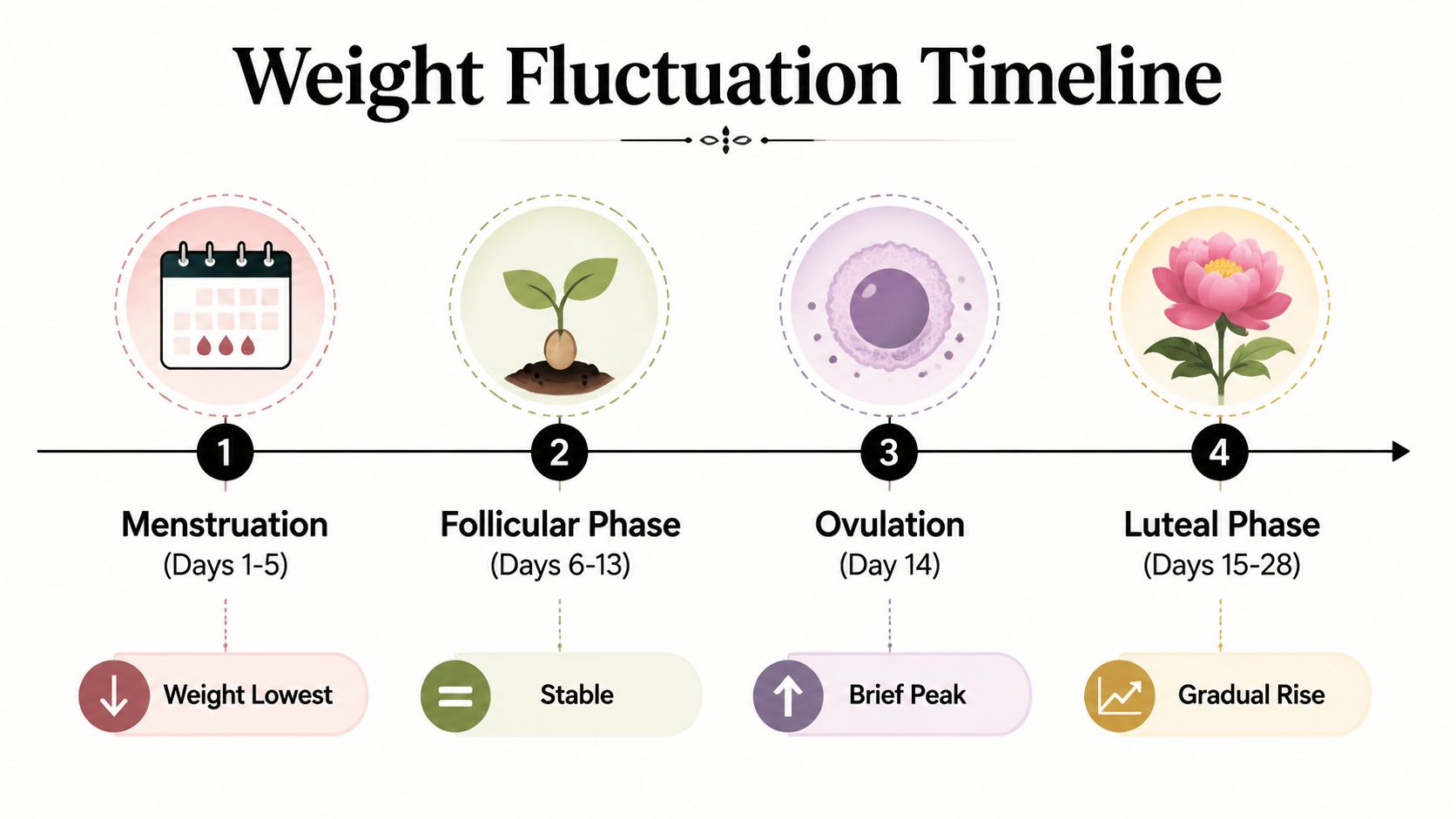
Cycle timing matters because the same body can look and feel different from one phase to the next. In the Apple Women's Health Study, the average cycle length was 28.7 days across 165,668 cycles, which helps show why symptoms often follow a repeatable rhythm even when the exact experience varies (Harvard summary of Apple Women's Health Study). That rhythm is useful for a practical reason. It helps you choose a better time to weigh yourself, plan training, and interpret changes on the scale without treating every swing as fat gain.
Menstruation and early follicular phase
Cycle day 1 is conventionally the first day of menstrual bleeding. A commercial Clue editorial summary discusses weight fluctuation around this time. Because symptom and fluid patterns differ, no phase is universally the “cleanest” baseline; if you track weight, compare similar cycle days and conditions across months.
Ovulation and the mid-cycle window
Around ovulation, some people notice changes in appetite, symptoms or performance and others notice none. There is not enough evidence to prescribe a universal “best” phase for training or weighing. Use your own repeated symptom and performance data rather than assuming a textbook response.
Late luteal phase and the pre-period rise
Some people notice greater appetite, bloating or scale weight in the late luteal phase, while the cited body-composition study found its average increase during menstruation. A rise that repeatedly resolves at a similar point in the cycle is more consistent with a cyclical effect than a lasting tissue change, although the exact phase varies.
Useful timing rule: if you want the cleanest comparison from month to month, compare the same cycle day, not random days in the same week.
The post-period “whoosh” is usually water leaving, not fat melting. A sudden drop after menstruation can feel dramatic even when body fat has not changed overnight. It usually means the cycle's temporary fluid signal has faded, so the scale is finally showing you a quieter baseline.
When It Is Not Just Your Period, Perimenopause and Metabolic Drift
A scale change that keeps showing up outside the pre-period window needs a wider lens. In the 40s, perimenopause can sit on top of normal menstrual fluctuation, and that overlap affects cycle regularity, body composition, fatigue, and the way weight reads from month to month. Many people are told to wait for the pattern to settle, even though the pattern has already changed.
Cyclical change versus persistent drift
Cyclical fluctuation tends to recur and resolve, whereas longer-term body-composition change persists across cycles. Perimenopause can make cycles and symptoms less predictable, but it does not create one uniform weight pattern. Persistent change or new irregularity deserves a broader clinical history rather than automatic attribution to fluid or hormones.
Weight change alongside new menstrual irregularity can have many explanations, including pregnancy, perimenopause, PCOS, thyroid disease, medication effects, changes in energy availability and ordinary variation. Association does not identify the cause, so a persistent change should prompt appropriate clinical assessment rather than self-diagnosis.
When weight gain is a signal, not a symptom
Public-health context matters here too. Being overweight or obese can contribute to missed periods, and sudden weight loss can stop periods as well, so cycle change can point in more than one direction. That is why the better question is not “How much do you gain on your period?” It is, “Is this a temporary cyclical change, or is my cycle reflecting something else about metabolism, ovarian function, thyroid status, or insulin regulation?”
If you compare the patterns side by side, the difference is usually clearer.
| Pattern | What changes | What stays the same |
|---|---|---|
| Cyclical fluctuation | Scale rises and falls around the cycle | Baseline returns after the period |
| Perimenopausal drift | Weight trend becomes more persistent | The old baseline stops reappearing |
Body composition can change through midlife because age, menopause stage, activity, sleep, diet and health interact. Hormones are part of the context but do not make tissue change independent of energy balance. The Telomyx guide to metabolic adaptation explains why changes in expenditure during weight loss should be separated from self-blame and from unsupported claims of a “damaged” metabolism.
Actionable Strategies to Minimise Unwanted Gain
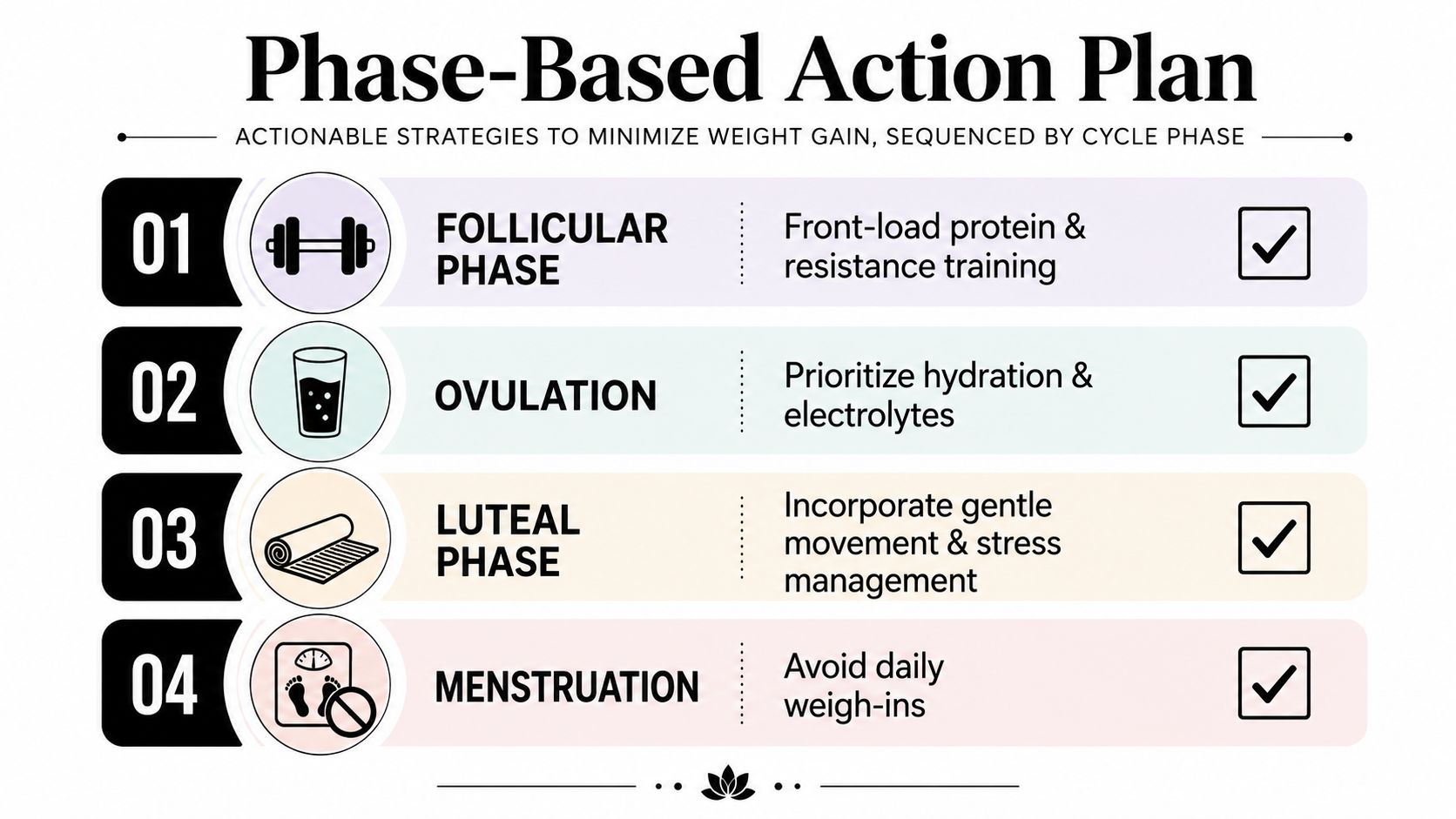
The goal is not to fight every ounce of fluid. It's to reduce the parts of the cycle that make the scale noisy and the body uncomfortable. A phase-based approach works better than generic advice because it matches your physiology instead of arguing with it.
Follicular phase
Keep training and nutrition broadly consistent when symptoms allow. There is no need to “front-load” protein or force harder sessions solely because the calendar says follicular phase. Adjust intensity when pain, fatigue or heavy bleeding affects performance.
Ovulation
Continue normal hydration and training according to symptoms. Electrolyte supplements are not routinely required because of ovulation; they may be relevant for prolonged sweaty exercise, heat exposure or a clinician-identified need.
Luteal phase
If hunger or cravings repeatedly increase, plan satisfying meals and snacks rather than imposing an aggressive restriction. Evidence suggests average intake may rise in this phase, but the response is individual. Sleep and symptom management may also help adherence.
Menstruation
Weighing is optional. If daily numbers cause distress or trigger restriction, pause and use a less frequent approach. If you do weigh, interpret the trend by cycle day and avoid changing intake in response to one reading.
Simple rule: adjust the behaviour, not the story. If your body needs more food, better sleep, or less sodium for a few days, that's management, not weakness.
For people who like to make plans from numbers, the cleanest planning tool is a calorie target that fits the whole cycle, not one stressful day. A useful reference for that broader nutrition calculation is calorie deficit calculation. The point is to make the plan match reality, not to let a bloated week dictate the next month.
How to Measure What Is Really Changing

Daily weighing captures both signal and short-term noise. It can be useful for some people when averaged over time and harmful for others if it drives anxiety or restriction. No home or clinical body-composition method perfectly separates menstrual fluid shifts from tissue change in a single reading.
If you track weight, compare similar cycle days, times and conditions across months. A Telomyx RMR test can estimate resting energy expenditure through indirect calorimetry, but it does not measure total daily needs, diagnose hormonal conditions or explain weight stalls and rebounds on its own.
A Telomyx DEXA body-composition scan can estimate total and regional fat mass and lean soft tissue. Lean soft tissue includes water and is not identical to muscle, so the scan cannot definitively classify a short-term change as menstrual fluid, fat or muscle. Whole-body bone data is also not equivalent to diagnostic hip-and-spine osteoporosis assessment.
Consistent timing, preparation and device improve comparability, including using a similar cycle phase when practical, but they do not remove all hydration or biological variation. Repeat testing should be driven by a decision it can change, not anxiety about normal daily fluctuation.
If you want to understand the body-fat side of the picture in more detail, accurate body fat measurement explains the limitations of common methods. Measurements can add context to a longer-term trend, but no combination of a scan and resting test identifies the cause of menstrual symptoms; that requires clinical assessment.
When to Stop Reassuring and Start Investigating
Seek clinical advice for missed periods, new or worsening irregularity, possible pregnancy, very heavy bleeding, severe or persistent pelvic pain, rapid unexplained weight change, generalised swelling, persistent bloating, marked fatigue, hair changes or cold intolerance. PCOS, thyroid dysfunction, perimenopause, medication effects and other conditions can share symptoms, and none can be diagnosed from body weight alone.
The decision point is simple. If your weight spikes briefly around bleeding and then drops again, reassurance is usually enough. If the change is persistent, if cycles are becoming harder to predict, or if you're in your 40s and the old pattern no longer fits, speak to a GP and consider objective testing rather than another round of guesswork. Persistent gain with cycle disruption is not the same as a normal premenstrual water shift.
A sensible next step is to record the timing and pattern of symptoms and discuss persistent or concerning changes with a GP. Body-composition or resting measurements may support a broader plan in selected cases, but they cannot distinguish all fluid shifts or diagnose the underlying cause.
The content in this article is for educational purposes only and does not constitute medical or dietary advice. If you may be pregnant, have an underlying health condition, are taking medication, have a current or previous eating disorder, or are considering significant changes to your diet or exercise regimen, consult a qualified healthcare professional before making any adjustments.
Visit Telomyx to explore objective measurements that can complement, but not replace, assessment of persistent menstrual or weight-related symptoms by a qualified healthcare professional.