
Sarcopenia Prevention: A Practical Guide for Stronger Ageing
18 August 2026Updated 19 August 2026

You step on the scales and the number hasn't changed. Your clothes still fit, but your shoulders look narrower, your waist feels softer and carrying shopping upstairs takes more effort than it used to. That combination often gets dismissed as normal ageing or a need to do more cardio. It deserves a more useful question: how much of your body weight is still active, functional muscle?
Sarcopenia is a progressive, generalised skeletal-muscle disorder. Under the current European consensus, low muscle strength makes sarcopenia probable, low muscle quantity or quality confirms the diagnosis, and poor physical performance indicates severe sarcopenia. It isn't restricted to people who already need care. UK data shows that the burden can appear in community-dwelling adults well before obvious frailty, which makes sarcopenia prevention a midlife performance strategy, not a retirement-only concern.
The practical approach is straightforward. Test what you have, train the muscles that matter, eat enough protein and energy, recover properly, then repeat the measurements. The aim isn't to chase a perfect scan. It's to keep strength, movement and independence improving while you still have plenty of capacity to build a reserve.
Table of Contents
- Why Sarcopenia Prevention Starts in Midlife
- Screening and Baseline Assessment You Can Do Today
- Resistance Training the Way Your Muscles Actually Need
- Protein, Energy and the Per-Meal Numbers That Matter
- Sleep, Stress and Inflammation as Recovery Levers
- Monitoring Progress with Real Numbers
- Red Flags and When to See a Clinician
Why Sarcopenia Prevention Starts in Midlife
Muscle loss often hides behind a stable body weight. If fat replaces lean tissue, the scales may barely move while your power, balance and work capacity gradually decline. The mirror can reveal the change before weakness becomes obvious, particularly around the arms, shoulders and legs.
UK prevalence estimates vary because researchers use different definitions and diagnostic thresholds. The British Dietetic Association reports estimates of 4–25% among older, free-living UK adults. The British Geriatrics Society also notes UK Hertfordshire Cohort estimates of 4.6–7.9%, depending on sex and the definition used. These ranges show why prevalence figures must always be read alongside the population and diagnostic method.
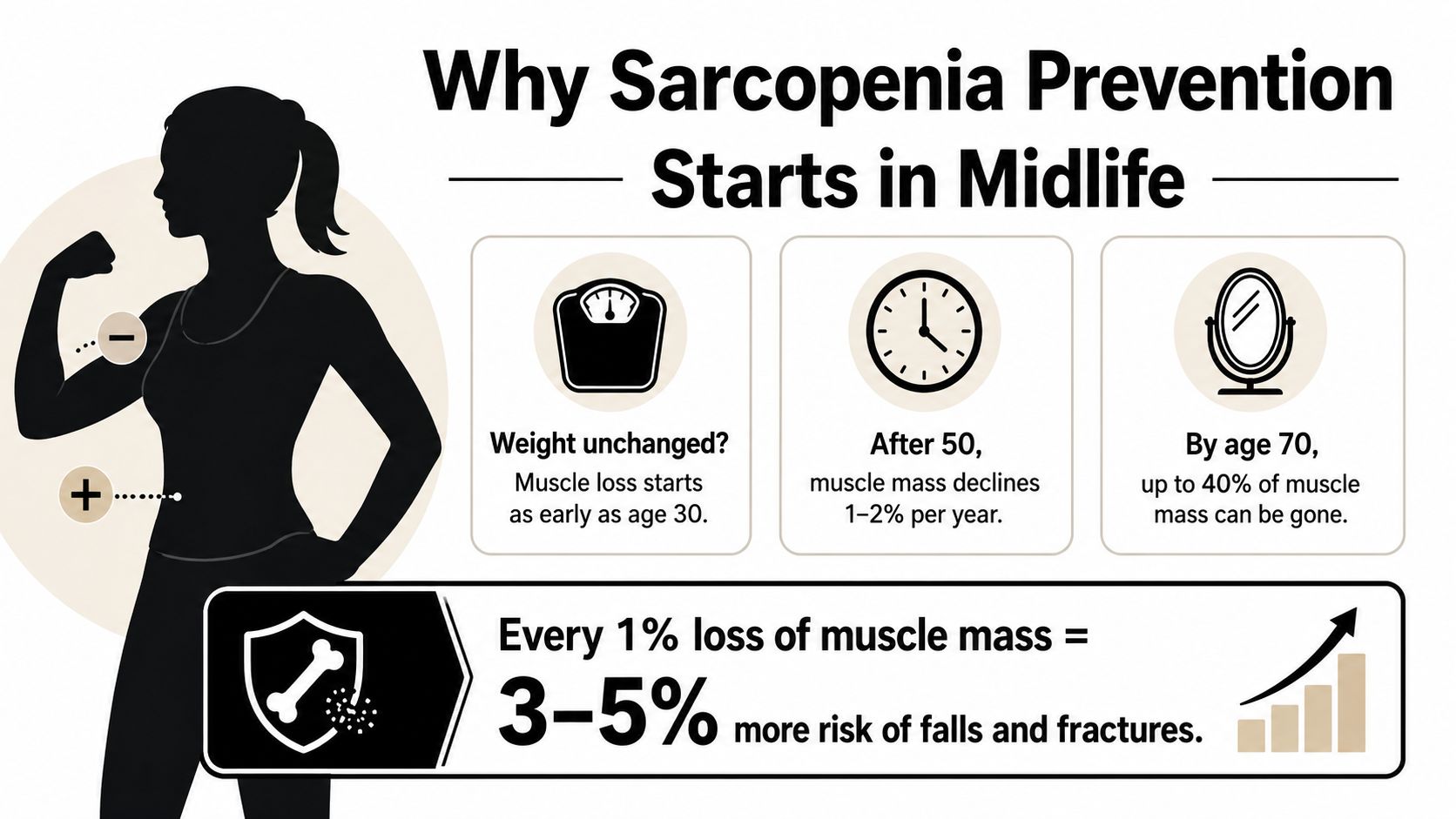
The prevention window is earlier than most people think
In 697 community-dwelling participants from the Lothian Birth Cohort 1936, mean age 76, the maximum test-dependent estimates were 24.2% of men and 24.8% of women for probable sarcopenia, 7.4% and 11.0% for confirmed sarcopenia, and 4.6% and 5.9% for severe sarcopenia. The authors stressed that prevalence varied substantially according to which EWGSOP2 tests were used. Separately, an English Longitudinal Study of Ageing analysis found probable sarcopenia in 33.7% of participants, or 36.1% after weighting, in a sample with a mean age of 70.7 years.
Midlife gives you more room to correct weak habits. You can build strength before a fall, illness, operation or long period of inactivity removes it. If you want a practical guide to staying strong as you age, focus on preserving the abilities you use every week, climbing stairs, lifting from the floor, carrying objects and getting up from a chair.
UK programme data also exposes a design problem. In a survey of 123 exercise programmes, resistance training was the main focus in only 11 programmes, or 9%, while balance training appeared in 61 programmes, or 50%, and functional exercise in 28 programmes, or 23% (UK survey of exercise programmes for older adults). Balance and mobility matter, but they can't replace a progressive stimulus that asks muscle to produce more force over time.
Screening and Baseline Assessment You Can Do Today
Body weight is a poor early warning system. A better baseline combines a short symptom screen with strength and movement tests. You can complete a basic check in a few minutes, then take the results to a GP, physiotherapist or dietitian if anything concerns you.
Start with function, not appearance
The SARC-F questionnaire asks about strength, walking, rising from a chair, climbing stairs and falls. It helps identify people who need a closer assessment, but it isn't a diagnosis. A high score should prompt professional review rather than a self-prescribed supplement programme.
For a repeatable home check, record these measures:
- Chair stand. Sit on a stable chair and stand repeatedly with controlled technique. Stop if you feel pain, dizziness or instability. Note how many complete repetitions you manage in the chosen test period, and use the same chair and method each time.
- Gait speed. Walk a measured short course at your usual pace. Record the time and calculate metres per second. A slower result, a noticeable decline or hesitation when turning deserves attention.
- Grip strength. A handheld dynamometer gives a more objective result than squeezing a tennis ball. Test both hands using the same position and record the best or average result according to the clinician's protocol.
- Symptoms and events. Write down recent falls, difficulty rising, stair trouble, fatigue and changes in walking confidence. Function can deteriorate before muscle size becomes visibly different.
These tests work because they measure what muscle enables you to do. Strength and performance can fall while body weight stays stable, particularly when fat mass rises alongside lean-tissue loss.
Practical rule: Use the same equipment, instructions and time of day whenever you retest. A consistent trend is more useful than one isolated reading.
Add body composition when the decision justifies it
A clinical body-composition assessment can separate fat mass from lean soft tissue instead of treating your body as one number. Lean soft tissue is related to, but not identical to, skeletal-muscle mass. That distinction is central to why body composition matters, especially if your training is consistent but the scales aren't explaining the change.
A Telomyx DEXA body-composition scan uses dual-energy X-ray absorptiometry to estimate total and regional fat mass and lean soft tissue. Its whole-body bone data is not equivalent to a diagnostic hip-and-spine osteoporosis assessment. Discuss regional lean-mass trends with a qualified professional rather than reacting to a single headline number.
Resistance Training the Way Your Muscles Actually Need
If body-composition testing shows falling lean mass while your body weight looks stable, the next question is practical: are your muscles receiving a clear reason to adapt? Resistance training is the main tool. Walking, cycling and swimming support cardiovascular fitness, but they do not reliably provide the progressive loading needed to preserve and build strength.
The British Dietetic Association guidance on addressing sarcopenia supports regular resistance exercise where appropriate, alongside adequate protein. The sessions do not need to resemble bodybuilding workouts. They need consistent practice, sound technique and enough difficulty to create adaptation.
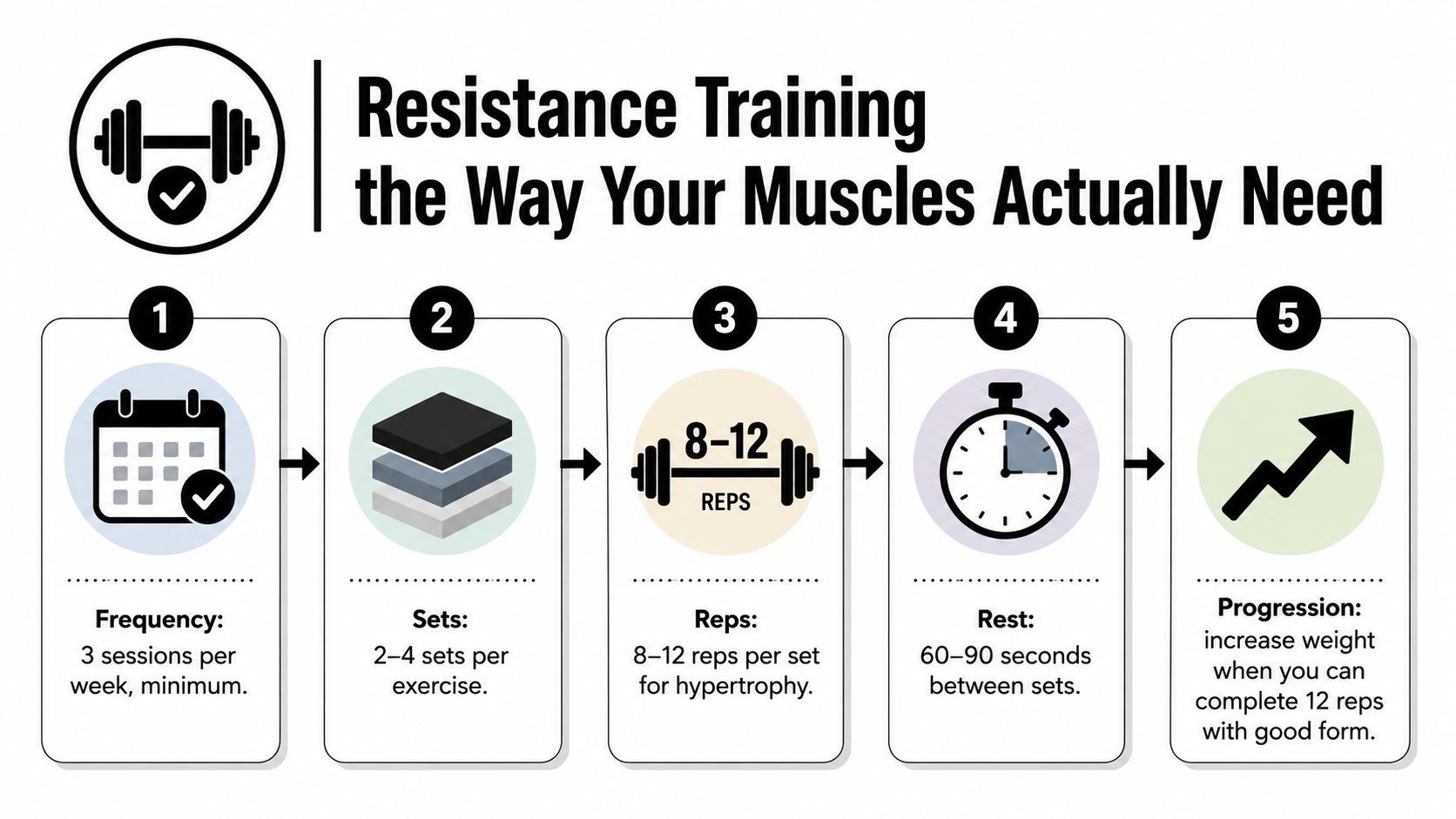
Build a repeatable weekly template
Use a full-body structure so each major movement pattern receives regular attention. A session can fit into roughly half an hour to three quarters of an hour if you prepare the equipment and limit distractions.
- Knee-dominant movement: Squat to a chair, leg press or supported split squat.
- Hip-dominant movement: Romanian deadlift with dumbbells, hip hinge or supported hip thrust.
- Push: Chest press, incline press or decline press-up.
- Pull: Seated row, cable row or resistance-band row.
- Carry and brace: Farmer's carry, suitcase carry or a controlled standing brace.
- Calf and upper-back work: Calf raise, face pull or another exercise supporting posture and gait.
If you are new to resistance training, start with one or two sets per exercise and a load you can lift with controlled form for approximately eight to twelve repetitions. Progress towards two or three sets as your tolerance and technique improve. Keep a small amount in reserve initially. The final repetitions should feel demanding without twisting, bouncing or shortening the range. People with frailty, pain, significant balance problems or complex medical conditions should seek an appropriately qualified assessment before progressing.
Progression should be measurable. When you reach the upper end of the repetition target with stable technique, increase the load slightly at the next session. If adding weight is not practical, add a repetition, slow the movement or use a fuller range. A lighter week makes sense after illness, poor sleep or a sustained run of heavy training.
The common failure is effort without progression. Low-intensity circuits can leave you tired while giving the muscle no clear reason to become stronger. Log the exercise, load, repetitions and any pain or instability, then review the trend alongside grip strength and relevant clinical measurements rather than relying on how hard a session felt.
For a closer look at strength training for longevity, keep one principle in view: progressive loading beats exercise variety for its own sake.
Use this demonstration as a technique reference, not a substitute for assessment if you have pain, neurological symptoms or significant instability.
Protein, Energy and the Per-Meal Numbers That Matter
Protein supports the training signal, but it cannot replace resistance exercise. In midlife, uneven intake can leave long gaps between opportunities to stimulate muscle protein synthesis, particularly as muscle becomes less responsive with age.
The British Dietetic Association sarcopenia nutrition guidance recommends that adults over 65 generally target 1.0–1.2 g of protein per kilogram of body weight per day, with at least 1.2 g/kg/day for active or exercising older adults and 1.2–1.5 g/kg/day during acute or chronic disease. Its practical per-meal guide is approximately 20–40 g of protein. One large evening meal may reach the daily total while leaving earlier meals underpowered.
Turn the guidance into meals
Build each meal around a recognisable protein source. Breakfast could be Greek yoghurt or eggs, lunch fish or lean meat, and dinner tofu, beans, poultry or dairy. A mostly plant-based diet can meet requirements, but portions and variety need attention. A dietitian can check total protein and essential amino acid intake.
| Eating point | Practical focus |
|---|---|
| Breakfast | A clear protein serving, such as eggs, Greek yoghurt or fortified soya yoghurt |
| Lunch | Fish, poultry, lean meat, tofu, beans or lentils |
| Evening meal | A protein portion paired with vegetables and a carbohydrate source |
| After training | A convenient meal or snack if the next full meal is delayed |
Energy intake determines whether that protein can support training and recovery. A severe calorie deficit can reduce training quality, slow recovery and contribute to lean-tissue loss. If body composition or performance is changing unexpectedly, a Telomyx RMR test estimates resting energy expenditure through indirect calorimetry. That personalised baseline can inform nutrition planning more directly than a generic calculator, although it still requires interpretation in the context of activity, goals and health.
Use body composition, measured resting energy expenditure and grip strength as complementary information rather than treating a protein target as proof that the plan is working. Stable or improving strength, alongside favourable lean-mass trends, is more useful than hitting a number in isolation.
Supplements may improve convenience, especially when a meal is delayed, but food remains the foundation. Spread protein across the day, match intake to progressive resistance training and review the plan if strength continues to fall.
Sleep, Stress and Inflammation as Recovery Levers
A training session is a message to the body. Recovery determines whether the body can answer that message. If sleep is poor, food intake is erratic and stress remains high, adding more sessions often produces fatigue rather than stronger muscle.
Sleep affects appetite, motivation, coordination and the ability to train with enough effort. It also influences how consistently you complete the behaviours that support muscle maintenance. Instead of chasing a perfect bedtime routine, protect a regular sleep opportunity, keep the bedroom dark and cool, reduce stimulating work close to bed and address snoring or suspected sleep apnoea with a clinician.
Reduce the background noise
Chronic inflammation and excess visceral fat can create an unfavourable environment for muscle retention. You don't need to label every symptom as inflammation, and you shouldn't treat a single blood result as a diagnosis. The useful approach is to combine clinical context with changes in body composition, waist measurement, energy, strength and recovery.
Body-composition trends can show whether regional fat and lean tissue are changing, while measured resting energy expenditure can help reassess a calorie target that no longer produces the expected result. Neither measurement replaces medical care, but both can improve the questions you take to a clinician.
Daily habits have more influence than most specialist products:
- Alcohol: Keep intake modest and avoid allowing drinking to displace meals, sleep or training.
- Smoking: Seek structured support to stop. Smoking undermines exercise tolerance and recovery.
- Movement: Use walking and light activity to manage stress without turning every stressful day into an exhausting workout.
- Food quality: Build meals around protein, vegetables, fruit, whole grains, legumes, nuts and healthy fats.
- Medical conditions: Treat diabetes, kidney disease, gastrointestinal disease and inflammatory disorders with the appropriate clinical team.
Persistent inflammation, unexplained fatigue or a marked change in strength needs assessment. A practical explanation of how to lower C-reactive protein levels should be treated as education, not permission to self-diagnose or chase a laboratory number.
Supplements deserve a hierarchy
Creatine monohydrate has a credible role as an adjunct to resistance training. It may support training capacity and strength, but it can't compensate for inadequate loading, poor food intake or missed sessions. Discuss suitability and dosing with a clinician if you have kidney disease, take relevant medication or have other medical concerns.
Vitamin D makes most sense when deficiency is suspected or confirmed, or when a clinician identifies a reason to supplement. It isn't a universal muscle-building shortcut, and taking more isn't automatically better.
Leucine and HMB may be useful in selected people with low intake, illness, hospitalisation or high muscle-loss risk. Their relevance is more limited for a well-fed person already completing progressive training. A dietitian can help decide whether the problem is protein quantity, meal distribution or overall energy.
Omega-3 supplements may support general dietary goals in some circumstances, but they aren't a substitute for resistance exercise. Choose food sources where practical and check interactions if you take medication affecting bleeding.
Be sceptical of products promising dramatic muscle gain without training. Powder, capsules and recovery drinks can solve convenience problems. They don't create the mechanical stimulus that tells muscle to adapt.
Know when lifestyle advice isn't enough
Testosterone treatment, GLP-1 medication and treatment for inflammatory disease belong in clinical conversations. Testosterone requires appropriate symptoms, examination and laboratory interpretation. GLP-1 medicines can change appetite and body weight, so anyone using them should discuss protein intake, resistance training and muscle monitoring with their prescriber. Neither should be started, stopped or adjusted as a DIY sarcopenia intervention.
Recovery isn't passive. It is the part of the programme that lets your next useful session happen.
Monitoring Progress with Real Numbers
A prevention plan can stall when you rely on motivation or the mirror. Measurements create a feedback loop, but only if each result leads to a decision.
Retest strength and function under the same conditions. A clinician can repeat grip strength, chair stands and gait speed, while your gym log can track load, repetitions and perceived effort. Body-composition testing adds regional lean mass and fat distribution, and resting-energy measurement can help inform changes in nutrition planning.
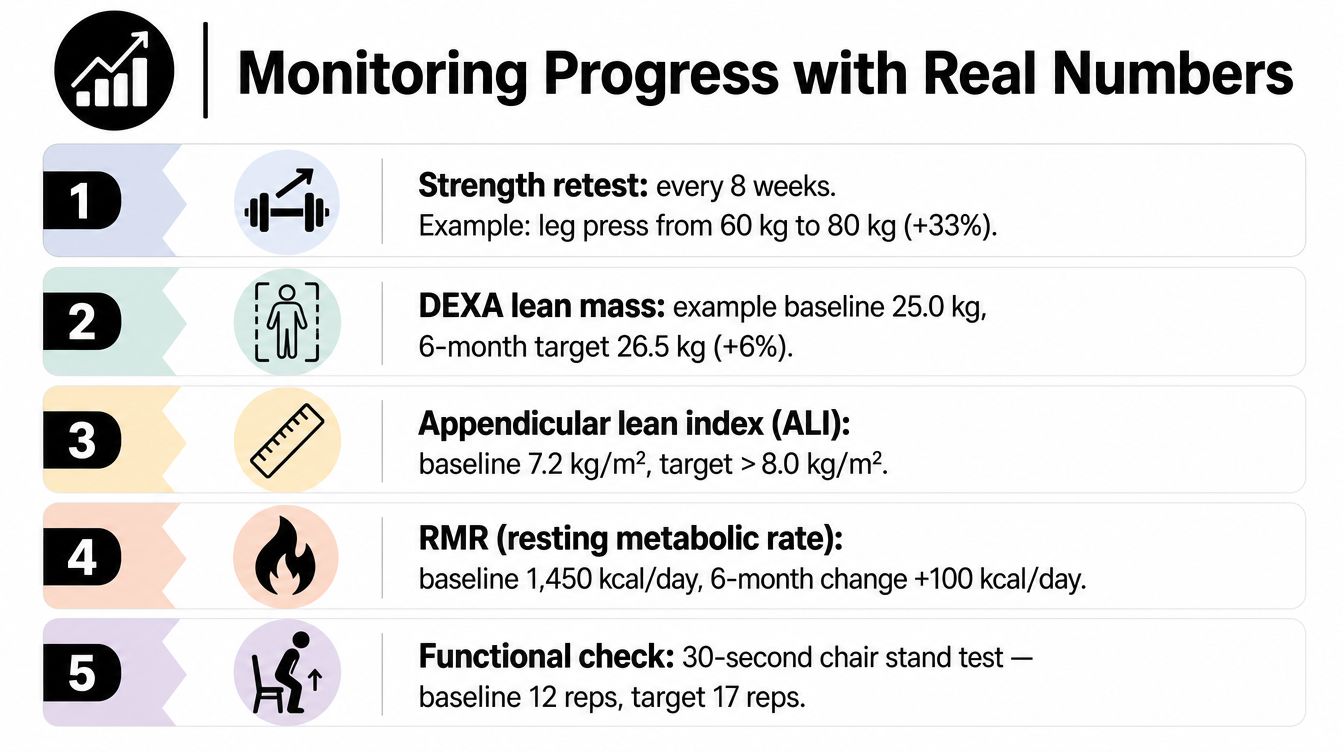
Use each metric to make one adjustment
| Measure | What it tells you | Sensible response |
|---|---|---|
| Training log | Whether load and repetitions are progressing | Review exercise selection, technique and effort |
| Grip or lower-body strength | Whether force production is changing | Check consistency, recovery and clinical symptoms |
| Chair stand or gait speed | Whether everyday function is holding up | Add supervised functional work and seek review if declining |
| Body-composition lean mass | Whether regional lean tissue is changing | Reassess training volume, protein and energy intake |
| Measured resting energy expenditure | A personalised resting energy baseline | Adjust nutrition with a qualified practitioner |
Don't treat a scan as a pass or fail. Hydration, recent training, illness and measurement conditions can affect body-composition results, so trend data is more useful than a single reading. Stable lean mass alongside improving strength may still represent excellent progress, particularly if function and training performance are moving in the right direction.
A good review asks four questions. Did strength improve? Did function stay stable or improve? Is lean mass changing in the intended direction? Are sleep, appetite, pain or fatigue limiting the programme?
A stalled result calls for investigation, not panic. Increase training quality if the programme is too easy, improve meal distribution if protein is inconsistent, reduce the calorie deficit if recovery is poor, or seek clinical input if strength falls despite sensible adherence.
Write down your baseline, record the testing conditions and set a calendar reminder for the next review. The exact interval should reflect your programme and clinical context, but the principle is fixed: measure, interpret and adjust.
Red Flags and When to See a Clinician
Self-directed training is appropriate for many healthy adults. It isn't appropriate to ignore a rapid change in strength, function or appetite and assume that more exercise will fix it.
Arrange clinical advice if you notice:
- Unintentional weight loss: Especially when it continues or appears alongside poor appetite.
- Rapid strength decline: A sudden inability to lift, climb stairs or rise from a chair needs explanation.
- Falls or near-falls: Repeated loss of balance warrants assessment of strength, vision, medication and environment.
- Post-illness deterioration: Fatigue and muscle loss after infection, surgery or hospitalisation may require a staged rehabilitation plan.
- Persistent low mood: Depression can reduce food intake, movement and engagement with treatment.
- Medication concerns: Ask for a medication review if several prescriptions, sedation or appetite changes coincide with worsening function.
- Pain or neurological symptoms: Numbness, weakness on one side, severe pain or new coordination problems shouldn't be managed through trial-and-error exercise.
Start with your GP and bring your notes. Ask whether you need a strength and function assessment, blood tests, a dietitian referral, physiotherapy, a falls service or specialist review. If you already have body-composition, resting-energy, grip-strength or training data, take it with you, while remembering that a clinician must interpret results in context.
Prevention remains a daily practice, but escalation is part of prevention. A referral doesn't mean you've failed. It means the problem may involve nutrition, medication, endocrine health, inflammation, neurological function or another condition that needs more than a generic exercise plan.
The most useful next step is concrete. Book an assessment, write down your current strength and function, schedule three manageable resistance sessions and review your protein intake against the British Dietetic Association guidance. Then retest rather than guessing.
The content in this article is for educational purposes only and does not constitute medical or dietary advice. If you have an underlying health condition, are taking medication, or are considering significant changes to your diet or exercise regimen, consult a qualified healthcare professional before making any adjustments.
Visit Telomyx to explore objective clinical measurements that can support a professionally guided sarcopenia-prevention plan.